ADVENTURES IN ADVAITA VEDANTA...

Adventures in Advaita Vedanta, the philosophy and science of spirit. We are one you and I; are you curious why?..


Showing posts with label Dharma. Show all posts

Times Of Your Life part three


Hari OM
Application - that is what 'Workings-days' are about!

For as long as it takes to complete it, we are going to be using today as well as Text-days to fulfil study of the SadaachaaraH. If you have not been following that text, then use the relevant label to go back to the beginning. It is, as might be surmised from its title, about how to go about saadhana, but also explores more of the Sanskrit philosophy; it is therefore both a 'working' as well as a 'thinking' text.

We saw, last Textday, the discussion on brahmacharya and gRhastha. Now for verses 52 and 53 in which we explore a little on retirement and old age ashramas.

Vaanaprastha; these days, when we think of retirement, we are inclined to plan out all sorts of activities and have an expectation of an easier life than when we were working. A great deal of consumerism is geared towards retirees.

This was not the purpose of the twilight years in Sanatana dharma, however. Rather, it is meant for refocusing on practices which would further spiritual development. Taking where it is quite likely we left off after brahmacharya ashrama. Life is to be kept simple, food to be kept simple, and all energy to go into achieving a higher level of being. Austerities (tapas) are often taken up. These might include regular fasting (vrata), periods of silence (mauna), setting disciplined times for meditation (nididdhyaasana) and so forth. In Indian tradition, there are some retirees who go to extremes with this, such as standing only on one leg for the entire day, or making yatra (pilgrimage) by taking a step, prostrating, rising and taking another step, prostrating, rising…

None of these outward expressions of dedication, though, will actually bring about enlightenment. That can only come about by proper Self-enquiry and working on the mental blocks created by the ego. If at all we feel pleasure, anger, fear, restlessness or any other reaction to the world, we are still in our ego. All our penance must go towards vanquishing that and gaining Self Knowledge.

Sannyaasa; total surrender of material life and commitment to the final goal of Realisation. In the old age, if still around, our only purpose in life is to align our spirit with the Higher. Sanatana Dharma is unequivocal about this.

Many will seek to study at this level when they are younger and so become sadhus (monks or nuns), but all members of society are expected to take on sannyaasa when they attain the age of 75 years. Traditionally, the yellow/orange cloth was worn and all other colours dropped. In India, this is still widely practiced. It serves as a 'badge' so that society knows the intention of the wearer.

However, it must be understood, donning the ochre robes does not mean the wearer has Realised the Truth. There are many who have Realised who do not wear ochre. To them, it does not matter. They have renounced identification with the physical and this includes the clothes and merged with the Self of All. They are all colour and no colour. They are aged and ageless.


Ashramas


Hari OM
'Freedays' are the 'gather our thoughts' days; Q&As; a general review of the week so far…

A little chart simply laying out the ashramas which are under study at the moment.


Times Of Your Life part two


Hari OM
'Text-days' are for delving into the words and theory of Advaita Vedanta.

We now explore the Sri Adi Shankara text, "SadaachaaraH". To obtain your own copy, click here.

Yesterday we saw the verses on dharma, now let's explore them.

It is considered, in Sanatana Dharma, that there are four stages of life, known as ashramas. The time of the student (brahmacharya), the time of the house-holder (gRhstha), the time or retirement (vaanaprastha) and the time of renunciation (sannyaasa).

The word ashrama itself means a place of rest (as in a physical compound) in the physical sense, but in the subtler sense refers to a state of being free of burdens. These four stages of life are called ashramas because the idea is that we find the optimal balance in each stage to live life fully and stress-free. Let us look at the first two of the ashramas. (Verses 50 and 51.)

Brahmacharya; the word means self-control. This applies at all levels. We might think that children and youth are the least self-controlled. However, this is also the time of learning. The period of time is brahmacharya, but not until the lessons are inculcated can one be said to be a Brahmachari. This is the time to be deeply set in study, contemplation, mulling over the lessons, building sincerity of purpose, defining goals. Of course, the purpose of dharma is that this ought all, ultimately, be for spiritual gain such that we come to know The Truth.

In Sanskrit tradition, schooling was always with a guru (gurukula) and all the lessons required for life were given there, as well as grammar and scriptural study. The whole point of Sanatana Dharma is that spiritual life is not a separate component of physical life. To separate these two is to divide our personality.

Without a sense of the spiritual part of our being, we can find ourselves adrift in society. The human psyche always will look for meaning and this occurs most when we are in childhood. It is why fairy tales and fantasies make the greatest impact in that time. If the tales provided contain horror or have no basis in reality, how are the young minds to integrate what they learn there with the actual case of life? In our current time, youngsters are lost in video games with all sorts of unfounded storytelling. Many young folk go unsupervised and have no solid, positive role-models, so make up their own with populism and potential danger. Understanding this, Sanskrit has many, many tales of its own to capture young imaginations, but all of them come out of the scriptures and all are adored! All inspire! All lift the minds and hearts of young people. What is more, it all takes place in gurukula, where daily routine and service of the teacher instils discipline and humility.

GRhastha; the time of the householder is given an arbitrary marking of 25 years to 55 years, but of course it can be longer. It is the time when attachment is accepted as a part of the process of dharma. Majority of people will marry, have a family. All can attain employment status, a home of their own, have the opportunity to support others.

If the lessons in the time of brahmacharya have properly taken within us, then we can pass through the time of gRhastha knowing that we are not the body through which we act, through which we experience, through which we suffer. If we attach to it and think we are this body, we set up for ourselves all sort of strife! The wise man knows the doer is not he in this body, but That of which we are part. Most of us fail in that wisdom. The wise man will continue to grow in his studies on dharma and will be in a ready state for action but know when inaction is worthy. The fool seeks only to learn of the world and is constantly in a state of reaction. The wise man knows he owns nothing. The fool can never own enough.

...tbc...


Times Of Your Life part one


Hari OM
Application - that is what 'Workings-days' are about!

For as long as it takes to complete it, we are going to be using today as well as Text-days to fulfil study of the SadaachaaraH. If you have not been following that text, then use the relevant label to go back to the beginning. It is, as might be surmised from its title, about how to go about saadhana, but also explores more of the Sanskrit philosophy; it is therefore both a 'working' as well as a 'thinking' text.

In the early verses of this text, notably 3 to 15, we saw how important it was for dina charyaa - daily acts - in order to improve our dharmic quality and to maintain meditation. The included things like basic hygiene not just of the body but of mind. It is now going to be mentioned that there are several stages of life in which we must execute certain things pertaining to dharma. Today, as again there are several verses, a photographic presentation of the Sanskrit, transliteration and then typed translation. Tomorrow, the exploration. There will be a 'glance chart' here on Friday.


The one endowed with the study of the Vedas and revelling always in the vow of brahmacharya, who knows everything as the Truth, is called a Brahmachari.

The body is called the house; the gRhastha is the one seated amidst the gunas. The wise householder knows that it is the gunas that do the actions and that he is not the doer.

For one whose austerity is of the nature of Knowledge, what is the purpose served by severe austerities? he who is free of joy and anger is called vaanaprastha.

The firm determination, "I am not the body but I am the Self", is the sign of renunciation. this practice with respect to the body is verily sannyaasa and is certainly not the mere wearing of ochre robes.


Actions Speak Loud

Hari OM

Application - that is what 'Workings-days' are about!

VEDANTA IN ACTION.
This is the title of a publication from CM which, whilst it of course has items by Gurudev, also includes selections of writing from other well-esteemed Gurus from the Vedantic tradition as well as leading businessmen. Its focus is the working life. We shall be exploring these essays for the next few weeks on Workings-day as, clearly, they pertain directly to the premise of this section of AVBlog! As ever, you  are encouraged to read back over previous posts, to ensure full benefit.

Part 2:Fulfillment Through work

On Karma Yoga (by Swami Vivekananda) cont'd
Working Without Motive

What is the meaning of working without motive? Nowadays, many understand it in the sense that one is to work in such a way that neither pleasure nor pain touches the mind. If this be its real meaning, then animals might be said to work without motive. Animals do what needs to be done with no display of emotion either way, even the killing of their own offspring at times. It is not that any benefitted from this than the animal itself which undertook the act. It was purely self-serving, which in the case an animal, is a case of survival. In this sense, the doctrine is a potent instrument in the hands of the wicked. They would go on doing wicked deeds and pronounce themselves as working without motive. If such be the significance of working without motive, to simply have no feeling, then a fearful doctrine has been put forth by the preaching of the Bhagavad Gita.

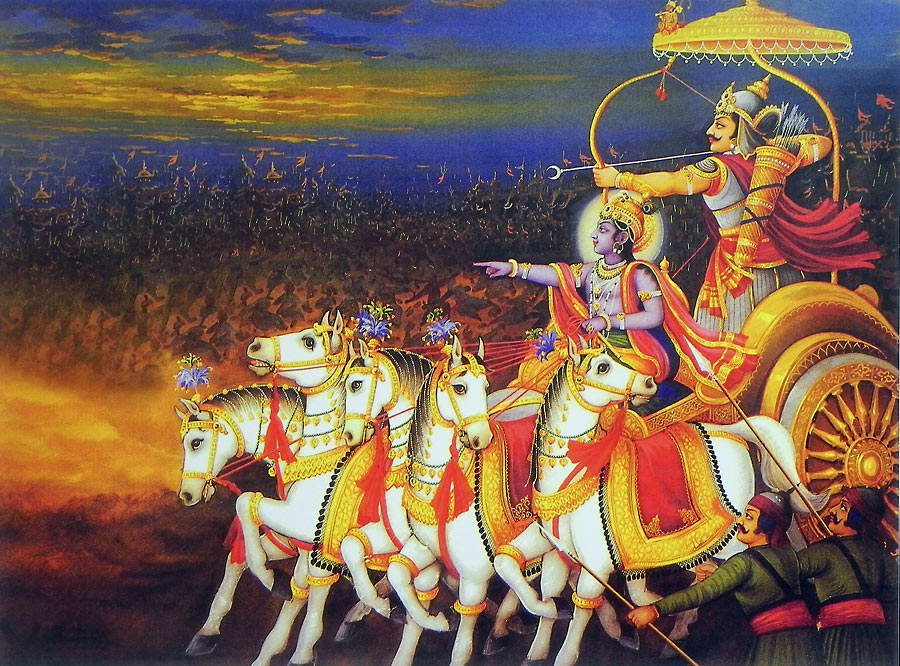
Certainly this is not the meaning. If we look into the lives of those who were connected with the preaching of the Gita, we find them living quite a different life. Arjuna sacrificed all his self-interest and desires and ego many times over, working for the greater good.

The Gita teaches कर्म योग /karma yoga. We should work through yoga (concentration) and in such concentration in action, there is no consciousness of the lower ego present. The consciousness that "I am doing this and that" is never present when one works through yoga. Many people do not understand this. They say that if there be no consciousness of ego, how can man work? However when one works with concentration, losing all consciousness of oneself, the that is done will be infinitely better.

This every one may have experienced at some point in life. We perform many works subconsciously, such as the digestion of food, many others consciously and others again by becoming immersed in samaadhi where there is no presence of the small ego.  If the painter, losing the consciousness of his ego becomes completely immersed in his painting, he will be able to produce masterpieces.  The good cook concentrates the wholly on the food being handled without ego and brings out food of Love for us to eat. However, these are dedicated, single tasks. They may not be able to bring such concentration to bear on other tasks in life. The Gita teaches that all works ought to be done thus. He who is one with the Lord through yoga, performs all his works by being immersed in concentration and seeks no personal benefit. Such a performance of work b rings only good to the world.

The result of every work is mixed with good and evil. There is no good work that has not a touch of evil in it. We ought to engage in such works that bring the least amount of evil and the greatest measure of good. In the Mahaabhaarata, Arjuna killed Bhishma and Drona; if this had not been done, Duryodhana could no have been conquered, the force of evil would have triumphed over the force of good and calamity would have befallen the country. The government of the country would have been usurped by a body of proud, unrighteous kings. Similarly, Krishna killed Kamsa, Jaraasandha and others who were tyrants, but not a single one of His deeds was done for Himself. Every one of them was for the good of others.  As we read the Gita by candlelight, insects are drawn to the flame and suffer to lose their lives there; even this work, then, is not without its evil. Those who work without any consciousness of their lower ego are not affected by evil, for they work for the good of the world. To work without motive, to work unattached, brings the highest bliss and freedom. This is the secret of Karma Yoga.


...tbc...


Happy, Grumpy, Sleepy

Hari Om

Each 'Choose-day' we will investigate the process by which we can reassess our activity and interaction with the world of plurality and become more congruent within our personality.

We are reading the small booklet called "Not Too Loose, Not Too tight - Just right!" This is written by Swamini Vimalananda, and gives a very general overview of Vedanta for the beginner, with emphasis on the sattvic, rajasic and tamasic approaches to life. Remember, we are a mixture of all; use this as your mirror.

कर्तव्य /kartavya - actions/inherent tendencies and duties

Each of us has inherent tendencies, potential talents and abilities which are called our स्वधर्म /swadharma. For example, Arjuna's gift or swadharma was brilliance in archery.

Also, depending on one's stage and position in life, duties come to us unasked.  If we are students, the duty is to study, whether or not we like the subject! These duties are called विवेश धर्म /vivesha dharma or कर्तव्य /kartavya. Actions with respect to our inherent talents and duties can be, again, seen in the light of the three great qualities.

Sattvic; to act according to one's inherent abilities, thereby manifesting one's full potential, is to follow one's swadharma. In such cases, one progresses easily like a fish striking through water. For instance, a man with good business acumen is likely to proper rapidly, whereas another without the same flair for business, regardless of study or qualification, may fail. We easily become proficient (skilled in knowledge) and efficient (skilled in application) when following swadharma. Work becomes a joy and we find we are less tired and can work quickly. It is said, 'take a job you love and you will not have to work a day of your life!'

A sattvic person does his or her duties cheerfully, without expecting others to congratulate, appreciate or offer reward. There is joy in performance, satisfaction on successful completion and even unpleasant duties are carried out this way.  There is an alertness in sattvic performance, resulting in proper and efficient completion, without pride, pomp or show.  We have duty towards family, society, nation and universe. We also have a duty towards ourselves. A sattvic person has no confusion as to priorities. Sattvic performance holds patience, determination and enthusiasm without elation or dejection in success or failure. There is equipoise and no regret.

Rajasic; when a person does work that is not consonant with his or her aptitude/swadharma, such work is called परधर्म /paradharma. For example, many who have no inclination to serve and sacrifice become doctors only for status and to make money. For such people, there is little joy in their work, for they are all the time thinking of the what can be gained from the work, rather than the benefit of the work itself. Work then becomes a chore - boring, burdensome and filled with tension. Things might fall in standards such as ethics or systems as shortcuts are sought to achieve the ends. Some act only to impress others, others blindly copy peers so as to appear to be equal (or better)… there is always a sense of unhealthy competition in the rajasic person. There is little or no unfoldment or fulfilment in such actions and often they lead to jealousy, frustration, dejection or depression.

The rajasic person does his orher duties with expectations, attachments and pride.  We often hear statements like 'my relations must appreciate what I do for them' or 'without me, it wouldn't get done'.  Such a person is often worried, tense, fearful and filled with worrying, fretful thoughts such as 'what if I fail my exams?... What if I can't find a partner?.... What if this or that..??!!' Such a person is confused about his or her duties and gets distracted by temptations even during their execution. 

Tamasic; all of us have good and bad within.  The tamasica performs actions according to his baser values, called अधर्म /adharma. Violent tendencies can cause a resort to murder, bullying and such like. Such actions give him no joy and, in the long run, his life become a hell. A tamasica does not do what should be done and will frequently do what ought not to be done.  Tamasic persons are lazy, procrastinating and forgetful. Excuses are made for poor or non-execution of tasks. There is a sense of stagnation and even rot about such personalities. Gurudev often said 'if you rest, you rust!'  Tamasic folk are burdened with guilt of not doing what ought to be done, or for doing the wrong thing, and they tend to find various means of escape such as drugs or alcohol or other negative activity.  They also seek to pass their duties onto others. They become a burden to society, not minding if they live off other peoples' sweat and toil and even might feel it ther right to be taken care of by others.  These are the types who appear to believe the 'world owes them a living'.  Even their efforts are half-hearted and their minds disintegrated.  It takes them a week to do what can be done in a day and they are often dissatisfied and depressed.  They believe if their work is left, someone will come along who can do it instead.