'Text-days' are for delving into the
words and theory of Advaita Vedanta.
We are now studying Aatmabodha. As
always, with each week, you are encouraged to review the previous teachings and
spend some time in contemplation of the meanings as the affect your life.
Please do consider purchasing the text. Remember, also, to recite the mangala charana before each study and
review the lessons before each new one.
It
has been mentioned previously, that the upaadhis arise from an ignorance
(avidya) of the True Nature of things. Avidya cannot itself be an effect - at
no time can we say "oh you became ignorant because…." We can gain
Knowledge but we can never 'gain' ignorance. We can, therefore, say that
"you do not know this or that because… of your ignorance" and then
set to removal of the ignorance. Avidya shows itself to be a cause of not
knowing. Once we know, we can no longer be ignorant… and have you ever tried
'unknowing' something?! This is the
basis by which the following shloka states;
Avidyaa, which is indescribable and beginningless, is
the causal body. Know for certain that the Aatman is other than these three
conditioning bodies.
When
Truth is not known (avidya), when the reality of a things is veiled from us
(aavarana), we cannot but misinterpret the Truth through our own confused and
erroneous imagings (vikshepa), which in turn form the delusory projections we
call the world (adhyaasa). A clouded
intellect dances to the tune of the untamed mind and creates all sort of
terrors for itself.
We
misapprehend the Aatman (spirit) due to the original avidya, crediting the
upaadhis (the physical manifestations) with more than their worth and
identifying with them, developing an ego-self and claiming "I-ness"
and "my-ness", setting up our own individual cells of torture!
This
'original ignorance' is said to be the causal body (karana shariira) insofar as
it is due to the non-knowledge of the possibility of Spiritual Perfection that
our gurgling desires in the intellect, the thoughts of our mind and the actions
of our body currently serve immediate and selfish needs, not even
recognising that in attempting to serve these needs, we are still answering the
call to serve the ultimate need - to return to the baseline existence of
Sat-Chit-Aananda… and if we don't know about that possibility, how can we
strive for it?
Upon
what basis can Shankaraacharya state that avidya is anaadi - beginningless? As
normal human beings, the concept of beginningless-ness is almost harder to
grasp than endless-ness. This may be due to the fact that at some level or
other we would all like to think we can live forever. However, one cannot have
endlessness unless there is no beginning. We can turn to physics for this.
Think in terms of time. For us to be perceiving anything at all, we have to be
experiencing. For there to be an experience (or a unit of time) three things
are required; the event to be experienced, the observer of the event
(experiencer) and the connection between the first two, the experiencing. An
experience cannot be said to exist until these three things are unified. Time
is said to be the interval between events. At point A, there is no distance to
measure. Only when point B appears, can distance be measured and that unit
between them is given a name… one second of time, let's say. Only in the
lapsing and replacing of A with B can time be said to be moving. Time cannot
exist without our imposing the upaadhi of 'measurement' upon it. In the case of
experience, even for the very first experience where 'time' is an impossible
concept, the very fact that we apprehend that experience suggests that the
equipments by which to measure experience must have arisen… and the only place they could have arisen from is that very avidya itself.
This
is such an advanced concept that the other word here given in reference to
avidya is 'indescribable'! Make no mistake, what we are talking about here in
Vedantic terms is the equivalent of the 'big bang' of the science of
astrophysics. By terming the causal body as 'avidya', we must understand that
what has arisen has come from something
and not from nothing, but that the description of this is, currently, beyond
us.
However,
in this shloka, it is not that we must know avidya, but that we must know and
understand the Truth by what we can
percieve - the upaadhis - the Knowledge being that Aatman is none of these.
Avidya is darkness. No matter how hard we try we cannot actually 'see'
darkness, as such, because the darkness itself prevents us from seeing it.
However, darkness is easily dispelled by light and much can be seen; light, of
course, being Knowledge.
A
fool lit a lamp and walked all over his house trying to find the darkness. The
more we try to understand avidya, the more it eludes us. By using the lamp, the
fellow might have found the jewel in his altar room, if he had chosen to look
for what can be found rather than what cannot.
We
cannot know Truth through ignorance, only through Knowledge.
'Text-days' are for delving into the
words and theory of Advaita Vedanta.
TATTVABODHAH.
[You are reminded that reviewing the
previous week's posts will become essential as the meanings of the Sanskrit
terms may not be repeated. There may come additional or alternative meanings,
but all should be noted. As study progresses, the technical terms must
necessarily become 'second nature' to the student. When the Sanskrit is used,
the translation will fall easily into place - or likewise, if the English is
used, the Sanskrit term must easily come forwards.]
Please revisit THIS post and chant the mangala-charana. Please use the
TattvabodaH label to access all posts relevant to this text.
MAYA.
Last week we saw the introduction to this section on the brahmaanda
- the macrocosm, as in the greater world. We found that when we speak of सृष्टि /srishti (creation), we refer to twenty-four factors in the process;
establishing that there is a twenty-fifth, but that being of the nature of avidya and therefore without beginning, we
have to consider it as part of the cause and not of srishti itself. Avidya is
the ignorance as it pertains to the microcosm. When we talk of avidya in
reference to the macrocosm, it is called as Maya.
The chanting provided here is for the aphorism relating to last
week's post and then for today's topic.
"Now we shall explain the
evolution of the twenty-four factors."
ब्रह्माश्रयासत्त्वरजस्तमोगुणात्मिकामायाअस्ति।
brahmaashrayaa
sattvarajastamoguNaatmikaa maayaa asti.
"Depending on Brahman, Maya exists, which is of the nature of
the three qualities of sattva, rajas and tamas."
The Truth is, in the macrocosm, referred to as Brahman. Big. This is
an adjective which generally qualifies a noun and is limited by the noun it is
qualifying. For example, we may say that an elephant is big we immediately
envisage the limitation of that 'bigness'. It may be big in relation to other
things, but actually can be quite small in relation to the forest it is in. If
there is no noun to which the Big adjective is applied, then that Bigness is
unlimited, there is no restriction on what that Bigness is and thus it becomes
potentially infinite. As we have established that Pure Self is the infinite
substratum to everything, and as Brahman is here the Self conditioned by
macrocosm, then Brahman and Self must be one and the same thing. Pure, unchanging
Reality.
Think carefully now. If we are seeing shristi ( a created cosmos),
it would naturally be our thought that Brahman is the creator. However, as
everything must arise from something else, it involves an element change, does
it not? Yet we have said that Brahman is unchanging. The created cannot come
from the uncreated, the Ever-Existing Self. The created can only come from the
created… but at some point of time, logically and philosophically, we have to
find as we research ever backwards (or inwards…), that we reach to that
uncreated entity, the source of everything. We intrinsically understand
creation only from the point of the created, but Existence itself cannot be
created or modified. Then we hit the question, 'can we say that entire shristhi
has arisen from That?' Brahman must have created; this would suggest that until
the point of creation, Brahman was quiet for some time and then became active
to create. This implies modification. If we accept modification we also have to
accept finitude - that is to say, destruction. If we accept that all which is
subject to change is also subject to destruction then we now face the incidence
of Brahman being destructible. [This can seem
very esoteric if you are knew to this type of thinking… go with the flow; it
comes up often!]
For there to be a stablising force behind everything, logically we
cannot have a destructible Brahman. How can an ever-changing srishti have come
from an unchanging cause? Our difficulty remains for as long as we consider
that the creative process resembles that of the potter and his lump of clay,
removing parts of the big lump to produce an endless variety of smaller clay
items.
Vedanta postulates that the srishti element is actually within
Brahman. Be careful here and be sure to understand the subtle difference. The
creative instance according to Vedanta is not that of larger parts being cut
into smaller parts, but of that large part going through internal process; it
is a whole item, it transforms itself within itself, remaining forever whole.
The 'formula' given is या मा सा माया /yaa maa saa maayaa - that which is not, yet appears to
be, is called Maya. From the standpoint of Truth/Brahman/Self, there is no
world - yet we experience it. This is Maya. Maya is sometimes referred to as प्रकृति /prkRiti - 'Mother Nature', the creatrix. The traditional example given for
this is that of the snake appearing on the rope. The rope (Truth) cannot create
the snake yet we experience the snake. As far as the rope is concerned there
never was snake and never could be. This is the effect of Maya.
Maya has two powers;
आवरण शक्ति /aavarana shakti - the veiling power; this is of the
nature of ignorance. For as long as we are ignorant, we do not know Truth.
Aavarana cannot of itself create the world.
विक्षेप शक्ति /vikshepa shakti - the projecting power; this is the
creative power which projects the entire world of names and forms. It
manifests our inherent impressions, but it cannot do this without the help
of aavarana - as in the snake rope; the ignorance of the rope should
precede the projection of the snake vision.
It is the existence of Maya upon Truth which together give us the
creator 'God' - Iishvara. The power of Maya is unfathomable, it can make the
impossible seem real. Maya alone creates the boundary-less cosmos from
beginningless time and will do so apparently endlessly. Maya at no time is
separate from the Truth - it only exists because of that True Existence. Truth
itself is not affected by Maya and even is unaware of it. Upon the discovery of
Truth, Maya is destroyed, just as finding that the rope is there, the snake
dissipates completely.
Now, the aphorism told us also that Maya is of the triguna by
nature. Sattva guna is characterised by knowledge, rajo-guna by activity and
tamo-guna by inertia. These three qualities pervade the entire srishti and it
is by the combination and permutation of the three which brings about the
enormous variety we perceive.
Further important points at this stage now, are that there are two
causes for any object; the material cause (उपादान कारण /upaadaana kaarana) and the
efficient cause (निमित्त कारण /nimitta kaarana). The
clay is the material cause of the pot and the potter is the efficient cause of
that pot. The finished product remains with its material, but generally, once
the potter's work is done, that efficient cause separates from the object. On
our big-scale model, panchabhuutas are upaadaana kaarana and Maya/Iishvara is
nimitta kaarana - but both are Brahman only and therefore there is no
separation of creator and created. As the five elements themselves arose from
Truth, we must conclude that there is some condition of illusion going on.
Example often used to illustrate the Grand Illusion is that of the waker and
the dreamer. To the dreamer, his world is as real as any in his waking state;
mind alone is the creator, sustainer and destroyer of all within the dream
world. By positing Maya, Vedanta extends the entirety of srishti to be of a
dream-like nature.
For us, the 'dreamers' this world is real! It has many natural laws,
for which we have developed specialised sciences to explore them and our
relationship with them… but such scientific exploration is not new. What
proceeds from here in the text is the ancient wisdom on the physical nature of
this Maya-created world.
Each 'Choose-day' we will investigate the process by
which we can reassess our activity and interaction with the world of plurality
and become more congruent within our personality.
We
are reading the small booklet called "Not
Too Loose, Not Too tight - Just right!" This is written by Swamini
Vimalananda, and gives a very general overview of Vedanta for the beginner,
with emphasis on the sattvic, rajasic and tamasic approaches to life. Remember,
we are a mixture of all; use this as your mirror.
बुद्धि शक्ति /buddhi-shakti -The Powers of the Mind.
We
really have little understanding of how powerful our mind is. It is known that
we rarely use it to full capacity! In Vedanta, the essence of teaching is that
everything we see and experience is based in mind only. There are certain
powers which Maya supplies to 'colour' our mind and divert us, keeping us
bonded to our baser existence; here they are presented in terms of the
trigunas.
आवरण शक्ति /aavarana shakti - the veiling power. Tamas has the power to veil or hide that
which exists and block our thinking capacity. It either totally incapacitates
our discrimination, ("I don't know; I don't understand; I can't
think"), or sets it thinking in a wrong direction. It creates a resistance to any form of
physical or mental activity, ("I don't want
to know…thinking is too hard!..just let me sleep...") It is the power of
inertia that induces man to want to remain in a state of motion or rest without
change. Aavarana is so strong, that the
tamasic mind becomes lazy and does not question the poor state of living.
विक्षेप शक्ति /vikshepa shakti - the projection power. Rajas
has the power to project, create, act, interact and change. It projects even that which is not there a
creates illusions which seem very real.
It starts its work of creating false illusions once tamas has done its
work of hiding the Truth. The classic illustration for this is the rope and the
snake... not knowing the object lying in the dark to be a rope, we mistake it
for a snake and get frightened by it. Equally, not really knowing a person, we are still disposed to make
assumptions as to his or her goodness. Mankind acts and reacts in the world
based on subjective projections, prejudices and the colourings of the mind. These make him or her agitated and
miserable. Projecting happiness onto an
object, we run after it and turn away disappointed when it fails to make us
happy.
विवेक शक्ति /viveka shakti - the discriminative power.Sattva has the power to discriminate and
helps us to see ourselves and the world 'as it is', without aavarana or
vikshepa interfering.Think;
On observing closely with a calm mind, one sees the
rope, thereby dispelling the false vision of the snake and the fear due to
it.
Through experience,
one understands that no object really makes us happy - or, indeed,
unhappy. It is the mind's
projections alone which cause these emotions.
Each 'Choose-day' we will investigate the process by
which we can reassess our activity and interaction with the world of plurality
and become more congruent within our personality.
KINDLE LIFE. We continue exploring
points raised by HH Pujya Gurudev Swami Chinmayananda-ji in the publication of
this name. Remember, you can purchase, (very economically!), the book
from Chinmaya Mission Publications or if you prefer,
the Amazon Link. Thus you can read
Gurudev's words directly and bring your own voice to the discussion.
(We
have been breaking up Chapter 26 of KL, firstly for length, but also for
'digestion'...mananam! It is hoped that you think deeply upon what you read,
making notes and finding levels of inspiration. This is saadhana. To review the
chapter so far, click the Choose-day label on right panel.)
By
naming all the aspects of nature, resulting in what appears to be a plurality
of 'Gods', it is to be understood that there is but one and same God Principle.
In fact, individually, each of the named Gods is helpless; they are fully
independent. Without creation, there would be no requirement of maintenance or
destruction. Without maintenance, creation has built in destruction which does
itself have purpose beyond the task done - there can be no re-creation. Only by
true 'teamwork' between the three can things exist as they do. What keeps this
balance? The One God Principle. Plurality, the idea that each living system of
the world and its process can operate independently, is an illusion. There is
one governing power.
That
nature ( सत्त्व-माया/sattva-maayaa, pure illusion) exists for us at this moment as we
wrangle with this philosophy, let us accept. In these times we do have an
improved sense of the interconnectedness of everything and it is this which is
being called the God Principle. If the reflection of that is found in nature;
then next thing to accept is that the reflection of the God Principle also
reflects in the realm of activity (rajas) and inactivity (tamas). The ego-self, the individualised sense of separateness, is
therefore but a poor reflection of The True Self.
The
example which is used often for this is that, just as we can see the sun
reflected upon water in a puddles and buckets, none of those 'suns' is the One
True Sun. Equally, each of those
reflections can only be as clear and as representative of The Sun as the purity
of the water doing the reflecting. The purest clearest and calmest water
(sattva) provides the best image. Water which is ruffled and agitated (rajas)
by any means causes the reflection to be broken up whilst this is so, but also
has the capacity to calm down and become steady again. Water which has become contaminated with mud
or dung (tamas) gives a dull reflection and purifying that water will take some
effort. The tamas quality acts in us in
two distinct ways. It produces the mental agitations of विक्षेप/vikshepa (agitation) and आवरण/aavarana (veiling).
The
veiling power of tamas plays out in three distinct negativities; a) don't know,
b) can't understand,
c) not experienced.
These three negative concepts in us are removed by the three main items
of Vedantic practice; a) श्रवणम्/shravanam - listening, b) मननम्/mananam - reflection upon
what was heard, c) निदिध्यासन /nididhyaasana - meditation, in attempts to gain the
experience.
The
first of these three main 'tragedies', is that when left to
ourselves, few of us have the capacity to independently observe, analyze and
conclude that there is a God Principle behind the ever-changing flux in the
phenomenal world. "I don't
know" is the grossest state of aavarana. It is removed by shravanam;
either directly from the great masters, or their disciples; or indirectly
through reading of the appropriate texts. In taking up shravanam we are
removing the first negativity and a subtler one now appears; "I can't
understand". This is surmounted by intellectual analysis and reasoning,
when the seeker comes to feel that in and through the endless names and forms
is running the One Golden Chord of Unity, a sense of oneness, the आत्मन् /aatman
(Universal Spirit).
A
problem at this stage is that very often, students of philosophy begin to
devalue their own intellectual awareness of this changeless Truth, since it is
"not experienced" by them. This aavarana manifestation is removed by
the process of the prescribed practice of meditation.
Meditation
is a process of inner self-discipline by which, through constant practice, the
seeker learns the art of keeping their mind at one and the same chosen line of
thinking to the strict and severe exclusion of all other dissimilar currents of
thought. Ultimately the saadhaka
succeeds in bringing the mind to complete stillness in which, unlike sleep, he
has his entire awareness brightly lit up and kindling in his bosom. At the moment of experiencing the
transcendental Bliss and Knowledge, (सविकल्प समाधि /savikalpa samaadhi), the saadhaka comes
to chop off the last traces of the aavarana.
From
vikshepa arises the unmanifest, subconscious, and from that springs forth the
grosser assertion of the manifest - the world of the five elements. The
interplay of the elements produces the names and forms, including the senses of
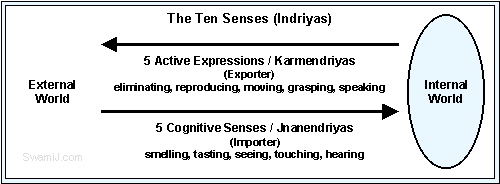
knowledge ( ज्ञानेन्द्रियाः/jnaanendriyaH) and the senses of action (कर्मेन्द्रियाः /karmendriyaH), which
together constitute the helpless 'traveller of this sea of life', the संसारिन् /samsaarin. By mistaking/misinterpreting our
experience gained through action we build a world around us, separate from The
Truth.
With
this, we have the 'fall of man'. From being the Eternal, Immortal, All-full
Pure Consciousness (नित्य-शुद्ध-मुक्त परमात्मन् /nitya-suddha-mukta paramaatman), due to the play of Maya
and like Somadatta's father, we too have come to feel our limitation and live
in our unbuilt huts with our unmarried wives and unborn sons.
Vedanta
is not a pessimistic philosophy to leave its conclusion with a mere theory of
fall. This very theory has been devised to explain the non-existent dream-fall
so that the faithful may be shown a way to wake up and realise their own true
and eternal nature once more; returning to the OM!