ADVENTURES IN ADVAITA VEDANTA...

Adventures in Advaita Vedanta, the philosophy and science of spirit. We are one you and I; are you curious why?..


Showing posts with label ego. Show all posts

Temper the Ego

Hari Om
Each 'Choose-day' we will investigate the process by which we can reassess our activity and interaction with the world of plurality and become more congruent within our personality.

The next text which will guide the Choose-day posts is "Tips for Happy Living - jIvnsUÇai[ /jiivanasuutraani", by Swami Tejomayananda (Guru-ji). Choose-days writings are here to prompt deeper thinking on the choices made on a daily basis and seek to provide prompts for raising the standard of one's thinking and living. This text composed in format of Sanskrit traditional teachings, speaks directly to this purpose. As ever, the full text may be obtained from CM Publications - or your local centre (see sidebar).

What, then, should be our attitude in giving and receiving help?

jIvn< ivnyenEv zae_ate.7.
Jiivanam vinayenaiva shobhate ||7||
Life becomes beautiful only with humility.

Here is a pure aphorism! One may have everything in the world, be it knowledge, wealth, status, power - even the practice pure and high virtues - but unless one has humility, all these things are empty of worth. When one has humility, one understands all things to have no worth anyway!

There is a quote of Gurudev, "humility is a strange value; the moment you think you have it, you have lost it."

It is true. Think. The minute you say to yourself, 'I am a humble person' you have let the ego stand up!

Humility, by its very nature, does not permit even the thought of it applying to ourselves. We may observe and admire it in others but we cannot see it in ourselves. If another says of us that we are humble, we will know instantly if it is true of us, for the ego will surely put up its hand and agree… or it will blush, acknowledge and then turn again to the task in hand, thinking no more on the matter.

An outer show of humility is of no use to us in spiritual practice. When all pride (maana) is removed, what remains must be humility (non-pride; amaana). There is the example of the saint Rahiim, who was a prosperous man, but a generous one. He always kept his eyes down as he gave to others. When questioned about this he said, "I cannot meet the eyes of people as they falsely praise my generosity. It is the Lord alone who gives." In other words, he saw himself purely as an instrument of the Higher to serve those in lesser circumstances and claimed nothing of that giving as his own.

When a person gives with arrogance, quite often the receiver will sense it and will either feel no proper gratitude or may even reject what is given as it may feel like other than charity.

Herein lies the essence of receiving also; appropriate gratitude requires humility. How often have we rejected help because our ego-pride got in the way?! If we genuinely do not require the assistance offered, then it behoves us to explain fully why this is the case. Otherwise, it is fine to accept and to do so with simple and meaningful thanks. Even if we think that the giver may have an 'agenda', if we need what is given, it is okay to accept and to be grateful. (Though, of course, if the relationship has potential for some kind of bondage, then there ought to rightfully be rejection.)

Write up this suutra and place it where you can see it as a visual prompt each day!


Clarify, Purify

Hari Om

Monday is AUM-day; in search of meditation.

We have been exploring the writings of Gurudev, through his book 'Meditation & Life'. All the instructive chapters have been rendered and now there follows twelve 'chapters' which are designed for contemplation both before and after each meditation session. Please note that the actual writings of Gurudev are quite lengthy, so only the gist and key points are going to be given here. You are again encouraged to seek out a copy of the book to keep to hand as it is an inspiration and with each reading something more will drop into place.

Ch. 35; Evolutionary Unfoldment.
Of itself, the mind is inert, having no life of its own - we ourselves give it the strength it has. It is little more than a vehicle of processing and, just as a driver can take their foot from the accelerator to have the vehicle come to a stop, so the meditator must remove all power from the mind so that it ceases to run.

All the seekers who have mastered this 'driving skill' make similar declarations…'mind is an inert thing. It cannot exist by itself. Therefore, we can say that is a dead thing - and this world dies and decays because of this dead thing called mind - what a strange wheel of stupidity!' In short, when the mind dies, so does the illusion of 'world'. To come to such 'realisation' is find oneself set free from the tyranny of mind. To do this, one must cultivate trust and faith in the words of the masters and earlier 'travellers'. Such faith ought not to be the result of 'seduction' of the scriptures or by falling in a swoon of charisma from a given teacher - this would be 'blind faith'. It must be a faith built upon your own researches into the Knowledge, giving them full reflection and by practicing the techniques given to the fullest degree.

Let us be clear here. We must not 'possess' faith, but let faith possess us. If we hold that we possess faith we are giving ourselves the chance to be dispossessed. Faith is not an object to be treated thus! By proper investigation of a philosophy, however, we learn surrender and the faith then possesses us; we don't have to think about or justify it. Such a faith cannot be lost and such a faith lifts us, especially within meditation. 

 Image result for meditation symbols

No matter how much we 'will' ourselves to something, it will ever elude us. Will is of the ego and ego can be punctured leaving the will nothing to cling to. The attempt of an intelligent meditator is to revolutionise thinking (and therefore their world) by removing the ego/will content, bringing an evolutionary unfoldment whereby there is a Divine system of peace and perfection. Once attaining this new internal condition, all interaction with external is transformed and evolves also. Life becomes fully useful; attachments and raaga-dvesha are no longer traps. We can operate and gain enjoyment of the world, we can serve it and gain from it, but without the angst, the sway of emotion, the traps of desires. We can live in joyful freedom of spirit.

Dropping the ego is to live life intelligently. To keep the mind High, with a sense of holiness within, we must constantly practice 'service of the good' (meaning the saints and sages), by devoted study and deep reflection upon what is given in their teachings. We must fuel a car with the best quality petrol in order for the engine to run smoothly. Similarly, to keep our mind pure and functioning at highest vibration, we must top up each day with the quality fuel of shaastra.

Our sense of doership and enjoyership is what feeds the ego. Seek to starve it, surrendering all 'this is me, that is mine'. On entering the meditative seat, leave the ego at the door. Without this preparation, seekers tend to burn and crash. The mind will take them all sorts of fanciful places; all pleasant and refreshing perhaps, but nothing to do whatsoever with correct purification and spiritual rise. Adjust your relationship with the external world using such techniques as the saadhana chatushtaya. Only then can you properly seek to alter your relationship with mind and ego. Your goal is to make your identity with the ego disappear into the vision of the Self.

Be. Just BE.

With each practice, a gleam of Self will shine through, as the sun may peep through the clouds. Let each such vision come and go, they will reappear more and more as you practice. Each glimpse revives, rejuvenates and resurrects the faith in purpose. Gradually the meditator starts to glow with the inner light and develops a poise and serenity beyond all felt before.

Use no force. Let spirituality open up within as a bud opens to a become a full bloom. Make no haste, progress slowly.


Mind No More

Hari Om

Monday is AUM-day; in search of meditation.

We have been exploring the writings of Gurudev, through his book 'Meditation & Life'. All the instructive chapters have been rendered and now there follows twelve 'chapters' which are designed for contemplation both before and after each meditation session. Please note that the actual writings of Gurudev are quite lengthy, so only the gist and key points are going to be given here. You are again encouraged to seek out a copy of the book to keep to hand as it is an inspiration and with each reading something more will drop into place.

Ch. 29; The Subjective Conquest
To 'stop' mind (i.e. flow of thoughts), we must refuse to feed it with perceptions/objects which trigger thoughts. The ultimate aim is to quite imagining we are anything other than Consciousness. In the absence of the PFT (perceiver/feeler/thinker ego-self) mind has nothing to latch on to.

Gurudev's chart is worth printing out and pasting up somewhere close to your place of meditation. In its visual impact we can see and be reminded straight away that the grosser our outlook, the further we are from our objective of yoga with OM. The world of Objects Emotions Thoughts is where we 'reside' majority of the time. In stepping back a little we understand that our interaction with these gross expressions of life are connected to the Body Mind Intellect through the medium of the Perceiver self, Feeling self and Thinker self. (Note that our thinker self only exists in order to permit the flow of thoughts - thinking is the connecting of thoughts, is the distinction here.)

The ego-self considers "I am the feeler/thinker" - the meditator needs to drop this identification.  In doing this, the "I" of aatmaan can come forward as the observer self (saakshi). Becoming the witness of the river of thoughts which bubble up and slither along allows saakshi to work back to source. Finally one reaches the end of mind, an egoless, detached state which is extremely subtle.

This is the jump-off point for deep and genuine meditation.

Mind is the thing which determines the sort of world we have around us. The quality of the mind generally speaking, reflects the quality of life. In Vedantic philosophy, it is understood that the mind projects the world in which we live. From our lower perspective, we do at least understand and accept that whatever is external to us can drive how we think and feel… and this is what traps us into thinking that changing the external will save us from our sorrows and pains. As Vedantins, though, we must come to understand that it is by taming the mind that we tame our world; by correcting our thinking, outer circumstances and the world of objects no longer make slaves or puppets of us.

It is this subjective conquest which determines 'conquests' in all other aspects. Quite often we do it in small terms, not necessarily noticing it. Diet for example. If we determine that certain foods are to be avoided in order to maintain health and body condition, those who are able to conquer their mind at the times of temptation will thus conquer the craving and the breakdown in dietary control. It is exactly this which is required for meditation - but at a much more advanced and knowledgeable level. Indeed, the satisfaction of success is determined not by the avoidance of temptation, but that we were able to control our mind in the process. We can win many battles without necessarily controlling the mental aspects, but that tends to mean that we face the same 'battles' over and over again. Only once mind has been fully reigned in do we fund the ability to not repeat our failing. All other conquests are small in comparison to conquest of the subjective "I" - the mind.

 Conquering mind does not have to mean that we must run away to the mountains - in fact, an unruly mind will haunt us more there, as we come to realise it is not the external but the internal we must deal with. No. All that is required is to become aware of how the external distracts and hoodwinks us through our BMI equipment, through the senses.

This brings us to the methodology of conquest. Start small. Be alert to the senses and how they reach out. Awareness alerts the intellect as it observes the mind's tendency to latch on. Use the intellect then to whip the mind back from the external and look to the internal. As a meditator, constantly redirect the attention from out to in. Call the mind like it is a pet or a small child. Until mind is fully controlled, substitute the baser cravings with saatvic ones - 'no, you do not need that magazine of false truths - here look at this text from the upanishads…' The mind needs something, so give it something, but have control over what that something is and ensure it is pointing in the direction of the Higher. This purifies the mind. The purer the mind becomes, the less its agitations and cravings will become. By following the 'code of conduct' such as the saadhana chatushtaya, with Bhakti, japa, surrender… little by little the mind becomes well managed and finally conquered.

Mind wishes to flow towards objects it loves. Mind will linger where Love is. Show it every day the Love Divine and it will start to crave that most of all. Once occupied with that Love, with nothing else intervening, mind as at the point of contemplation. This can be aided by use of an altar, an image representing the object of devotion. This is where Bhakti leverages Jnaana and we have the two wings to lift us to the Higher.


Recognise and Decide.

Hari Om

Each 'Choose-day' we will investigate the process by which we can reassess our activity and interaction with the world of plurality and become more congruent within our personality.

MANAGING THE MANAGER (cont'd) - Swami Swaroopananda

Managing the Six Mighty Forces (cont'd)
We saw two last week; kaama and krodha. Let us complete.

Lobha - Greed.
Keeping one's needs to the minimum conquers greed and leads to संतोष /santosha (satisfaction). Santosha lies not in the fulfilment of all desires, but in the realisation there is actually plenty already. Thus another use of the word santosha is 'contentment'. From this we get the inkling that desire, anger and greed arise from a feeling that we are lacking in something, a sense of being 'poor'…

A simple method to cultivate satisfaction is to write down five things that you are grateful for - five blessings you have felt in any given day. Soon, the realisation dawns how much you already have. Then you can never become a beggar.

Satisfaction comes from gratitude; when we are grateful for what we have, we stop complaining about what we do not have.

Moha - Delusion.
The delusion referred to here is that of what is Real and what is not. Right knowledge and right thinking overcome delusion. If one remains steady on the path of dharma - righteousness - as guided by the scriptures one will never get deluded. If the mind is kept occupied on duties, there will be no time for unnecessary distractions and delusions are easily conquered.

Ahamkaara - Pride (ego)
Use the writing tool again - but this time write down the things of which you are proud. You may be a good singer, for example, or clever with figures… in addition, write down the contribution of others in your success.

Image result for pride emotionFirstly, not everyone can sing, and for those who can, it is good remember it is a gift of God.

Secondly, remembering that you did not succeed in your field or hobby without the input of, perhaps, parents who paid for lessons, teachers who gave those lessons, neighbours who tolerated the practice...When you acknowledge the contribution of others in helping you achieve, your pride moderates and gratitude will help you express the appreciation through doing our duties and serving others in turn.


Matsarya - Jealousy
This should be seen as nothing but a distortion of admiration. The substitution of admiration for jealousy is the key to overcoming this monster.  If you think someone is better than you at something, don't moan about it, but rather attempt to become better at that thing yourself. Emulate their aptitude and don't waste your energy in attempting to pull that person down or cast slanders. If someone appears to have more than you do… refer back to lobha!

Often, matsarya is related to appearances. Remind yourself that no matter the surface, it is what lies beneath that makes all the difference in matters of beauty, and a refined personality, bright with the colour of Love, is the most attractive thing of all. Resolve to refine and brighten yourself so that you shine among all other lights.

Take All As Prasaad.
In conclusion, take everything as the Lord's प्रसाद /prasaad - gift of beneficence. Do your duty; do whatever work is required of you; do it all as an offering to Him. Then whatever comes, whatever life gives you, be satisfied and accept it as His will. Once that acceptance is developed there will be no anger, no frustration, no depression, no dejection, or laziness. The moment there is laziness or depression, admonish your mind, get yourself into some activity, do something you enjoy. The best thing is to serve others for this leads to a great sense of achievement and fulfilment.


Thus we conclude this little writing from Swami-ji. Remember that all the posts here on Choose-day are about helping to clarify some of the basics of making choices in life. To say that 'you are who you are' as a result of your birth is only a part of the story. Ultimately, we can only ever be who we are as a result of the choices we make - whatever the circumstances.

Image result for om

Love At The Core

Hari Om

'Freedays' are the 'gather our thoughts' days; Q&As; a general review of the week so far…

Having spent a week with folk who are at various stages of  indifferent health, it has struck one how much attached the spirit becomes to the flesh. Not that it wasn't previously understood, on an intellectual level. However, when faced with a physical example, it can be very hard not to say, "Aha! Detach! Detach!"

Just because, for oneself, attachment to the physical aspects of existence has been much reduced, letting the Vedantic understanding supplant the old habit of living, it also has to be acknowledged that majority folk have yet to consider and accept the possibility of death simply being another stage in 'life'. This is what Vedanta teaches; the body is like a suit of clothing, to be dispensed with once used. If parts can be recycled, all to the good for the bodies which remain and are in need of those parts; for the essence of personality which inhabited that body though, it is time to get on with the next stage of experience and growth.

Taking it one step further, Advaita Vedanta** teaches that the departing spirit returns to source and is part of the ONE again. It may have some karma balance still to be spent, therefore another 'suit of flesh' is formed and the spirit enters it. Thus the cycle of reincarnation is set.

Advaita allows for no distinction between our perception of existence and the source of that existence (called variously as Brahman, OM, God, etc). Its teachings imbued with indubitable logic, if read well, and its examples and exercises applied, physically as well as intellectually, bring the dedicated adherents to the conclusion that All IS One and that One is the AMness within.

It is not an easy thing to allow, though. The antaH-karana (mind-intellect-ego-"memory") is itself an attachment and it takes a great deal of effort to move beyond it. The ego-self becomes very, very dominant and when we use the first person pronoun it is almost entirely in reference to the contained and flesh-packaged, individualised self - the jivaatman. Occasionally, we may stop and ponder, 'who am "I" really?'... All too briefly, for then 'life' pushes in again and distracts us from the question. However, there are a few who stick with it and begin to research it more fully through the various techniques available. It can be through explorations in artistic endeavour, through music, through adventure… endless methods offer the possibility of understanding who is this "I". The majority, though, only serve to strengthen lower-self, ego-identity.

That ego-self attaches to other ego-selves as well as to the world of objects. Somewhere inside there is the idea that to possess things and relationships will keep us safe. Yet the more we are attached to things, the greater the fear of their loss which arises, rather than an increase in feelings of safety.

This is particularly obvious when it comes to members of family or pets being seriously ill or dying. Those who suffer most in their grief are those who are attached in such a way as to believe that their own life cannot function fully without the presence of the departed one. Others will grieve long and become attached to that very grief, as if it is a crime for them to take on happiness of any sort again. Still others will grieve, but then find that life does indeed go on and they can operate fully in the absence of the departed without guilt or excessive pain. The Vedantin is not untouched by grief, but rather does not permit it to become debilitating in the way it can be for others. Acknowledging the loss is very much there and the absence is surely felt. However, there is also a sense of relief for that spirit that it has chosen to move on and a prayer that it will find an improved existence hereafter.

How to sit with those who have the pain of breaking attachment upon them when there is such a different understanding? Just that. Simply sit. There is no need to preach or look dispairingly upon those who lack this understanding. The one thing which crosses all 'understandings' is Love (with the capital 'ell'). Simply 'being there' (even from a distance) is sometimes all that is required to bring solace and strength during such times. If the query comes as to how one can be so calm in such a time of stress, the easy and honest answer is, "Sit in Love for in Love there is no loss."

It is within the mantel of Love that we can rest and drop our burden. In the time of stress, we need not search out the big answers for what is that Love. All that is required is to feel it and allow others a share in it.

Image result for come unto me

**Vedanta is the teaching of the Upanishads. As within Christianity, there are different interpretations of the message. Advaita claims the unity of all without division of the Divine; Dvaita claims all are one, but The Divine stands separate; Vishishtaadvaita acknowledges the unity of all, whilst allowing for the individuality of the Divine… there are other subdivisions also. On the key points of life and its purpose, however, all the philosophical sections are in agreement. Therefore Vedanta stands as one philosophy.

Actions Speak Loud

Hari OM

Application - that is what 'Workings-days' are about!

VEDANTA IN ACTION.
This is the title of a publication from CM which, whilst it of course has items by Gurudev, also includes selections of writing from other well-esteemed Gurus from the Vedantic tradition as well as leading businessmen. Its focus is the working life. We shall be exploring these essays for the next few weeks on Workings-day as, clearly, they pertain directly to the premise of this section of AVBlog! As ever, you  are encouraged to read back over previous posts, to ensure full benefit.

Part 2:Fulfillment Through work

On Karma Yoga (by Swami Vivekananda) cont'd
Working Without Motive

What is the meaning of working without motive? Nowadays, many understand it in the sense that one is to work in such a way that neither pleasure nor pain touches the mind. If this be its real meaning, then animals might be said to work without motive. Animals do what needs to be done with no display of emotion either way, even the killing of their own offspring at times. It is not that any benefitted from this than the animal itself which undertook the act. It was purely self-serving, which in the case an animal, is a case of survival. In this sense, the doctrine is a potent instrument in the hands of the wicked. They would go on doing wicked deeds and pronounce themselves as working without motive. If such be the significance of working without motive, to simply have no feeling, then a fearful doctrine has been put forth by the preaching of the Bhagavad Gita.

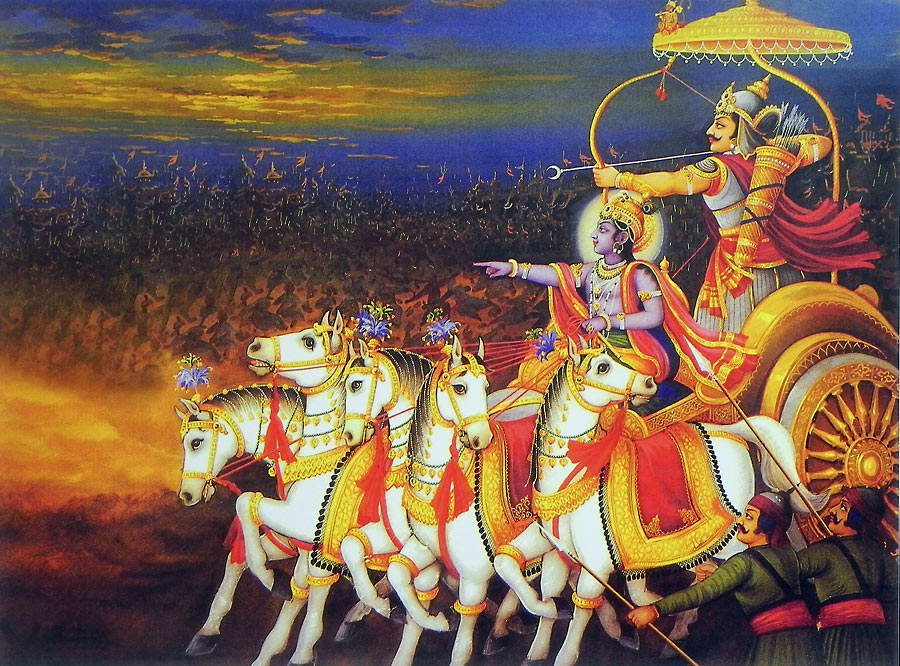
Certainly this is not the meaning. If we look into the lives of those who were connected with the preaching of the Gita, we find them living quite a different life. Arjuna sacrificed all his self-interest and desires and ego many times over, working for the greater good.

The Gita teaches कर्म योग /karma yoga. We should work through yoga (concentration) and in such concentration in action, there is no consciousness of the lower ego present. The consciousness that "I am doing this and that" is never present when one works through yoga. Many people do not understand this. They say that if there be no consciousness of ego, how can man work? However when one works with concentration, losing all consciousness of oneself, the that is done will be infinitely better.

This every one may have experienced at some point in life. We perform many works subconsciously, such as the digestion of food, many others consciously and others again by becoming immersed in samaadhi where there is no presence of the small ego.  If the painter, losing the consciousness of his ego becomes completely immersed in his painting, he will be able to produce masterpieces.  The good cook concentrates the wholly on the food being handled without ego and brings out food of Love for us to eat. However, these are dedicated, single tasks. They may not be able to bring such concentration to bear on other tasks in life. The Gita teaches that all works ought to be done thus. He who is one with the Lord through yoga, performs all his works by being immersed in concentration and seeks no personal benefit. Such a performance of work b rings only good to the world.

The result of every work is mixed with good and evil. There is no good work that has not a touch of evil in it. We ought to engage in such works that bring the least amount of evil and the greatest measure of good. In the Mahaabhaarata, Arjuna killed Bhishma and Drona; if this had not been done, Duryodhana could no have been conquered, the force of evil would have triumphed over the force of good and calamity would have befallen the country. The government of the country would have been usurped by a body of proud, unrighteous kings. Similarly, Krishna killed Kamsa, Jaraasandha and others who were tyrants, but not a single one of His deeds was done for Himself. Every one of them was for the good of others.  As we read the Gita by candlelight, insects are drawn to the flame and suffer to lose their lives there; even this work, then, is not without its evil. Those who work without any consciousness of their lower ego are not affected by evil, for they work for the good of the world. To work without motive, to work unattached, brings the highest bliss and freedom. This is the secret of Karma Yoga.


...tbc...


Play of Mind

Hari OM

'Text-days' are for delving into the words and theory of Advaita Vedanta.

TATTVABODHAH.
[You are reminded that reviewing the previous week's posts will become essential as the meanings of the Sanskrit terms may not be repeated. There may come additional or alternative meanings, but all should be noted. As study progresses, the technical terms must necessarily become 'second nature' to the student. When the Sanskrit is used, the translation will fall easily into place - or likewise, if the English is used, the Sanskrit term must easily come forwards.]

Please revisit THIS post and chant the mangala-charana. Please use the TattvabodaH label to access all posts relevant to this text.

Do not fret at the apparent rush of this section on creation. It may appear 'glossed over'; bear in mind that we are on prakarana only - the 'infant' teachings of Vedantic philosophy, and it is a case of planting seeds for later germination. Grasp only the terminology and the essence of the meaning and implications at this stage. It ought to be considered also that Advaita Vedanta only pays homage to 'creation' at all because we have to start with what we think we know and can relate to… that in fact, none of this holds any substance at all…

Having been introduced to the Maya principle of illusion arising in Brahman, we have been told that it is of the three qualities, Truth, Activity and Destruction. No reference to actual creation here, you will notice. The dream in the dreamer is not 'created' by the dreamer. It was all an intrinsic part of the dreamer, not a seperate condition at all. The dreamer is the Truth, within which, for some time, activity takes place and 'creates' a world. Upon waking, that 'world' is destroyed and the dreamer knows it for the illusion it was. This is the implication. 

Very often, when a shishya comes before a Guru, that teacher will test the student right from the beginning… the question will be asked, "You go to bed at night and sleep. In sleep, this world no longer exists for you. Where does this world go? When you arise, is it the same world?  Who asks?"

This ought to set the serious seeker in a spin of investigation. The question would not be asked by such a Master without some basis for there being an answer. The entire inquiry through Vedanta is to obtain that very answer. Students are generally very eager to answer the teacher at the beginning of classes; whether to show their own prowess in thinking and argument, or simply to show that they appreciate being given such a nugget to work with.

The teacher will then tell the group that their answers, at this point, will most likely be of the श्रिष्टि -दृष्टि /shrishti-drishti vada; the model of 'created therefore seen' - an object-based theory. Advaita posits दृष्टि -श्रिष्टि /drishti-shrishti vada; the model of 'seen thus created' - a subject-based theory. In short, that 'world' arises within Consciousness.

In the next suutra of our text, we now find how mind itself arose. (Please note that no chanting clip is provided for this stanza, small technical 'hiatus'…)

एतेषां पञ्चतत्त्वानां स्मष्टिसात्त्विकांशात्
मनोबुद्ध्यहंकारचित्तान्तःकरणानि संभूतानि।
संकल्पविकल्पात्मकं मनः। निश्चयात्मिका बुद्धिः।
अहंकर्ता अहंकारः। चिन्तनकर्तृ चित्तम्।
मनसो देवता चन्द्रमाः। बुद्धिः ब्रह्मा।
अनंकारस्य रुद्रः। चित्तस्य वासुदेवः।
eteShaaM pa~ncatattvaanaaM smaShTisaattvikaaMshaat
manobuddhyahaMkaaracittaantaHkaraNaani saMbhuutaani.
saMkalpavikalpaatmakaM manaH. nishcayaatmikaa buddhiH.
ahaMkartaa ahaMkaaraH. chintanakartR^i cittam.
manaso devataa candramaaaH. buddhiH brahmaa.
anaMkaarasya rudraH. cittasya vaasudevaH.

"From the total sattvic aspect of these five elements, the inner instrument of the mind, intellect, ego and memory are formed. The mind is of the nature of indecision. The intellect is of the nature of decision. The ego is of the nature of notion of doership. Memory is of the nature of thinking or recollection. The presiding deity of the mind is Moon, of intellect is Brahmaa, of ego is Rudra and of memory is Vaasudeva."

The ten organs (note; tongue, by virtue of dual-purpose, is counted as two) as seen on the chart, are referred to as बहिस्करण /bahiskarana - the outer equipments. They are the 'interface' with the external. All the information received  and output by them is governed by the अन्तः-करण /antaH-karana - the inner equipments, as here described. The organs can only perceive according to their assigned purpose. Mind must perceive everything.

Mind, as we know it in English, is considered but one thing - the continuous flow of  वृत्ति /vRtti - thoughts. Generally, we think no more of it than this. Sanskrit, however, understands 'mind' to be but one of four inner tools with which we process the world. Let us briefly look at them.

ManaH; this is the mind portion. Thoughts in a state of volition are mind. "Shall we do this or that?... What is the movie tonight?... Is there a meeting?..." Mind is also the seat of emotions. One who is mind-dominated is likely to find decision-making slow, or even difficult, due to being swayed by moods, emotions, swings in like or dislike and so forth. This is why the Moon is considered as the 'deity' of the mind. In Vedic terms, when 'deity' is applied it is actually referring to the prevailing characteristic of a natural phenomenon. It is well recognised that we are prone to the wax and wane of the moon, just as are the tides of the oceans. This was observed by the ancient Rsis and nothing has changed this fact over the millennia!

Buddhi; this is the intellect portion. Still thoughts, but here they have moved into the realm of the rational; analysis and decisions; observation, reasoning, conclusion. Those who are buddhi-dominant are said to be 'rationalist'. There is strong logic and confusion is eliminated. There is a risk, for some, of becoming too hooked in this mode; dry intellectualism is cold and can lack tenderness of compassion.  The deity assigned here is Brahmaa - Prince of Wisdom - for knowledge and creativity arise in the intellect.

Ahankaara; this is the ego. It is constituted of the single thought "I" and is used in relationship to doing. Ego here is not about pride, as is so often thought in Western usage. It is the sense of individuality and it generates the idea that "I" am acting in the world; this may or may not result in pride, which is a subset of ego. The thoughts in manas and buddhi and in chittam (remembered thoughts) all keep changing. However, in ahankaara we find there is a consistency of the one thought of "I"ness which is present within all the other thoughts. This is where the Pure Self interfaces with the lower self, but due to "I eat", "I am tall," "I sleep," and so on, ownership of being individual arises, forgetting the universality of "I". It is this which leaves us open to wear and tear as we seek to defend our 'territory' of "me-ness" and it can often bring tears. This is why Rudra ('the maker of tears' - a form of Shiva) is the presiding deity of Ego. Shiva is the Lord of destruction (deconstruction), and we require the 'death' of the ego for suffering to end.

Chittam; 'memory' is the easiest way to think of this portion. Its function is reflection and recollection. All experiences are stored as impressions and can be brought into focus according to need of the moment - or sometimes unbidden. If we think of things in terms of computing; the brain is the hardware upon which our software can play; antaH-karana is RAM in which our software can run. Mind is the data processing system; intellect is the operating software; ego is the specific programming; memory is the storage retrieval system. There are lots of files and not all are stored within the active system - much is stored in 'the cloud'. These are the vaasanas. The presiding deity of this component is Vaasudeva, (a form of Vishnu - the preserver). He is the most sattvic of the deities here and it is true that for best recall we require to be calm and clear.

It follows, given the information about Maya, that the next aspect is that of rajas, which we will see next week. 


Questioning the Questions

Hari Om

'Freedays' are the 'gather our thoughts' days; Q&As; a general review of the week so far…

It has been fourteen days.

"Say what?"

Fourteen days ago there was an exercise put out there for those to follow who are seeking to get their world in order and who feel bogged down in a mire of 'whys - what ifs - whens' and other such questions. If you have undertaken it, you now have a page - or many pages - of questions. They may be entirely random and obscure but that is fine. At first, it may have felt a bit strange; artificial, even. That is also fine. The importance of any activity is to overcome the ego and participate unreservedly. We are often totally unaware of our own ego (even though we readily point to others!), or if we acknowledge, do so with an element of that very egoism, "this is how I am/think/act and that's that".

This exercise, as basic as it is, will have been as much of  a challenge as the ego is dominant. Do not mistake this for meaning 'egotistical or brutish' or any of those other very negative things. We can be very positive and high-functioning people but still be firmly bound by the ego. In Vedanta when ego is referred to, it is in the same manner that it is understood in psychology; the "I" self, the awareness of individuality and the fight to keep that individuality. Majority folk spend a significant part of any day in 'brushing' that ego. Ego wants this or that or the other and poor old body and mind chase around attempting to satisfy it. Ego has two ways to go when it is dominant; it can indeed go the path of the egotistical and bombastic, pushing and pulling at others in an attempt to come out on top, or it becomes unstable and reactive, taking all the troubles of the world upon itself.

Okay, those are the two extremes; however, all the stages between these two sides are just variations on the theme. Sometimes, we pendulum between them as we struggle to protect our ego territory. In physical/ psychological terms, the healthiest ego is that which is balanced well between these two and knows how to redress any shift in that balance with no danger to the ego-self or the others with which it comes into contact.

In spiritual terms, the aim is to overcome the ego entirely and shift into the spirit-self, which can stand as strongly independent as any other self, but without the crests and troughs experienced by the ego-centric self.

The ego-self is a fragile beast and causes us great pain. Surely it deserves a medicine which will not merely patch it up, but renew it and support it and put it back in its rightful place. Mind and intellect are the channels through which ego manifests. Mind is the feeling element, intellect is the assessment tool. Mind is a poor thing, with tendency to be responsive only. The intellect is the grander sibling, having the ability to direct mind, provided it is not become lazy and dull. Mind can hoodwink intellect. Mind is the interface with body and the feedback from body may say 'tired - hungry - sleepy' and so on. Mind then makes arguments to intellect for responding to these triggers. If intellect is not fully on its game, it lets mind have its own way. If it does not question what is presented to it, all sorts of chaos ensues.

Do not let intellect give mind its slack!

Stage Two.
This exercise, begun 14 days past, is to now go to the intellectual stage. Review. Whether or not you chose to make 'folders' of related questions, it ought to become clear that there are distinct 'patterns' in the thinking. By placing the questions onto paper, it is now possible to take a step back and view these thought threads with a more 'distant eye'. In this manner it is possible to 'gather one's thoughts' into a more cohesive and functional pattern.  Intellect taking charge.

The first stage of this, after simply reading through them, is to notice the repeated questions. When 'asking' (writing) them, it may not have occurred that there was even a repetition.  Look for them now. You are looking for those which have the same basis. For example; "...without wealth, how will I feed myself/family?" and then "...without wealth, how to maintain health?" Do you see how these are not actually about either food or health, but about wealth only? If you have categorised already, you may find that this appears in all of them… remember, do not start forming judgements or pigeon-holing yourself! This is not an exercise in pointing the internal finger. It is to aid a clarification of thought and address the best way to formulate questions in order to obtain greater Self-understanding and move along spiritually. The first 'gain' which may be noticed, if applying this tool well, is an emotional easement. The mind, for all its flutterings, is actually our child and it likes nothing better than to have 'the parent' intellect take charge.

Spend the next 14 days going over the questions which were raised. There may be only a few - there may be hundreds. When you spot the obvious replicates, write them all out separately on a fresh page. Go over again and find the not so obvious replicates. They are there, lurking. Be alert to them. If you have not previously categorised, do so now with something like a colour-coded marker, or numbering system.  Spend no more than 30 minutes each day on this. Why? Firstly, because it is easy to become distracted with what's on the page - or have the mind jump and want to play - and the purpose of the exercise is dissipated. Secondly, it is to begin a daily discipline of subjective enquiry, but not to indulge. If one day is missed for any reason, do not then spend an hour the next day to make up. Stick to 30 minutes. Thirdly, there will be tendency to try and make sense of the patterns or to begin justifications and all other such distractive nonsense. Leave the questions on the page. You are being the Witness Self (sakshi) in this exercise; nothing more. An additional thing which may take place is 'fresh' questions arising. This time, armed with some increased awareness of the process, assess the question before it gets written down - if it truly is fresh, place it accordingly; if with further assessment it proves to be yet another replicate, place it on the relevant list.

You are doing this so very privately, but over time, using such techniques, the benefit will show externally. Do not rush at this. To create a lasting change takes time and effort.  What's that?  "Too much work... too hard…"……….. Who (what) says so??!!!


Know Thyself

Hari OM

Monday is AUM-day; in search of meditation.

Meditation & Life, with Sw. Chinmayananda (Gurudev).
We are now exploring the writings of Gurudev on our focus subject of Meditation. The book is a thorough treatment of the subject and extends to over 170 pages of closely printed text. No attempt is intended, here, to present the text in its entirety. However, important paragraphs and quotes will be given, within a summary of each section. You are encouraged to use the links on sidebar to obtain a copy for yourselves from CM publications. Please remember that each of the posts under this title is part of a thought flow and it is important to go back and read the previous post in order to refresh and review the context.

7: How to begin.

With so much said about it's need, the most likely question is "How can I start living the divine life?" It is perfectly logical, but far too general a question; for it implies that 'the divine life' is a complete package ready for the obtaining. Nothing could be further from it!

Image result for the journey of a thousand miles clipartThe divine life is a systematic way of life. It is a steady process of renouncing the negative values of the material life, all habits of the current life which prevent spiritual flow, and accepting, replacing, renewing values which turn spiritual flow to the positive. There is no secret to this. It is simply the hard work of making a daily vow to improve oneself this way - even the greatest of Gurus, Prophets, Saints and Sages had to go through this process and (despite rumours) none of these greats can actually provide an overnight transformation from old life to a life of divinity. Certainly, by their touch and being in their presence, one may have an 'epiphany' and thus the 'magic' happen, but work is there to do for the maintenance of such a life.

Just as a child must learn to walk, then to run, then to swim and so on, including all the falls and bumps in the process, so it is that spiritual aspirants are best to take things in their logical fashion, small and easy at first, then stretching themselves. Just as parents are usually always present for the growth of their child and to keep it focused on its work, so it is that the spiritual teachers keep a watchful eye upon their students.

In both cases, the only way to begin… is to start!

For another implication of the question asked is that one can go from being who one is currently, to a much improved and more sacred person with a few adjustments. Well, for some it may be only a few, for others it can be a mountain of adjustments, as so much depends upon one's state of being at the time of asking. Regardless of where one is now, however, the fact that the question was asked at all suggests some readiness to make effort. It is only in the getting started and making a daily commitment to keep going that one can discover the inner depth of conviction to live the life divine. Where to start? By now it must have dawned that the only place which needs adjustment is within oneself. Our external world only reflects where we are just now. To make a better world, we must make a better "me".

Introspection and Self-analysis.
So far in this writing, there has been an exploration of the world as if you were an observer - giving some objectivity to the world of objects and how it is that "I"-ness and "my"-ess of your current ego self create the delusion of potential happiness. It is hoped that you have gained enough to now think that it is worth making some attempt to walk out of the embrace of this delusion and start to view the world differently. To do this, you must start, little by little, to become your own detached observer. Detachment cannot exist for as long as you have a sense of ownership or possessiveness. "Just as we, blinded by attachments and prejudices, fail to see the real nature of things and beings, so also do we… remain blissfully ignorant of our own weaknesses and faults. The divine life starts with the practice of detaching ourselves from our body, mind and intellect and impartially estimating the motives, intentions and purposes that lie behind our thoughts, words and deeds.  Such impartial witnessing is called introspection."

It is no easy thing. Self-analysis and self-criticism are hard to truly perform. Self-delusion is strongly ingrained! No matter how intelligent or even how acutely accurate any of us may think we are about others, we certainly almost always fall short of self-analysis. Indeed, it is common for us to recognise the weaknesses and faults of others the more readily because they are resident within ourselves - yet we are blind to this fact 99.9% of the time! Conversely, we can be admiring of others' strengths; however, unless that strength is one we already possess and we can be magnanimous about it, such admiration is likely to be tinged with a degree of envy or jealousy and we wish we had that quality. [AV-blog note; recall last year, early on in our studies together, there were a number of posts on various qualities which block our spiritual nature? Some may have found this challenging to read - but now, perhaps, a review of that would be helpful? We can so easily find ways to avoid such material, in the same way we may avoid looking in the mirror is we suspect we won't like what we see. Then comes the day we must try on some new outfit… go on. Take a look. Right back at the beginning, on Workings-days.]

As Gurudev points out now, "Each person generally goes about with the idea that he or she has an ideal personality. Very few are without some kind of ideal perception of that. Such things as honesty, goodness, Love, tolerance, cheerfulness…. All create in our thoughts a total ideal personality and, in our eagerness to be that ideal, we accept ourselves as actually established in that ideal already. Then come flashes of how far we are from our goal!"

If we are not truly established on those ideals, our worlds will crumble at different times in different places and under different circumstances according to the weaknesses which are our actual, current, foundation. For many, to deal with this, they will instead withdraw and build defences and try to 'repair' from existing material, only to find the weakness remains. The biblical example of this is that of the man who built his home upon the sand. If we are to be secure in the world, we must be secure in ourselves and that means using solid 'rock' values and taking shelter under faith. To rid ourselves of the 'sand' of personality traits and values and to replace our 'foundations' requires regular and disciplined practice. To do it requires that we detach from our ego. It is not easy to discover in ourselves some kind of 'Mr Hyde' personality - even if we have progressed a ways along the spiritual path already,  it pays to keep attention, for the creature does lurk!

This all sounds very dark. For some it indeed may be, but for others it may not be all that radical, more just a 'fine-pointing of the brickwork'. Even if we have but one seriously negative trait, however, we have work to do and introspection, daily monitoring of who we are and 'where we are at', is the way to do it. Not everything will reveal itself to us at once. It can be the smaller, less active 'devils' which can cause the greatest hurdle.

Do not be discouraged to start! Of course this takes courage; but if you have listened (read) this far, then some heart is there for change. This can all sound rather unpleasant and difficult - if you think of it as a chore, that itself is negative and to be rooted out! Make of this a sport with yourself. In a few days you will begin to look forward to the 'workout', perhaps even finding that you can laugh at yourself. Note how it can make life 'lighter', having the increased self-awareness this introspective activity brings. Note that the optimum time of day recommended for introspection is in the early evening, after food; regardless of how bad the day has been, the meal will have created some barrier to it and permit the mind to look at your own part in the events and activities of the day with a degree of separation. Sit with your book [...remember the book???...] and let the day's happenings stream by, but be your own observer. When you gave the money for the workmate's leaving gift, was it done with charity and good wishes - or was there other feeling there in giving? When asked to do a task not usual to your day, what was your feeling around it? When your colleague corrected something, what was your reaction? When you overheard someone bullying another, what did you do? These and thousand other possibilities are there for you to reflect on.

See yourself in your own play. Become your own true observer. Detection is a large part of correction. On the next occasion where something arises you will be familiar with it and make and adjustment based on new self-understanding. Perhaps not immediately, and not always easily, but this is the work which begins the path of living divinely. Just as bathing, cleaning our teeth, brushing our hair are daily actions to maintain the body, so introspection must become our 'inner hygiene'.


Choose Life Divine

Hari OM

Monday is AUM-day; in search of meditation.

Meditation & Life, with Sw. Chinmayananda (Gurudev).
We are now exploring the writings of Gurudev on our focus subject of Meditation. The book is a thorough treatment of the subject and extends to over 170 pages of closely printed text. No attempt is intended, here, to present the text in its entirety. However, important paragraphs and quotes will be given, within a summary of each section. You are encouraged to use the links on sidebar to obtain a copy for yourselves from CM publications. Please remember that each of the posts under this title is part of a thought flow and it is important to go back and read the previous post in order to refresh and review the context.

6: Spiritual Growth cont'd.
The Technique of Self-Perfection.

The many saints and sages who have taken the path of meditation and proven its value all tell the promise - you too can achieve this Supreme State of Consciousness, a unified and glorious Bliss. Cease from all your tumbling around in life looking for happiness; when you have the lost key in your pocket how can you find it anywhere else?! Another example often given is that of the lady who, for a moment, wonders where her favourite necklace is, only to have her husband point out it is still round her neck! A modern example might be the person who frantically seeks the missing spectacles, which are all the time on their head!

Image result for i am not the bodyYes, almost the entirety of our lives is about seeking that which we do not have, but often not understanding exactly what it is we seek. When we stop and think deeply on it, we come to realise that all we need is the inner search to bring balance and meaning to life. The Bliss is within and all that is required is for you stop beating about, sit calmly and let it come to you.

The physical body, with its organs of perception and action, all its chemistry and natural magicks, is nothing more than a 'suit of flesh' for the jiiva to tire out some of its karmic debt; to burn out the vaasanas. The mortal jiiva, however, is under the delusion that the 'suit' is himself… you are NOT the body! You are the essence of Self, separated from your wholeness - reconnect with that whole and you come to know you are immortal. The jiiva identified with the body is the ego-self. The ego alone suffers, pain, limitation, 'death'. The attempts to disassociate ourselves from our body 'habit' and the consistent practice of seeking our Real Identity is what constitutes the divine life. This can be done by any of the four paths (yogas); karma (action), bhakti (devotion), raaja (ascetisim - includes hatha, the physical yoga) and jnaana (Knowledge). Saadhana is the daily practice of the spiritual life. "The present life is not the tyrannical dispensation of a power-mad, superhuman dictator God… it was made by each of us, for ourselves, in our past hours, days and lives. Our self-effort in the past is our destiny in the present. Thus any self-effort (purushaartha) made in this life will have its effect in the next incarnation...make your tomorrow peaceful by living today in right understanding, divine thought and selfless action."

Wishes, desires, are the nascent kernal around which thoughts arise. The thought alone tells us there is a desire lurking. The purpose of meditation is to quieten the wishes so that the thoughts cease. Arresting the flow of thoughts, the mind is free to focus on the one Truth. The life lived in pursuit of the total removal of the river of thoughts is the divine life.

In the thought-castle we build for ourselves, we find such story-telling! The "I" of ego is the king of its castle, all its hopes and memories and pride… stopping thoughts, topples the king ego. To live the life divine, is to live in the Kingdom of God. To enter that kingdom, the requirement is that we surrender our personal kingdoms, the ego. Alter your attitude and live the life divine. You need not give up position or family or possessions. Simply tweak the outlook from "I, Mr Jones, desire or plan to execute…", which only solidifies the ego self, and adopt instead the thoughts that 'He is the Truth and the Way, His will be done, may I be an instrument in His hands and through this body may His plans be fulfilled.' With this adjustment in thinking our path becomes clearer, less troublesome… more divine.

As you progress thus, it becomes easier to spend more time in the genuine search for Self Unification. A liberated person lies dormant in every individual. As butter is in milk, God is in you. To obtain the tasty butter, the milk must be churned. Churn your inner being to find the delicious butter of God. If we stop using any one of our senses, one fifth of the world ceases for us - closing one's eyes provides an easy demonstration of this. When all the senses and the mind are thus controlled, we can see the Truth as it is. This is the process of meditation which aids the life divine. There is a choice to follow this. The choice is yours to make.


Perpetual Check-in


Hari Om

'Freedays' are the 'gather our thoughts' days; Q&As; a general review of the week so far…

A lot of the posts till now have brought out the necessity to assess our value system and hold it up to the light, as well ourselves; measuring our words against our deeds and so forth. This is the very nature of philosophical enquiry and rightly so. Putting values into practice is the challenge which is always set.

The quote of Gurudev above brings to mind the need to keep congruent within ourselves as to those values. We may say them, we may act them… but how deeply do we feel them, believe them, live them? Often when things are not working out as we had hoped in our tasks, we are inclined to step back and look for reasons. Not so often do we look within for those reasons.

A very familiar old saying is akin to what has been given here by Gurudev; "it is a poor workman who blames the tools".  We understand the latter readily for we are so caught up in the physical world and therefore a physical example can be appreciated. If the hammer hits the thumb of the user, it is the user whose attention has been diverted sufficiently that either he could not move the thumb in danger away quickly enough, or keep proper aim. However, the key to that was the awareness - an internal thing after all, even in the physical action.

Applying that to the study and intellectual pursuits as well as the creative outlets of any kind, when we flunk a test or feel we are not getting a point or the poem or drawing is not at all seeming complete, we cannot blame the teacher, the books, the pens or whatever. We must look to ourselves and work on what the hurdle is which has arisen within.

One of the common problems is discovering that we have not, perhaps, fully lived what we preach.

Conversely, to experience the flow of creativity and comprehension which comes when one is congruent and 'together'…. Well, it borders on the magical.

Check in with yourself constantly. Be aware constantly. Then be aware when awareness falls.  It is okay for this to happen, it is human; being aware of unawareness remains true to Vedantic values and allows for rest and recovery.  That is all that is asked. This is saadhana.