ADVENTURES IN ADVAITA VEDANTA...

Adventures in Advaita Vedanta, the philosophy and science of spirit. We are one you and I; are you curious why?..


Showing posts with label Nididhyaasana. Show all posts

Guided Meditation 7


Hari Om
Monday is AUM-day; in search of meditation

Meditation has 'caught on'; many people in many places will talk of their practising 'meditation'. That is, overall, a very positive thing. However, for the spiritual seeker, it is essential to be focused and have a deep and full understanding of what dhyaanam truly is. From that, the practice of nididdhyaasana can arise. The first is what we regularly know - the 'act' of meditation. The second is the regular, intense, devoted practice.

Over the next few weeks, you will be given a link to a presentation given by Swami Advayananda in 2018. These are for the serious, those who truly wish to further their saadhana of dhyaanam and move it into nididdhyaasana.

Click the image to go to this week's session. There may be a temptation to move on to the next and subsequent sessions, but please resist this urge. Rather, each day, repeat the session of the week and listen intently - notice if you discover points that you missed at first or other listenings. Also, note what corrections you are making to improve your own practice - best seen from repeating the same thing over and over! Repetition IS practise.

SESSION SEVEN; 


Guided Meditation 6


Hari Om
Monday is AUM-day; in search of meditation

Meditation has 'caught on'; many people in many places will talk of their practising 'meditation'. That is, overall, a very positive thing. However, for the spiritual seeker, it is essential to be focused and have a deep and full understanding of what dhyaanam truly is. From that, the practice of nididdhyaasana can arise. The first is what we regularly know - the 'act' of meditation. The second is the regular, intense, devoted practice.

Over the next few weeks, you will be given a link to a presentation given by Swami Advayananda in 2018. These are for the serious, those who truly wish to further their saadhana of dhyaanam and move it into nididdhyaasana.

Click the image to go to this week's session. There may be a temptation to move on to the next and subsequent sessions, but please resist this urge. Rather, each day, repeat the session of the week and listen intently - notice if you discover points that you missed at first or other listenings. Also, note what corrections you are making to improve your own practice - best seen from repeating the same thing over and over! Repetition IS practise.

SESSION SIX;


Guided Meditation 5


Hari Om
Monday is AUM-day; in search of meditation

Meditation has 'caught on'; many people in many places will talk of their practising 'meditation'. That is, overall, a very positive thing. However, for the spiritual seeker, it is essential to be focused and have a deep and full understanding of what dhyaanam truly is. From that, the practice of nididdhyaasana can arise. The first is what we regularly know - the 'act' of meditation. The second is the regular, intense, devoted practice.

Over the next few weeks, you will be given a link to a presentation given by Swami Advayananda in 2018. These are for the serious, those who truly wish to further their saadhana of dhyaanam and move it into nididdhyaasana.

Click the image to go to this week's session. There may be a temptation to move on to the next and subsequent sessions, but please resist this urge. Rather, each day, repeat the session of the week and listen intently - notice if you discover points that you missed at first or other listenings. Also, note what corrections you are making to improve your own practice - best seen from repeating the same thing over and over! Repetition IS practise.

SESSION FIVE;


Guided Meditation 4


Hari Om
Monday is AUM-day; in search of meditation

Meditation has 'caught on'; many people in many places will talk of their practising 'meditation'. That is, overall, a very positive thing. However, for the spiritual seeker, it is essential to be focused and have a deep and full understanding of what dhyaanam truly is. From that, the practice of nididdhyaasana can arise. The first is what we regularly know - the 'act' of meditation. The second is the regular, intense, devoted practice.

Over the next few weeks, you will be given a link to a presentation given by Swami Advayananda in 2018. These are for the serious, those who truly wish to further their saadhana of dhyaanam and move it into nididdhyaasana.

Click the image to go to this week's session. There may be a temptation to move on to the next and subsequent sessions, but please resist this urge. Rather, each day, repeat the session of the week and listen intently - notice if you discover points that you missed at first or other listenings. Also, note what corrections you are making to improve your own practice - best seen from repeating the same thing over and over! Repetition IS practise.

SESSION FOUR;


Guided Meditation 3


Hari Om
Monday is AUM-day; in search of meditation

Meditation has 'caught on'; many people in many places will talk of their practising 'meditation'. That is, overall, a very positive thing. However, for the spiritual seeker, it is essential to be focused and have a deep and full understanding of what dhyaanam truly is. From that, the practice of nididdhyaasana can arise. The first is what we regularly know - the 'act' of meditation. The second is the regular, intense, devoted practice.

Over the next few weeks, you will be given a link to a presentation given by Swami Advayananda in 2018. These are for the serious, those who truly wish to further their saadhana of dhyaanam and move it into nididdhyaasana.

Click the image to go to this week's session. There may be a temptation to move on to the next and subsequent sessions, but please resist this urge. Rather, each day, repeat the session of the week and listen intently - notice if you discover points that you missed at first or other listenings. Also, note what corrections you are making to improve your own practice - best seen from repeating the same thing over and over! Repetition IS practise.

SESSION THREE;


Guided Meditation 2


Hari Om
Monday is AUM-day; in search of meditation

Meditation has 'caught on'; many people in many places will talk of their practising 'meditation'. That is, overall, a very positive thing. However, for the spiritual seeker, it is essential to be focused and have a deep and full understanding of what dhyaanam truly is. From that, the practice of nididdhyaasana can arise. The first is what we regularly know - the 'act' of meditation. The second is the regular, intense, devoted practice.

Over the next few weeks, you will be given a link to a presentation given by Swami Advayananda in 2018. These are for the serious, those who truly wish to further their saadhana of dhyaanam and move it into nididdhyaasana.

Click the image to go to this week's session. There may be a temptation to move on to the next and subsequent sessions, but please resist this urge. Rather, each day, repeat the session of the week and listen intently - notice if you discover points that you missed at first or other listenings. Also, note what corrections you are making to improve your own practice - best seen from repeating the same thing over and over! Repetition IS practise.

SESSION TWO;


Guided Meditation 1


Hari Om
Monday is AUM-day; in search of meditation

Meditation has 'caught on'; many people in many places will talk of their practising 'meditation'. That is, overall, a very positive thing. However, for the spiritual seeker, it is essential to be focused and have a deep and full understanding of what dhyaanam truly is. From that, the practice of nididdhyaasana can arise. The first is what we regularly know - the 'act' of meditation. The second is the regular, intense, devoted practice.

Over the next few weeks, you will be given a link to a presentation given by Swami Advayananda in 2018. These are for the serious, those who truly wish to further their saadhana of dhyaanam and move it into nididdhyaasana.

Click the image to go to this week's session. There may be a temptation to move on to the next and subsequent sessions, but please resist this urge. Rather, each day, repeat the session of the week and listen intently - notice if you discover points that you missed at first or other listenings. Also, note what corrections you are making to improve your own practice - best seen from repeating the same thing over and over! Repetition IS practise.

SESSION ONE;


Impediments

Hari Om

Each 'Choose-day' we will investigate the process by which we can reassess our activity and interaction with the world of plurality and become more congruent within our personality.

KINDLE LIFE. We continue exploring points raised by HH Pujya Gurudev Swami Chinmayananda-ji in the publication of this name. Remember, you can purchase, (very economically!), the book from  Chinmaya Mission Publications or if you prefer, the Amazon Link. Thus you can read Gurudev's words directly and bring your own voice to the discussion.

(We have been breaking up Chapter 26 of KL, firstly for length, but also for 'digestion'...mananam! It is hoped that you think deeply upon what you read, making notes and finding levels of inspiration. This is saadhana. To review the chapter so far, click the Choose-day label on right panel.)

By naming all the aspects of nature, resulting in what appears to be a plurality of 'Gods', it is to be understood that there is but one and same God Principle. In fact, individually, each of the named Gods is helpless; they are fully independent. Without creation, there would be no requirement of maintenance or destruction. Without maintenance, creation has built in destruction which does itself have purpose beyond the task done - there can be no re-creation. Only by true 'teamwork' between the three can things exist as they do. What keeps this balance? The One God Principle. Plurality, the idea that each living system of the world and its process can operate independently, is an illusion. There is one governing power.

That nature ( सत्त्व-माया/sattva-maayaa, pure illusion) exists for us at this moment as we wrangle with this philosophy, let us accept. In these times we do have an improved sense of the interconnectedness of everything and it is this which is being called the God Principle. If the reflection of that is found in nature; then next thing to accept is that the reflection of the God Principle also reflects in the realm of activity (rajas) and inactivity (tamas). The ego-self, the individualised sense of separateness, is therefore but a poor reflection of The True Self.

The example which is used often for this is that, just as we can see the sun reflected upon water in a puddles and buckets, none of those 'suns' is the One True Sun.  Equally, each of those reflections can only be as clear and as representative of The Sun as the purity of the water doing the reflecting. The purest clearest and calmest water (sattva) provides the best image. Water which is ruffled and agitated (rajas) by any means causes the reflection to be broken up whilst this is so, but also has the capacity to calm down and become steady again.  Water which has become contaminated with mud or dung (tamas) gives a dull reflection and purifying that water will take some effort.  The tamas quality acts in us in two distinct ways. It produces the mental agitations of  विक्षेप/vikshepa (agitation) and  आवरण/aavarana (veiling).

The veiling power of tamas plays out in three distinct negativities; a) don't know, b) can't understand, 
c) not experienced.  These three negative concepts in us are removed by the three main items of Vedantic practice; a) श्रवणम्/shravanam - listening, b) मननम्/mananam - reflection upon what was heard, c) निदिध्यासन /nididhyaasana - meditation, in attempts to gain the experience.

The first of these three main 'tragedies', is that when left to ourselves, few of us have the capacity to independently observe, analyze and conclude that there is a God Principle behind the ever-changing flux in the phenomenal world.  "I don't know" is the grossest state of aavarana. It is removed by shravanam; either directly from the great masters, or their disciples; or indirectly through reading of the appropriate texts. In taking up shravanam we are removing the first negativity and a subtler one now appears; "I can't understand". This is surmounted by intellectual analysis and reasoning, when the seeker comes to feel that in and through the endless names and forms is running the One Golden Chord of Unity, a sense of oneness, the आत्मन् /aatman (Universal Spirit).

A problem at this stage is that very often, students of philosophy begin to devalue their own intellectual awareness of this changeless Truth, since it is "not experienced" by them. This aavarana manifestation is removed by the process of the prescribed practice of meditation.

Meditation is a process of inner self-discipline by which, through constant practice, the seeker learns the art of keeping their mind at one and the same chosen line of thinking to the strict and severe exclusion of all other dissimilar currents of thought.  Ultimately the saadhaka succeeds in bringing the mind to complete stillness in which, unlike sleep, he has his entire awareness brightly lit up and kindling in his bosom.  At the moment of experiencing the transcendental Bliss and Knowledge, (सविकल्प समाधि /savikalpa samaadhi), the saadhaka comes to chop off the last traces of the aavarana.

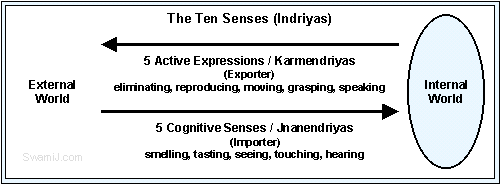
From vikshepa arises the unmanifest, subconscious, and from that springs forth the grosser assertion of the manifest - the world of the five elements. The interplay of the elements produces the names and forms, including the senses of knowledge ( ज्ञानेन्द्रियाः/jnaanendriyaH) and the senses of action (कर्मेन्द्रियाः /karmendriyaH), which together constitute the helpless 'traveller of this sea of life', the  संसारिन् /samsaarin. By mistaking/misinterpreting our experience gained through action we build a world around us, separate from The Truth.

With this, we have the 'fall of man'. From being the Eternal, Immortal, All-full Pure Consciousness (नित्य-शुद्ध-मुक्त परमात्मन् /nitya-suddha-mukta paramaatman), due to the play of Maya and like Somadatta's father, we too have come to feel our limitation and live in our unbuilt huts with our unmarried wives and unborn sons.


Vedanta is not a pessimistic philosophy to leave its conclusion with a mere theory of fall. This very theory has been devised to explain the non-existent dream-fall so that the faithful may be shown a way to wake up and realise their own true and eternal nature once more; returning to the OM!

...the conclusion of chapter 26 next week...


Carpe Diem!

Hari Om

'Freedays' are the 'gather our thoughts' days; Q&As; a general review of the week so far…

Gurudev has been addressing a group of young people and one fellow in particular who asked a very pertinent question.  Their conversation has become almost personal, despite there being quite a large crowd. The discussion is in regards to who, or what, constitutes "God". Now for the second part of YOU, ME & GOD…(2nd?!, Yes - go back here to read the first!)

Ram is alert and asks "Swami-ji, why did you say 'Self'?"

"The Supreme, the Life Principle, is also the Self in you, in me and in everybody.  It is the innermost core of your personality.  The popular misconception is that man is a body with soul. The Truth is that man is a soul which has become embodied! He is eternal.  The role of the body is likened to a worn-out garment that is discarded by the wearer at his will. 

Now, the other members of the audience, who have been listening with awe and reverence, take the opportunity to clear their dowbts.

"Swami-ji, if God cannot be seen or thought of, is an abstraction...is there any significance in worshipping murti (idol/icon)?"

"Of course there is a lot of significance. When your son is in america and you cannot see him whenever you want, do you or do you not get solace by looking at his photograph? You do know that the photo is not your son, but only a piece of paper with play of colour and light creating his likeness, but it reminds you of your beloved boy and his great love for you.  So also the murti-s in temples are to remind the devotees of the ideal, the Supreme.  Since the human mind cannot conceive of a formless Supreme, god is conceived in a form as represented by a statue, a painting, or a symbol.  To the earnest devotee, this image appears as a 'living embodiment of his Lord'. It is, however, necessary to remember that the statue, painting or symbol are not God, but represent God."

"Why is it, Swami-ji, that, as Christianity or Islam, a particular day of the week is not earmarked in Hinduism for temple worship?"

At this question, Gurudev straightened and roared, "Hinduism is not a part-time job?!" He then explained at length that the aspiration to associate with divinity cannot be restricted to any particular time. "Have you heard of any school-boy who would say the Earth is round on Sundays and flat on other days? Man cannot be made divine on Sundays and devilish on all other days." [AV note; of course there are advocations for daily observance in all faiths; but the question was specific to the physical structures of worship, and in this Hinduism is unique in that there is no specific 'day of observance'.]  "Constant practice, frequent association with the good and so on are needed.  Temple visits and worship should elevate the mind of the seeker and help him to keep his mind on that higher plane.  He must take steps also for the purification of the mind at all times of the day, at home, office or market place."

"What is a pure mind, Swami-ji?"

"A pure mind is one which is calm, free from agitation. Agitations are caused mainly by our likes, dislikes and desires. Desires spell disaster, fulfilled or frustrated.  Mahatma Ghandi was very fond of the 'sthitha prajna' portion of the second chapter of the Bhagavad Gita, in which the causes and consequences of desire are most graphically described.  It is the ladder to fall;

'When a man thinks of objects, attachment for them arises; from attachment desire is born; from desire (unfulfilled), anger; from anger, delusion; from delusion, loss of memory; from loss of memory, the destruction of discrimination; from this, he perishes.' 

The three great entrances to the state called as 'hell' are lust, anger and greed."

An audience member raised the practicality; "I have read a good deal, I also have convictions. Yet to put these values into practice is my problem."

Gurudev pointed out this was exactly the problem Arjuna was having when he was faced with fighting his battle in the Bhagavad Gita. "The Lord advised him to recognise the enemies born out of anger and passion. Knowing the enemy is a boon to defeat of same; equally, knowing your weaknesses and acknowledging them is a big step in overcoming them.  If you know there is a rat in the cupboard, do you not make all effort to remove it?! The shaastras (scriptures) have laid down a clear procedure. The three-fold practice consists of श्रवण/sravana (listening), मनन/manana (consideration) and निदिध्यासन/nididhyaasana (meditation as 'application').

"Hearing is not 'in one ear and out the other'! It is attentive listening to discourses on the shaastra (this includes reading them), contemplating and giving due consideration to the tenets and suggestions there, then moving into the fullness of meditative practice.  Many people come and tell me that they have gone through the Gita many times.  I tell them 'let the Gita go through you once at least!' Not just hearing or reading, but absorption and assimilation, then applying the values, alone will produce the Radiance of Life you seek.  Proper understanding and correct attitudes are important. For example, we often meet the allegation that Hinduism is an 'out of the world' religion meant only for the reclusive. The spirit of Hinduism is not understood by those who say this. Wealth is not a taboo for the seeker, but the constant craving for wealth is.  Property is not prohibited, but one is enjoined to use it in the service of society.

"The Vedantic concept of renunciation has nothing to do with have or have-not in a physical sense; it means the attitude of non-attachment. The classical example in our ancient lore is that of the Emperor Janaka, living in the luxury of a palace, but still considered such a great saint and sage he had countless aspirants seeking his guidance.  If you ask me 'how or when to start?' my answer is 'Just start - NOW!'

"Today is the best day - a better day will not come. …"


...Next Free-day we will take chapter 32 of Kindle Life in which Gurudev gives his instruction...