ADVENTURES IN ADVAITA VEDANTA...

Adventures in Advaita Vedanta, the philosophy and science of spirit. We are one you and I; are you curious why?..


Showing posts with label Mahaa Vaakya-s. Show all posts

Four Truths - Four


Hari OM
'Text-days' are for delving into the words and theory of Advaita Vedanta.

Nothing beats learning from a true Master. Today, the final link to talks by Swami Advayananda.   Please take the opportunity to listen attentively (shravanam).

Do not be tempted to race ahead and listen to all four. Instead, stick to the link given each week and then spend some time considering what it is you heard - and hopefully took notes for! - and work on some conclusions and deeper contemplation of the subject for yourself (mananam).

It is with the understanding and knowledge gained from proper shravanam and mananam alone that we can move forward into nididdhyaasanam - proper and thorough contemplation.


Four Truths - Three


Hari OM
'Text-days' are for delving into the words and theory of Advaita Vedanta.

Nothing beats learning from a true Master. Today we reach the third of four links to talks by Swami Advayananda.   Please take the opportunity to listen attentively (shravanam).

Do not be tempted to race ahead and listen to all four. Instead, stick to the link given each week and then spend some time considering what it is you heard - and hopefully took notes for! - and work on some conclusions and deeper contemplation of the subject for yourself (mananam).

It is with the understanding and knowledge gained from proper shravanam and mananam alone that we can move forward into nididdhyaasanam - proper and thorough contemplation.


Four Truths - Two


Hari OM
'Text-days' are for delving into the words and theory of Advaita Vedanta.

Nothing beats learning from a true Master. Last week you were given the first of four links to talks by Swami Advayananda.  Today is the second of these talks. Please take the opportunity to listen attentively (shravanam).

Do not be tempted to race ahead and listen to all four. Instead, stick to the link given each week and then spend some time considering what it is you heard - and hopefully took notes for! - and work on some conclusions and deeper contemplation of the subject for yourself (mananam).

It is with the understanding and knowledge gained from proper shravanam and mananam alone that we can move forward into nididdhyaasanam - proper and thorough contemplation.


Four Truths - One


Hari OM
'Text-days' are for delving into the words and theory of Advaita Vedanta.

Nothing beats learning from a true Master. Swami Advayananda, (Yamini-amma's personal aachaarya) is one such. Today and for the next three Text-days, please take the opportunity to listen attentively (shravanam).

Do not be tempted to race ahead and listen to all four. Instead, stick to the link given each week and then spend some time considering what it is you heard - and hopefully took notes for! - and work on some conclusions and deeper contemplation of the subject for yourself (mananam).

It is with the understanding and knowledge gained from proper shravanam and mananam alone that we can move forward into nididdhyaasanam - proper and thorough contemplation.


Further Rungs

Hari Om
Monday is AUM-day; in search of meditation

Continuing the overview of the Mahaa-vaakyas…

तत्त्वं असि / tat-tvam asi;
That thou art.

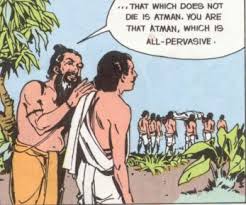
Having resolved all doubts and concerns regarding the nature of the substratum of existence which is described as Consciousness, it must then be taken on board that, if all else arises from that cause, then 'I' the ego self, must also do so.  The guru, seeing the student is ready, heartily declares 'you are that only!' and sends the eager thinker away to ponder deeply on this part of the connection of the little self with the Big Self, the individual with the Totality.

As all doubts and concerns on this second level of acceptance clear, the student must now be wondering about what follows. Everything arises from That, and "I" am That, therefore every thing seen must be a reflection of 'myself' as That, is it not?

© Yamini Ali MacLean


अयं आत्मा ब्रह्म / ayam aatmaa brahma;
Aatmaa and Brahman are one and the same.

© Yamini Ali MacLean
Aatmaa is the individualized self, Brahman (Consciousness) is the Total Self. They are one and the same and in fact have no division. The illusion of individuality is researched at great length in the early stages of philosophical study... at this level, the sadhak is to firm up the understanding and make the Knowledge his or her own. Removing all traces of illusion is the key to this third level of thinking.

As the seeker ascends this scale of philosophical examination, the standard of meditation is also extremely high... it is not the going and sitting for musical 'time out' in a nice community hall or back yard somewhere. It is not the letting of monkey mind have whatever rave party it likes as you sit with eyes closed and desire to sleep.

This is hard, focused, determined contemplation.

The reward for the one who can bring the mind into that pin-point, laser-sharp focus is to move into the cry, which is the fourth of the great statements.

© Yamini Ali MacLean
अहं  ब्रह्मास्मि / aham brahmaasmi;
I AM Brahman (Consciousness)

It is a rare individual indeed who can scale the heights of inner research to lose that individuality and merge with the totality. Saints and sages of history have done this, however. What is more, due to the strict adherence and preservation of the scriptures, the various methods and protocols are available for all who think they would like to 'recreate the experiment'.

Many would pretend it. For the most part, the only harm done is to their own personality.

Sincere and willing participants in the discipline, though, will find great benefit along the way. Even if not attaining the highest goal, they cannot fail but to become the very best human beings possible.


First Statement

Hari Om
Monday is AUM-day; in search of meditation

Last week the Chatur Mahaa-vaakyas were mentioned; four advanced sutras provided as focus for meditation. Let us now take them one by one. Not in huge depth - that is for more advanced stages. The purpose of putting these here now is like the carrot to the donkey! When we have these snippets in the back of our head as we seek to further our contemplations, as we build our knowledge we will find they will more and more come to the fore and demand to be pondered deeply and with purpose. No one is, at this stage, expected to grasp the fullness - the enormity - of the statements and how they apply to the little self as it seeks the Big Self: just know that there is a place to go from here and make a decision to set off for it!

प्रज्ञानं ब्रह्म / prajnaanam brahma;
Consciousness Alone IS.

Through logic and experimentation of all their theories of the material world and the human critter, the Rsis determined, finally, that there is one unifying force/energy/presence upon which all that we perceive is at play... just as we, at our base, animal level, have a concept that "I am", so there is a single and stable "I AM" which is aware of All. It is of the nature of consciousness, subjective in nature and thus will ever elude all attempts to seek it materially.

© Yamini Ali MacLean
Everything which manifests as 'existence' is but a reflection of that Universal Consciousness principle. IT is the background energy, the substratum, upon which all this sits and acts, and is the power behind all the process of change.

Consciousness (Brahma) ever was, ever is and ever shall be.

At some point Consciousness became Self Aware and Existence (materially) manifested. The sound which arose at that point was OM. It is the background music of the universe.

The keen and prepared student, having completed significant levels of self-improvement, dropping of ego-effects such as desire, greed, anger and so forth, having also asked all questions and done much to clear doubts, is likely at some point to be instructed by their Guru to go away for some time and sit in contemplation of only this statement. The adhikaari must maintain focus and churn all the philosophical arguments for and against within his or herself, based upon the knowledge thus fur gained. It may be that the truth of the statement eludes them and they understand that further knowledge must yet be obtained, therefore they return in supplication to the Guru and continue with their study efforts to gain the clarity required.

However, it is possible to reach the stage of purity and clarity wherein the truth becomes one's very own knowledge and there remains no doubt whatsoever. At this point, one is ready for the next level of contemplation.

SAADHANA

Ponder the art of pondering! To attain a level of clarity which has no doubt about the statement requires a strong intellect and deep bhakti. Ponder your readiness.


Why Do This, Again?

Hari Om
Monday is AUM-day; in search of meditation

Meditation has become something of a 'buzzword' these days, particularly in the West. It has been 'discovered' as a means to stress reduction, a mental balancer and well-being enhancer. Which is, of course, true. However, for it to actually be true, it is necessary to understand it. Whilst going along to the local sports hall or library for an hour in peaceful surroundings, with or without music, almost certainly with a 'facilitator', is definitely a good start… that is not meditation as such! It is merely a setting of example, a preparation. What needs to happen is that one then practices this thing every day in order to ensure the peacefulness felt in that source room is carried with us.

What also is required is the learning of what it is exactly. Meditation is not the destressing; that is but a side benefit. Meditation is an at one-ness with Spirit. Not our ego-spirit, but the Universal Consciousness, the energy which drives all creation. To gain that at one-ness, we have to work really hard on our personalities, our habits... our egos.

Sitting in peaceful contemplation, with the mind at rest - but not sleeping! - is a great benefit to many people and is not to be disparaged for that much. However, if the 'facilitator' is worth their spiritual salt, they will seek to educate and raise the individuals in their group beyond mere peacefulness. There is something to be had which is so far beyond peacefulness, words fail in its description. This is the true goal of contemplation; to rise to full meditation. When following jnaana-marg (path of knowledge) we must also take on the teachings of the masters. If we, the students, are worth our spiritual salt, we will question, bring forth our doubts, debate and relate with our Guru so that can clear away the chaff of life and ego and leave space to work on the truly great teachings. These are found in the form of mahaa-vaakyas (great sayings) of which there are quite a number, but there are four key vaakyas.

When we set out on any journey, we are likely to have made preparations for the trip, but also have a good idea of where we are headed. Without that destination in mind, we can go so easily side to side and lose all sense of worth or value in life. We also will be looking out for way-markers; a lookout point, a place of refreshment and so on.

This 'trip to meditation' has the Great Four Statements.
  • Consciousness Alone Is
  • That (Consciousness) You Are
  • Consciousness and mySelf Are One and the Same
  • I Am Brahma

There is a lot of preparation a student must do before truly taking on the contemplation of these statements; that does not preclude us from viewing them and beginning to churn within as to the possibilities contained within them. We shall take a longer look at them from next week.


More Gems

Hari OM

Freedays are currently about YAM's visit to Sandeepany Sadhanalaya.

Two weeks back, you were introduced to the Mahaavaakya "Prajnaanam Brahma".  Images are from the 'mandirs' which have been built to give a visual experience of the great sayings.

The next level of thinking is...

© Yamini MacLean


तत्त्वं असि / tat-tvam asi; That thou art.

Having resolved all doubts and concerns regarding the nature of the substratum of existence which is described as Consciousness, it must then be taken on board that, if all else arises from that cause, then 'I' the ego self, must also do so.  The guru, seeing the student is ready, heartily declares 'you are that only!' and sends the eager thinker away to ponder deeply on this part of the connection of the little self with the Big Self, the individual with the Totality.

As all doubts and concerns on this second level of acceptance clear, the student must now be wondering about what follows. Everything arises from That, and "I" am That, therefore every thing seen must be a reflection of 'myself' as That, is it not?

© Yamini MacLean
अयं आत्मा ब्रह्म / ayam aatmaa brahma; 
Aatmaa and Brahma are one and the same.

Aatmaa is the individualized self, Brahma (Consciousness) is the Total Self. They are one and the same and in fact have no division. The illusion of individuality is researched at great length in the early stages of philosophical study... at this level, the sadhak is to firm up the understanding and make the Knowledge his or her own. Removing all traces of illusion is the key to this third level of thinking.

As the seeker ascends this scale of philosophical examination, the standard of meditation is also extremely high... it is not the going and sitting for musical 'time out' in nice community hall or back yard somewhere. It is not the letting of monkey mind have whatever rave party it likes as you sit with eyes closed and desire to sleep.

This is hard, focused, determined contemplation.

© Yamini MacLean
The reward for the one who can bring the mind into that pin-point, laser-sharp focus is to move into the cry, which is the fourth of the great statements.

अहं  ब्रह्मास्मि / aham brahmaasmi;
I AM Brahman (Consciousness)

It is a rare individual indeed who can scale the heights of inner research to lose that individuality and merge with the totality. Saints and sages of history have done this, however. What is more, due to the strict adherence and preservation of the scriptures, the various methods and protocols are available for all who think they would like to 'recreate the experiment'.

Many would pretend it. For the most part, the only harm done is to their own personality.

Sincere and willing participants in the discipline, though, will find great benefit along the way. Even if not attaining the highest goal, they cannot fail but to become the very best human beings possible.


Some Gems

Hari Om

Random Freeday here!

Some of the change at the ashram of Sandeepany was the setting up a an interactive display centre for visitors to explore, within a museum/gallery-like environment...but in the open air... the entire history of Gurudev and the mission. There some gems amongst the clutter. (Yes, one felt it to be a bit too much in a small area - but that is purely a personal opinion.)

The key point to get across is the Sanskrit philosophy of Advaita Vedanta... the Knowledge system which culminates in the understanding of 'all is one and One is All'. It even incorporates its own vision of what is currently referred to as the Big Bang theory, only it was envisioned and deducted through reasoning and observation by the Rsis of millennia past.

We like to think that WE are the BEST generation, the THINKING generation and so on. However, only by delving properly into these ancient teachings does one come to understand that there is truly no original thought and that the thinking patterns and standards of the human race are no greater now than they were six thousand and more years ago. All that is happening is that we are developing the external equipments which can measure and annotate everything which can be seen, or even 'not seen', yet still be of the material existence. These are beginning to prove what the Rsis postulated.

Sadly, in the rush for all this empirical evidence, we have cut away and even abolished any notion of the subtlest of existences. For those with no other way, it is referred to as 'God'. Vedanta does not call it so - but allows for all the possibilities that everyone needs as they fight their way up the intellectual ladder to finally reach the understanding of OM, Brahma and the emergence of 'it all'. ...please do not mistake this for condescension, it is simple statement of how things are and these things are written - and they are far from 'new age'!

© Yamini MacLean


There are many great statements in the teachings, but there are four key ones - the Mahaavaakyas. These are the cornerstones of the advaitic scholar and also the way-markers for one's inner and intellectual progress. They are not mere words, they are to be experienced, through study, deep and meaningful contemplation, meditation.

One of the gems at the new Pradeep centre is a small set of 'temples' through which one can move, lingering and meditating as one does so, upon each of these Supreme Statements.

प्रज्ञानं ब्रह्म / prajnaanam brahma; 
Consciousness Alone IS.

Through logic and experimentation of all their theories of the material world and the human critter, the Rsis determined, finally, that there is one unifying force/energy/presence upon which all that we perceive is at play... just as we, at our base, animal level, have a concept that "I am", so there is a single and stable "I AM" which is aware of All. It is of the nature of consciousness, subjective in nature and thus will ever elude all attempts to seek it materially.

Everything which manifests as 'existence' is but a reflection of that Universal Consciousness principle. IT is the background energy, the substratum, upon which all this sits and acts and is the power behind all the process of change.

Consciousness (Brahma) ever was, ever is and ever shall be.

At some point Consciousness became Self Aware and Existence (materially) manifested. The sound which arose at that point was OM. It is the background music of the universe.

This will continue in the March Freedays. Next week is Maha Shivraatri...


Negate, Negate

Zu_a! jnmaZtim SHUBH JANMAASHTAMI!
Happy Birthday Sri Krishna!!!

Hari OM
'Text-days' are for delving into the words and theory of Advaita Vedanta.

We are now studying Aatmabodha. As always, with each week, you are encouraged to review the previous teachings and spend some time in contemplation of the meanings as the affect your life. Please do consider purchasing the text. Remember, also, to recite the mangala charana before each study and review the lessons before each new one.

There's a slight shift in the teaching now, as the next shloka advises one method of reaching to the Higher.

ini;Xy iniolaepaxIÚeit netIit vaKyt>,
iv*adEKy< mhavaKyEjIRvaTmprmaTmnae>.30.
Nishidhya nikhilopadhiin-neti netiiti vaakyataH,
Vidhaadaikyam mahaavaakyair-jiivatma-paramatmanoH ||30||
By the process of negation of the conditionings (upaadhis) as per the scriptural statement 'it is not this, it is not this', the Oneness of the individual soul and the Supreme Soul, as indicated by the mahaavaakyas, has to be realised.

A reminder that the mahaavakyas (the great statements) of the upanishads as whittled down from many to four, key 'essence' statements according to the Veda from which they arise. To review;

à}an< æü/prajnaanam brahma - Consciousness is Brahman (from Rg Veda)
Ay< AaTma æü/ayam aatmaa brahma - That Self is Brahman (from Atharva Veda)
tTv< Ais/tattvam asi - That Thou Art (from Saama Veda)
Ah< æüaiSm/aham brahmaasmi - I Am Brahman (from Yajur Veda)

The pinnacle of Vedantic thought is contained within these. There are a number of mahaavaakyas which form a 'stairway' to them, but these are given out in the same way that the World Cup of soccer, or any other coveted sports prize are put on display; so that those who are 'in the sport' know exactly what it is they are working towards.

Thus, in this shloka, Shankaraachaarya-ji tell us that by thinking on the unity indicated by these four Master Statements, but even more specifically on the statement of 'neti-neti', it is possible to attain to the Ultimate - aham brahmaasmi. This is known as the process of negation.

Fine. Intellectually that seems a fairly clear-cut teaching and something we can take on board. Meditate on the fact that everything which is perceived, even our very thoughts, are not The Self, they are not The Self. However, we cannot expect this to be a magic switch and carry ourselves to Realisation with this alone. The very placement of the mahaavaakyas indicates this. First we must fully grasp the concept of Universal Consciousness and that this is what is called as 'God' (Brahman, Aatman…) by all who seek their spiritual dimension. In our every day, if we are alert and sensitive, we can already sigh deeply at the wonder of Nature, the Cosmos, the uniqueness of being born a human being within that. This must go one stage further, however. We must start to 'see' the powering factor behind all which can be seen without such effort. The essence of existence, here called Consciousness.

That pure Consciousness is the Absolute Reality. That Self Is Brahman. This must be our next step in spiritual evolution. Until we are firmly established in the understanding and acceptance of this fact, we can then grasp what the teacher means when he points at us and says "That Thou Art!" That which we have now come to understand as the Universal Consciousness, a single Self Presence, is nothing but our own self. Is it so? We must work hard in our meditations and studies to determine this fact and make it come alive to our own intellect and then move beyond even the intellect into the knowledge the teacher already has of us… yes, yes, yes indeed, aham brahmaasmi! Realisation dawns. One of the best ways for attaining this understanding is, as stated here in shloka thirty, 'It is not this'… Self is none of this plurality, none of this nonsense we currently call 'life'.

We shall have a discussion around the vaakya 'tattvam asi' at a later stage; as a short foray into the sort of thinking which is required to resolve arguments and debates can be indicated here though, let it be known that there are differences of opinion regarding this statement in particular. Those who wish to support the idea of 'all is one except for God, who remains separate from us' argument (Dvaitic -duality- thinking) like to argue dualism is inherent in the use of 'that', indicating an other, further compounded by saying 'it is not this'. Advaitic (non-duality) thinking, however, moves beyond the semantics to the lakshana, the intended meaning. To stick only at what the words say is to limit the spirit and a limited spirit becomes a painful thing. An example of this can be worked out from the sentence 'this is that Gupta'. A friend you are talking with spots a fellow he thinks he recognises but is not certain. You can confirm, 'yes, this is that Gupta!' The friend is astounded. The fullness of this picture is the better understood by the history that Gupta was known once in the local town of their birth as nothing more than a pretty cloth-store keeper. Now, here in the capital city, he is spotted and it is discovered he is a multi-millionaire fabric designer. Gupta, however, is  still Gupta. He was that, he is now this, but is still one and the same person. If we took dvaitic thinking, the argument would be that there are two Guptas existing in same body.

Likewise, the jiiva, the lowly self we think we are now, is at the same time That Self, the 'multi-millionaire' spirit! We just have to rediscover our riches of bliss and existence. All sense of duality dissolves.


Contextual Difference

Hari OM

'Text-days' are for delving into the words and theory of Advaita Vedanta.

TATTVABODHAH.
[You are reminded that reviewing the previous week's posts will become essential as the meanings of the Sanskrit terms may not be repeated. There may come additional or alternative meanings, but all should be noted. As study progresses, the technical terms must necessarily become 'second nature' to the student. When the Sanskrit is used, the translation will fall easily into place - or likewise, if the English is used, the Sanskrit term must easily come forwards.]

Please revisit THIS post and chant the mangala-charana. Please use the TattvabodhaH label to access all posts relevant to this text.

This text is a primer for technical language, but also in how to approach the study of Vedantic philosophy. This becomes very apparent in the question just asked by the shishya (last week's post beginning with "nanu…"), which is pertinent and demonstrates alertness. Having been told by the Guru that there was a direct relationship between jiiva and Iisvara, such that they were one and the same, the doubt immediately came as to the voracity of such a statement as 'tat tvam asi'. There is a clear case of opposites - apparently. The Guru now goes on with an introduction of how to analyse the great statements and other teachings in the Vedic scriptures. This of course will be developed with each succeeding text, just as maths or chemistry at school build on the basic arithmetic and formulae we learn in junior year. Something to take on board just now is that there are different ways of assessing; by direct word meaning (वाच्यार्थ  /vaachyaartha**),  or by implied meaning ( लक्ष्यार्थ  /lakshyaartha). For example, some fellow says to you, "look out here comes Devadatta the jackal."… you look to see where the jackal is but see only a man. You have understood by the words only, that there is a canid form somewhere nearby. However, the other fellow had meant by implication, that Devadatta, the man, had the qualities associated with a jackal so as to describe him thus. Lakshyaartha is not always so readily 'seen'! Here, though, the Guru introduces the concept in response to the shishya's query.

इति चेन्न। स्थूलसूक्ष्मशरीराभिमानी त्वंपदवाच्यार्थः
उपाधिविनिर्मुक्तं समाधिदशासंपन्नं शुद्धं चैतन्यं
त्वंपदलक्ष्यार्थः। एवं सर्वज्ञत्वादिविशिष्ट ईश्वरः
तत्पदवाच्यार्थः। उपाधिशून्यं शुद्धचैतन्यं तत्पद्लक्ष्यार्थः।
एवं जीवेश्वरयोः चैतन्यरुपेणाभेदे बाधकाभावः।
iti cenna. sthuulasuuxmashariiraabhimaanii tvaMpadavaacyaaarthaH
upaadhivinirmuktaM samaadhidashaasaMpannaM shuddhaM chaitanyaM
tvaMpadalaxyaarthaH. evaM sarvaGYatvaadivishiSTa iishvaraH
tatpadavaacyaarthaH. upaadhishuunyaM shuddhachaitanyaM tatpadlaxyaarthaH.
evaM ca jiiveshvarayoH caitanyarupeNaabhede baadhakaabhaavaH.

"If there is such a doubt, no [it could not be so]. The literal meaning of the word 'thou' is the one identified with the gross and subtle bodies. The implied meaning of the word 'thou' is the Pure Consciousness which is free of all conditionings and which is appreciated in the state of samaadhi. Likewise, the literal meaning of the word 'That' is Iisvara having omniscience and so on. The implied meaning of the word 'That' is the Pure Consciousness free from al conditionings. Thus there is no contradiction regarding the identity between jiiva and Iishvara… from the standpoint of Consciousness."

Read that again, slowly and carefully. This is a very important component of this study… it is about context. If, indeed, we read a phrase of "you are That" without proper context, it is easy to become confused and even doubt the sanity of the speaker! It implies that as you look at the screen just now, you also are that screen… we find this extremely difficult to comprehend in our current, trapped and bound, conditionings (upaadhis) which have us believing we are finite, individual components… even if we subscribe to a 'whole'. Majority consider themselves to be cogs in Nature's workings. What Advaita brings is a sense of not simply being the cog, but of being the engineer as well. To do this we have to alter our frame of reference.

Bhagavan Ramana Maharshi was asked if the Lord was with or without form. He said, ' it depends on what you think you are. If you think you are with form, He too is with form. If you think you are formless, then He too, being formless, is one with you."

Thus, in one suutra, the Guru has 'upped the game' on the shishya. For proper enquiry, he has been rewarded with an insight to a much higher level of thinking. Eventually, we must work our way to the ease of context. Till then, we can only begin with what we know - currently that is form and individuality. To gain the Knowledge of our Universality, our Divinity, is the key purpose of being given human life. The tool we have been provided is the antaH-karana. However we start, there must come the point for every student of spiritual philosophy where the question "Who am I in essence?" arises. In seeking Self, we find God.  अहं ब्रह्मास्मि /aham brahmaasmi… "I Am Truth."


**please note in your books for future reference, there is another word which looks almost identical - वाक्यार्थ /vaakyaartha - which is the general meaning of a phrase or sentence.


The Crux

Hari OM

Application - that is what 'Workings-days' are about!

We are now undertaking basic technical discourse on Vedanta. The text forming the basis of these posts is 'Kindle Life'.

We have been covering all the basics of Vedanta in a very short space. It is a philosophy which underpins the very basis of Life - everywhere. This can be discovered by each individual if they take up its genuine study, with open hearts and inquisitive minds. Today, the conclusion of this introduction.

Given that any philosophy must have a core purpose, keywords if you will, prompts to keep the student of that philosophy focused on the point of it all, Vedanta is no different. All of what Vedanta is about can be said to be contained within the महा वाक्याः/mahaa vaakyaaH, the four great declarations, one from each Veda. There is an ascending order, in the sense that each is a signpost to the next. (Here is a 'thumbnail' description of each; don't fret over them… we will be studying in depth as and when they arise!)

प्रज्ञानं ब्रह्म/prajnaanam brahma (definition of Truth = 'consciousness is Brahman'). This gives a simple statement of The Truth as held and proven through Vedanta. It is declaring that the very essence of who we are, being consciousness, holds a possibility of being universal.  Consciousness is the one thing which binds as a common factor in 'life'.
तत्त्वं असि/tat tvam asi (instruction/advice of the guru to the shishya = 'that thou art'). A statement of profound import.  First we heard that consciousness could be a unifying factor (called as Brahman), now we are being told that Brahman is who we Are.  Brahman is not an abstract concept, but is ourselves, manifest. This is rather a mind-blowing idea! Majority of us, if we have an idea of Brahman ("God") as being some old bloke sitting in judgement over all the cosmos, or other equally pluralistic view, would find this concept challenging in the extreme. Many stumble at this juncture.
अयं आत्मा ब्रह्म/ayam aatma brahma (statement of direct experience = 'this atman is Brahman'). The avid student (mumukshu) however, will want to work on this (mananam) and thus will now seek to understand it further; this is where withdrawal from old life habits and, traditionally, leaving the home for the caves or forests would take place. His teacher has told him that there is a connection between himself and Brahman and he must now find it. Using all the texts given to him by the guru, using his own intellectual powers, applying the experiments through saadhana, japa and meditation, the sishya will make attempts to prove the truth in the first statement (Self is Consciousness) and that it applies to himself (Self [I] am that Consciousness [Brahman]).
अहं ब्रहास्मि/aham brahmaasmi (statement of the realised soul = 'I am Brahman') the student moves into mastership! Realisation is his.  Moksha is assured.
 

The word 'philosophy' derives directly from the Greek with barely a change over the centuries and has the meaning 'love of wisdom'. In modern times it has taken on, to some degree, the context of 'system of thinking', but always with an intellectual edge. (Businesses, for example, might describe their mode of operation or the purpose of their existence  in terms of 'philosophy'.) Thus we could say that when studying logics and motivations and suchlike, it is the capital letter Philosophy; and when we are talking about applying a system with consistency and round a core purpose, it is the small letter philosophy. Philosophy deals with much that is abstract, mysterious, and is used to explain Man's relationship with Life and why we have it, what it means and so on.  It provides sound principles of living. There are many who would decry Philosophy as a dry, intellectual process having no bearing on 'real life'… but without Philosophy defining who and why we are, the human species would not have risen any higher than other animal species.  In a sense, it is the very nature of Philosophising which defines us as something other than mere animal. Thus Philosophy (capital letter) can be called as 'a view of life'.  When we apply it as small letter philosophy, we are making it a 'way of life'… and this is more correctly to be called religion.

Religion has an etymology a little more altered. It derives from old French 'religare', meaning 'to bind'. It had no specific relation to motivation or purpose, it was merely an action. As it progressed, the term was applied where there was an obligation due, thus requiring a return to the same action over and over ('repitition'; serf to master for example). The Latin 'religio' took on the aspect of 'reverence' and finally the term religion was derived and tended to indicate those who were dedicated in matters of reverence (i.e. service of God). Religion, then, is very much a Euro-English term and does not exist within Vedanta or Sanatana Dharma (Hinduism). However, Gurudev taught in English, for he wished maximum number of people to obtain maximum benefit, so he used this term to refer to the application of the philosophy of Vedanta. If we take the original root of the word and think on how Man can 'bind' himself to a path which will bring him back to his maximum potential as a spiritual being, then we have a true expression of religion.

"Philosophy without religion is tantamount to a Utopian myth; religion divorced from philosophy becomes a bundle of superstitions." (Gurudev)

For many, religion has been distorted from its philosophical meaning into one referring to unthinking, unquestioning, ritual practice - or indeed, a practice involving rituals and rites. Religion is to have a goal and to strive for realisation of that goal.  In this way, we can see that sportsmen, entrepreneurs, charities and such can all have a religious approach to their field of focus. Within spiritual establishments, it is a sad thing (and cyclical over the centuries) that the physical expression (rites, doctrinal expression, distorted use of scripture)  has become so misused and, (dare it be said?), abused that the term 'religion' holds inflammatory potential.

All the ancient faith systems, though, hold a kernal of the Ultimate Truth, that which brings them back to the same goal as that which has ever burned and never wavered within Vedanta - this is why all true seekers of any background, who are ready for the highest spiritual journey, will 'recognise' Vedanta. It is akin to recognising family, even after decades of separation. There is a familiarity, a softness, a feeling of…' at last…'
   

The term 'yoga' is much touted in the West and is most often referred to in terms of physical stretching.  The word itself, though, is derived from the Sanskrit root 'yug' which means 'join'. To Join (yoga) is used in all the paths to refer to joining with the Supreme Self. This union can be achieved through the four different paths, according to one's abilities, inclinations and stamina.

Karma yoga is to follow the path of action; that is to say, right action and as instructed by scripture.  Everyone can take up this path, for it means that every act of every day can have Love and Pure Intention behind it, with Lord as focus - be it sweeping the streets or running a country.  Bhakti yoga is to follow the path of devotion and service; all who take up caring professions and specified spiritual practices can practice this path. Hatha yoga is the path of mysticism (sometimes referred as Raja) and includes the physical 8-way ( अष्टन्ग/ashtanga) yoga with which so many are familiar. Keeping the body as temple and understanding it as an instrument of the spirit is contained within this path.  Jnaana yoga is the path of knowledge.  Vedanta lies within this path.

Each path may have different practices (saadhanas), but all are for mental integration and self-purification with a goal of Realisation.


With this we conclude the introduction to the fundamentals of Vedanta as provided by Gurudev in the 23rd chapter of Kindle Life. Next week we shall follow into the 24th, wherein Gurudev expands on the matter of philosophy and religion and its place in life - the keynote chapter!