ADVENTURES IN ADVAITA VEDANTA...

Adventures in Advaita Vedanta, the philosophy and science of spirit. We are one you and I; are you curious why?..


Showing posts with label Maya. Show all posts

Maya


Hari OM
Application - that is what 'Workings-days' are about!

For as long as it takes to complete it, we are going to be using today as well as Text-days to fulfil study of the SadaachaaraH. If you have not been following that text, then use the relevant label to go back to the beginning. It is, as might be surmised from its title, about how to go about saadhana, but also explores more of the Sanskrit philosophy; it is therefore both a 'working' as well as a 'thinking' text.

Maya was brought into discussion in the previous shloka. Let us look a little closer.

A}an< caNywa }an< mayameta< vdiNt te,
$ñr< maiyn< iv*aNmayatIt< inrÃnm!.39.
Ajnaanam chaanyathaa jnaanam maayaametaam vadanti te,
Iishvaram maayinam vidhaan-maayaatiitam niranjanam ||39||
The wise declare these two ~ non-apprehension and misapprehension ~ to be Maya. The Lord is the wielder of Maya and that which is beyond Maya is The Immaculate.

Iishvara is the form of the Brahman projected as the 'God' most people refer to in religion. Not a physical being, but a power of keeping things ticking in the world. It is important to remember that, despite giving a visual presence in the form of images and figurines, all Hindu 'gods' - said to be 33,000,000 - are but powers and workings of things in the world. Brahma the creator, Vishnu the maintainer, Shiva the destroyer, for example, are key to physical processes of the cosmos. Iishvara pertains specifically to this planet and life upon it. Every deity has a masculine and feminine power. Iishvara's "consort" is Maya.

Maya is the ultimate creative and imaginative power. She can never delude her husband, but, by his bidding, throws her veil upon all this and through her, He creates this world and all things in it.

Maya's independent power takes two forms. Avarana shakti (the veiling power) and vikshepa shakti (the projecting power). With avarana, she hides the Truth from us and with vikshepa, she tricks us with falsities. Avarana results in non-apprehension, the inability to see something. Vikshepa results in misapprehension, seeing things wrongly. Both are nothing but ignorance.

Indeed, Maya herself is nothing but an illusion, for if we inquire deeply enough we find our way to the Pure Self, the infinite and nameless in which there is no trace of Maya - or any other deity/power.


Worthiness

Hari OM
Application - that is what 'Workings-days' are about!
The Narada Bhakti Sutra is our guide for a while… the nature of Love (with the capital 'ell') and a full exploration of it. As always, you are encouraged to seek out the full text from Chinmaya Publications (links in side-bar); but for those who prefer e-readers, this version is recommended. Whilst awareness and interest can be raised by these posts on AV-blog, they cannot substitute for a thorough reading and contemplation...and practice!
 
Who crosses Maya? is the focus of Chapter 4. Here we will find clearer definitions of the personality required to progress spiritually, to add to our saadhana and so on.  Section 1 has the subtitle, 'Means for Love'.

kStrit kStrit mayam!  y> s'g< Tyjit,
yae mhanu_aav< sevte nimRmae _avit.46.
Kastarati kastarati mayam? yaH sangam tyajati,
Yo mahaanubhaavam sevate nirmamo bhavati ||46||
"Who crosses Maya? Who really crosses Maya?" He who gives up all attachments to sense objects; he who serves the great devotees; he who renounces all sense of possession in himself…

In the preceding few sutras, Sri Narada had told the conditions which will draw the seeker up to the Supreme Devotion. Now, in a few stanzas, he stresses that Love (with the capital 'ell') is the essential component for liberation. The essential question, given that we are constantly bombarded with the effects of Maya and her Grand Illusion and with voices telling us what a clutch Mistress Maya has on our lives and that to remove that clutch is phenomenally hard, is who precisely is the person who does beat her back and free himself from that clutch? Can anybody cross Maya? Is it ever really possible to exhaust our vaasanas and rediscover our True Nature?

Narada-ji begins to tell us of the sort of person who can manage this. The person who surrenders any sense of attachment, who acknowledges the greater wisdom of their teacher and seeks to serve them and who can recognise the ego at work, seeking to dispossess it of any power within.

It is not the objects of the world as such which are 'Maya'; it is our attachment to those objects. Our false mental relationship with the objects which makes us cling to them, wrongly assuming that any sense of happiness or security we have when they are present is brought to us buy those objects themselves. It is clearly a false notion. Think! If an object has the intrinsic power of happiness or security we so readily assign to it, then possession of it will surely have the same effect upon everyone, regardless of circumstance. This does not happen. In fact, as much as you place such value in an object, another fellow may be wholly averse to it and feel misery at its presence.

Therefore, releasing our attachment and false attitude to the objects of the world leaves the seeker free to refocus on the internal object of self-development and Self-realisation. To this end, the seeker can look to those who have succeeded in the field, the great teachers and practitioners from whom the can seek guidance.

To the great ones, says Narada-ji, service is rendered. Real service to any teacher is to listen carefully and seek to understand the words and ideas, reflecting upon them and striving to bring the concepts into daily life. No teacher is more happy than to see the student succeed. One of the hurdles to be met when embarking on serious spiritual research though, is to watch out for the ego. That monkey mind can start to twist things back towards mischief! Service of the Guru helps to keep the focus. Keeping objects in their rightful place in life. Daily saadhana. These are methods to avoid sinking back into Maya. Note that at no time is it said that 'things' are not to be had and used… but it is important to recognise the place of such objects and that they have no hold over one, producing any sense of "I"ness and "my"ness. Sense of possession is an ego-activity and is to be released.

Thus the initial condition of recognition of Maya's hold, release of that and turning to the teachers in service is given. Further personality requirements will be enumerated.


Hints of Illusion

Hari OM

'Text-days' are for delving into the words and theory of Advaita Vedanta.

We are now studying Aatmabodha. As always, with each week, you are encouraged to review the previous teachings and spend some time in contemplation of the meanings as the affect your life. Please do consider purchasing the text. Remember, also, to recite the mangala charana before each study and review the lessons before each new one.

If you are going to learn about quantum physics, you are likely to have decided to do so because you have first heard some experts in the field speaking upon the subject - they may have brought to the general audience some of the great examples of how and why the theory of QP stands up to testing and will draw 'pictures' to demonstrate some of the key concepts of the discipline. They will whet the appetite of the burgeoning intellects and capture the imagination also. These two things are required for that scientific discipline. This is true of Advaita too.

Having given one of the great analogies of Vedanta with reference to the kataka nut clearing the muddy water, Sri Shankara presses on. In Aatmaabodha, the Guru wishes the keen and able student to grasp the import and value of pursuing this study. It is a presentation to the wider audience to shake out those who have genuine intent for study.

 तावत्सत्यं जगद्भाति शुक्तिकारजतं यथा |
यावन्न ज्ञायते ब्रह्म सर्वाधिष्ठानमद्वयम् ||7||
Taavatsatyam jagadbhaati shuktikaarahatam yathaa;
Yaavanna jnaayate brahma sarvaadhishthaanamadvayam ||7||
The world appears to be real so long as Brahman, the non-dual substratum of the entire creation, is not realised. It is like the illusion of silver in the mother-of-pearl.

Most of us can relate to walking along a beach somewhere and seeing something glint in the sun. The curious human being is attracted to such as that! Bending to pick up what appeared to be a shiny coin, we find that it was only a shell, it's insides turned outwards, the nacre there-in being sufficiently polished to capture the light and appear, for that briefest moment, as if it were precious metal. Most would feel just a mere prick of disappointment - although there may be some joy in the beauty of the shell, our eyes no longer mistake and the mind is no more deceived with the idea of silver where shell alone is.

Image result for nacreLikewise, the Guru tells us that this whole world, as we currently perceive it, is nothing more than nacre - it is not the rich metal we believe it to be - and only when we get wise to this can Brahman reveal Itself to us. Having realised such, it is  not that the world will disappear. The shell remains where the coin was thought to be, but the relationship is now fully understood. The shell is the substratum material upon which the nacre sits, permitting the chance of illusion caused by a trick of the light. When we hold the shell, we can see the nacre for what it is, but also appreciate that it is part of a whole, known as 'shell'. Similarly, Brahman is the 'shell' upon which the illusion we call 'world of objects' sits and by trick of the light called Maya, we are deceived into thinking it is shiny and worth having. If we learn to hold the world at arms length, we gain the wider perspective and find that all is not as it seems. Thus, in discovering The Truth, we can hold the world in our hands and admire the beauty, look upon the encrustations, see the flaws, but remain separate from them, knowing that they are no more real than that 'coin' we thought we had found.

Just as the dreamer, on waking, realises the truth of the dream and revels in the waking, so the seeker of the Divine Truth can move from this waking dream called life into Total Consciousness where no illusion remains.

SAADHANA

Pay attention. Begin to notice when the eye is drawn to something; recognise how instinct drove the attraction but intellect follows to rationalise what has been seen. Make no judgement. Just note how often things of the world distract one. Note what arises within; start to recognise the basis of desire and how it motivates everything we do. Start to see the shell, not the nacre.

Image result for om made of mother of pearl

Self Created

Hari OM

Monday is AUM-day; in search of meditation.

Meditation & Life, with Sw. Chinmayananda (Gurudev).
We are now exploring the writings of Gurudev on our focus subject of Meditation. The book is a thorough treatment of the subject and extends to over 170 pages of closely printed text. No attempt is intended, here, to present the text in its entirety. However, important paragraphs and quotes will be given, within a summary of each section. You are encouraged to use the links on sidebar to obtain a copy for yourselves from CM publications. Please remember that each of the posts under this title is part of a thought flow and it is important to go back and read the previous post in order to refresh and review the context.

Illusion and Reality.
The world we experience is an assortment of varied forms, names, tastes, smells and sensations. These sense impulses are reported by our sense organs to the mind (via hardware of brain), which then consults with intellect and forms opinions based on the input. Generally speaking, any thoughts which arise from this are based upon comparison with present experience with previous experience (or lack of in relation to present), plus a mingling of vaasanas (predispositions which colour our thoughts and opinions).

It is this inner variety which results in outer variety, in terms of individual reactions and behaviours in same situations and around same objects. Neither is this a static situation within each individual, as all current experiences add to the store of past experiences and vaasanas to colour future experience and the thoughts and opinions can change - sometimes to polar opposite.

Image result for illusion
You can make this picture stand still
...if you focus!
The worldly person seeks joy amidst their ever-changing moods as well as seeking to satisfy the mood with what is on offer in an ever-changing world. Two shifting parameters will always yield short-term results of satisfaction, if any at all. The only permanent solution is to fix at least one side of the equation and make it a constant factor. The seeker, even during early days of practice, with correct discrimination, comes to the understanding the subject within who seems to experience all the roundabouts and roller coasters of life is, in fact, a false entity and that an equally false world of objects is external to that entity. The misconception is that of the "I" as "Mr/Mrs/Miss/Doctor…" has substance, when in fact it is a mere bundle of thoughts; the mind. In this process, the subject begins to see that mistaking the "I" for being part of the sensory world. Once it is accepted that there is no permanence to it and the problem is the mind which attunes itself externally rather than internally, positive changes can be made.

The Illusory World.
Using the deep sleep model as being the bliss state, we an postulate that if the world and its objects were indeed 'true', they would pervade that bliss also. They do not. Anyone who says they had a bad night's sleep, disturbed by the intrusion of 'the world' has not actually entered deep sleep state at all. That which is the permanent, blissful underpinning of life cannot be affected at all by the vicissitudes of that life.

In deep sleep, mind ceases to function - where, then, is the world and it's mischief? The Vedantic philosophers of old brought to bear their extraordinary analytical acumen and vivid intuitional experience and observed that, in deep-sleep, even the most intimate emotions and memories are shut off from cognitive experience; then as the individual re-enters the plane of waking, there is a bursting forth of memory and experience. Our own knowledge of the world and its objects, the memories of such knowledge, is but trickery of the mind. Where mind is, jagat also is; where the mind is not (as in deep-sleep), jagat is not.

"To gain freedom, we merely have to understand that our enemy is the illusion of our own mind, then to train ourselves to calm down the dreadful emotions that our mental mistake caused!"

Vedanta explains that the world (jagat) has about as much venom as the rope mistaken for a snake. We suffer from our own mistaken perception of the Real Nature of things. Only Knowledge will remove ignorance. Deep and steady inquiry into the nature of the world, of God and of the subject "I", constitutes the pursuit of Self-perfection. Currently we do not know that the objects and the world we crave more and more of holds no more reality than the snake on the rope. We are so identified with the sensations of the world; we yearn for immediacy and ever more extreme consummation of our desires.

The mind must be controlled, for the mind alone is our interface between inner and outer. The mind must be curbed of its tendency to roam randomly from us, bringing back offerings of false desires, illusory fears and fancied joys. The mind has to be decluttered so that it can see the rope and no more mistake it for a snake.

Inner War.
If, then, we think of the mind as 'satan', we come to understand that the real war of life is within us. By seeking the divine within us, the truth mind's delusions and the fact that it too is but an illusion will finally be ours. It is through the five sense organs that the mind experiences the outer world, leaving impressions (vaasanas) which rumble away and generate our thoughts and desires anew. Thus it can be seen that to control mind, we must also take control of our external sensors. Self-discipline begins at physical level.

Image result for smoke and mirrorsThe technique of training the mind to forget its delusion and to reach for its native state of bliss is called meditation. Meditation alone can raise the individual to the largest state of being so that s/he can remain balanced throughout the daily strife. Through regular and patient practice, meditation gains in steadiness and value. As it soars, a new dynamic power of alertness is generated and true peace enters the thought-free hollow that was mind. At it's greatest level or practice, there can come the blinding flash of true wisdom… "I alone Am". Unification with Self.

In truth, meditator, meditated and meditating  do not exist. There is only One Single Truth upon which arises all this illusion. This is the pinnacle of the meditative journey - where all is left behind for the full union with the Divine. The state of samaadhi. Walking in Godhood, such individuals bring such profound wisdom and Love and Peace to the world around them. Such as these are the saints and sages and prophets. They are rare, but not at all an extinct species! The exist in the world even today. Who would recognise them in today's race for the material, however? "...if God Himself were to come right now, He would probably not even be offered a seat unless He wore a clean suit and pretended to be an agent of Mssrs Sin & Sorrow Inc, the famous multi-billion-dollar manufacturers of illusion and falsehood!"


Smoke & Mirrors

Hari OM

'Text-days' are for delving into the words and theory of Advaita Vedanta.

TATTVABODHAH.
[You are reminded that reviewing the previous week's posts will become essential as the meanings of the Sanskrit terms may not be repeated. There may come additional or alternative meanings, but all should be noted. As study progresses, the technical terms must necessarily become 'second nature' to the student. When the Sanskrit is used, the translation will fall easily into place - or likewise, if the English is used, the Sanskrit term must easily come forwards.]

Please revisit THIS post and chant the mangala-charana. Please use the TattvabodaH label to access all posts relevant to this text.

MAYA.

Last week we saw the introduction to this section on the brahmaanda - the macrocosm, as in the greater world. We found that when we speak of सृष्टि /srishti (creation), we refer to twenty-four factors in the process; establishing that there is a twenty-fifth, but that being of the nature of  avidya and therefore without beginning, we have to consider it as part of the cause and not of srishti itself. Avidya is the ignorance as it pertains to the microcosm. When we talk of avidya in reference to the macrocosm, it is called as Maya.

The chanting provided here is for the aphorism relating to last week's post and then for today's topic.

अथ च्तुर्विंशति-तत्त्वोत्प्त्तिप्रकारं वक्ष्यामः।
atha chturviMshati-tattvotpttiprakaaraM vaxyaamaH.

"Now we shall explain the evolution of the twenty-four factors."

ब्रह्माश्रया सत्त्वरजस्तमोगुणात्मिका माया अस्ति।
brahmaashrayaa sattvarajastamoguNaatmikaa maayaa asti.

"Depending on Brahman, Maya exists, which is of the nature of the three qualities of sattva, rajas and tamas."

The Truth is, in the macrocosm, referred to as Brahman. Big. This is an adjective which generally qualifies a noun and is limited by the noun it is qualifying. For example, we may say that an elephant is big we immediately envisage the limitation of that 'bigness'. It may be big in relation to other things, but actually can be quite small in relation to the forest it is in. If there is no noun to which the Big adjective is applied, then that Bigness is unlimited, there is no restriction on what that Bigness is and thus it becomes potentially infinite. As we have established that Pure Self is the infinite substratum to everything, and as Brahman is here the Self conditioned by macrocosm, then Brahman and Self must be one and the same thing. Pure, unchanging Reality.

Think carefully now. If we are seeing shristi ( a created cosmos), it would naturally be our thought that Brahman is the creator. However, as everything must arise from something else, it involves an element change, does it not? Yet we have said that Brahman is unchanging. The created cannot come from the uncreated, the Ever-Existing Self. The created can only come from the created… but at some point of time, logically and philosophically, we have to find as we research ever backwards (or inwards…), that we reach to that uncreated entity, the source of everything. We intrinsically understand creation only from the point of the created, but Existence itself cannot be created or modified. Then we hit the question, 'can we say that entire shristhi has arisen from That?' Brahman must have created; this would suggest that until the point of creation, Brahman was quiet for some time and then became active to create. This implies modification. If we accept modification we also have to accept finitude - that is to say, destruction. If we accept that all which is subject to change is also subject to destruction then we now face the incidence of Brahman being destructible. [This can seem very esoteric if you are knew to this type of thinking… go with the flow; it comes up often!]

Image result for srishti vedantaFor there to be a stablising force behind everything, logically we cannot have a destructible Brahman. How can an ever-changing srishti have come from an unchanging cause? Our difficulty remains for as long as we consider that the creative process resembles that of the potter and his lump of clay, removing parts of the big lump to produce an endless variety of smaller clay items.

Vedanta postulates that the srishti element is actually within Brahman. Be careful here and be sure to understand the subtle difference. The creative instance according to Vedanta is not that of larger parts being cut into smaller parts, but of that large part going through internal process; it is a whole item, it transforms itself within itself, remaining forever whole. The 'formula' given is या मा सा माया /yaa maa saa maayaa - that which is not, yet appears to be, is called Maya. From the standpoint of Truth/Brahman/Self, there is no world - yet we experience it. This is Maya. Maya is sometimes referred to as प्रकृति /prkRiti - 'Mother Nature', the creatrix. The traditional example given for this is that of the snake appearing on the rope. The rope (Truth) cannot create the snake yet we experience the snake. As far as the rope is concerned there never was snake and never could be. This is the effect of Maya.

Maya has two powers;
  1. आवरण शक्ति  /aavarana shakti - the veiling power; this is of the nature of ignorance. For as long as we are ignorant, we do not know Truth. Aavarana cannot of itself create the world.
  1. विक्षेप शक्ति /vikshepa shakti - the projecting power; this is the creative power which projects the entire world of names and forms. It manifests our inherent impressions, but it cannot do this without the help of aavarana - as in the snake rope; the ignorance of the rope should precede the projection of the snake vision.

It is the existence of Maya upon Truth which together give us the creator 'God' - Iishvara. The power of Maya is unfathomable, it can make the impossible seem real. Maya alone creates the boundary-less cosmos from beginningless time and will do so apparently endlessly. Maya at no time is separate from the Truth - it only exists because of that True Existence. Truth itself is not affected by Maya and even is unaware of it. Upon the discovery of Truth, Maya is destroyed, just as finding that the rope is there, the snake dissipates completely.

Now, the aphorism told us also that Maya is of the triguna by nature. Sattva guna is characterised by knowledge, rajo-guna by activity and tamo-guna by inertia. These three qualities pervade the entire srishti and it is by the combination and permutation of the three which brings about the enormous variety we perceive.

Further important points at this stage now, are that there are two causes for any object; the material cause (उपादान कारण /upaadaana kaarana) and the efficient cause (निमित्त कारण /nimitta kaarana).  The clay is the material cause of the pot and the potter is the efficient cause of that pot. The finished product remains with its material, but generally, once the potter's work is done, that efficient cause separates from the object. On our big-scale model, panchabhuutas are upaadaana kaarana and Maya/Iishvara is nimitta kaarana - but both are Brahman only and therefore there is no separation of creator and created. As the five elements themselves arose from Truth, we must conclude that there is some condition of illusion going on. Example often used to illustrate the Grand Illusion is that of the waker and the dreamer. To the dreamer, his world is as real as any in his waking state; mind alone is the creator, sustainer and destroyer of all within the dream world. By positing Maya, Vedanta extends the entirety of srishti to be of a dream-like nature.

For us, the 'dreamers' this world is real! It has many natural laws, for which we have developed specialised sciences to explore them and our relationship with them… but such scientific exploration is not new. What proceeds from here in the text is the ancient wisdom on the physical nature of this Maya-created world.


Scaling It Up

Hari OM

'Text-days' are for delving into the words and theory of Advaita Vedanta.

TATTVABODHAH.
[You are reminded that reviewing the previous week's posts will become essential as the meanings of the Sanskrit terms may not be repeated. There may come additional or alternative meanings, but all should be noted. As study progresses, the technical terms must necessarily become 'second nature' to the student. When the Sanskrit is used, the translation will fall easily into place - or likewise, if the English is used, the Sanskrit term must easily come forwards.]

Please revisit THIS post and chant the mangala-charana. Please use the TattvabodaH label to access all posts relevant to this text.

The Self is known to Itself, by Itself. This is the implication of satchitananda. The part of us which is ever-present and unchanging; the awareness which is the substratum for all experience. All that has 'variance' and takes part in the experiences is nothing but the ego-self, which becomes attached and dependent on the experiences and forgets the Self from which it arose.

Thus the Guru of TattvabodaH introduces his shishya to the fullness, which is to be researched through the avenue of correct inquiry and application of the various 'formulae' provided, in order to make That Condition of Fullness his own.

Every text, indeed every maarga (path) within the four yogas of "Hinduism" (more correctly referred to as sanaatana dharma), points to That One Glorious Truth. It is even recognised by other doctrinal systems, though given different names; Holy Spirit, Allah, Hu, Manitou, The Dreaming… Not all will have the same intellectual understanding or rigour of research and explanation, but all do recognise that there is an unmanifest power behind all of creation and that the attempts of giving description or form to such is really beyond us. Thus we have the development of a "God" concept. It is provided for we mere humans to have something to grasp onto and raise ourselves up.

Thus, in the manifest world, the world we currently know, what is the arrangement? How does Vedanta describe it? Let us begin at the largest end.

The Universe.

यथा ब्रह्माण्ड तथा पिण्डाण्ड
As the macro, so the micro
There are three aspects of life. जीव /jiiva - the individual (soul); जगत् /jagat - the world (Earth and all it presents); ईश्वर /iishvara - the 'Creator/God'. Philosophically there are two other terms used now; for jagat we think of it as macrocosm and for jiiva we think of it as microcosm. Macrocosm will be referred to also as ब्रह्माण्ड /brahmaanda - totality. Of that total the individual is a part, the microcosm, which will be referred to as पिण्डाण्ड /pindaanda. The Sanskrit words literally mean 'big lump' and 'small lump'. Think of a large lump of clay, from which the potter removes a small lump to form into different things. Seeing how the small arises from the larger lump is relatively simple, however the clay itself must have a 'cause', a source of origin. That is to say both must have a cause. Of what is everything made? 

It might be useful here to give a thumbnail recap of the text so far to demonstrate the thought-flow.

It began with an introduction and the declaration that 'we will now explain how to properly conduct an enquiry into Reality'. To discover the Reality, what is the method - tattva-viveka-prakaara - in order that moksha can be attained. Who is qualified for this? The adhikaari, one who has made preliminary enquiries and who has now understood the need to become focused and determined in his or her personal search. Then we had three sections; first on saadhana chatushtaya, then on enquiry, and then on the what of enquiry (i.e. what again is the purpose here?) - that there is only One Truth and all else which we perceive is false. Student asked question of what exactly is this 'aatmaa'; attempts were then made to give a simple description of the indescribable through a process of telling what the Self is not and how it is understood through the three states of consciousness. For a truly advanced student, this explanation alone would provide, perhaps, the revelation required for moksha. However, majority seekers are still at the early stages so an explanation of current condition is required. Thus we have an exploration of the panchakoshas and there is mention of the panchabhuutas - the five elements. These elements are about to be explored in their different manifestations.

It is here that we discover the very ancient thinking on matters of biology, physics and chemistry; bear in mind that there were none of the instrumentations we have in our times. The Sanskrit word अनु /anu is, to all intents and purposes, the atom. This was all discovered through intellectual power.

Thus, till now, the discussion has been in relation to the jiiva/microcosm. The Guru now shifts focus to the jagat/macrocosm. We shall look at the Sanskrit and chant with next post; the aphorism to begin this section is short; "Now we shall explain the evolution of the twenty four factors."  What factors are being referred to? All those previously mentioned. Check back and see!
Five elements
Five karmindriyas
Five praanas
Five jnaanindriyas
Manas            )
Buddhi           )
Chitti             )     collectively, 'antaH kaarana' -  referred to in context of mind and intellect
Ahankaara     )

In actual fact there is a twenty-fifth factor, that being avidya (ignorance) as being part of the effects; however it is not included due to the fact that it is actually beginningless. Remember that ignorance exists until knowledge removes it. Once knowledge is present, ignorance cannot return. The fact it can be negated makes it part of the factors which make up the world but we cannot determine its cause therefore it is not counted in this list.

Thus, in this opening aphorism, the Guru indicates an adjustment of focus for his teaching. Whilst looking at this list we may think that again the individual only is being addressed, but we now have to start thinking 'universally'. The individual body is but one of infinite numbers and all have a subtle body, which have the potential to merge and then at the total level, we will find the causative factor for the manifest world which is called as माया /maayaa (generally written as Maya). As much as the list of factors is applied to the microcosm, it is also applied to the macrocosm thus showing a direct and qualitative connection between the two. This is not directly referred within the text itself, but here we note that such texts were written for students who held a certain amount of prior knowledge of certain concepts and who would be familiar with certain terms. As adjunct, then, the following is provided.

More terms and concepts to note; Consciousness, conditioned as "I"-ness, at pindaanda level is referred to as aatman and Consciousness/"I"ness at brahmaanda level is referred to as Brahman. It is very important to understand that Consciousness remains one constant here; only the nomenclature is different according to viewpoint for as long as we remain in our separated condition. Additionally, it is important to recognise that even at level of Brahman, there is implication of some conditioning, as in the "I"dentification. We came to know of pindaanda "I"ness in relation to the gross body as vishva (waking), to the subtle body as taijasa (dream) and to the causal body as prajna (deep sleep/ignorance). At the brahmaanda level the "I"ness manifests as विरात् /viraat (gross), हिरण्यगर्भ /hiranyagharba (subtle) and Maya at causal level. Another name given which can be applied to all three of the macrocosmic states is Iishwara.

From here, then, the Guru tells that there will be an exploration of how jagat and jiiva evolved. Only two things are un-evolved, that is to say, can be found to be beginningless. All else having a beginning, we must find from where and it is logical to think we must start with the beginningless. The two things are Brahman and Maya. What is their relationship? Are they equal? Is one dependent on the other?  


Experiencing the Inexperienceable

Hari Om

'Freedays' are the 'gather our thoughts' days; Q&As; a general review of the week so far…

Once in a (very long) while, a question pops up in from the email box... (you can do that folks!)... and this week one such came along. To be fair, it was not so much couched as a question, per se, rather it was a 'musing' and demonstrated that the sender had been reading with an 'open ear' (shravanam) then allowing it to revolve in mind and trying to work against already existing 'knowledge' (mananam). 

The point under scrutiny arose as a result of the post on AUMday recently which give some indication of the fullness of samaadhi. On Choose-day this week, also, the territory of advanced meditational practice was touched upon and reference made to that final 'yoga', the ultimate union and realisation of Self.

The struggle this reader was having was in marrying up the concept of THAT being not at all in the realm of objects, yet apparently being something to 'gain'.

Let it be plain. Brahman/Self is most definitely not an object. Neither, in truth, can it be 'gained' or in any way bought, borrowed, acquired ... The difficulty all teachers of this philosophy have is that, to convey the knowledge, they must use the tools at hand. Language is extremely limiting. In a study group once, someone said this is why all the saints utilised miracles; no words required ... our brahmaachaarya pointed out that even such miracles were a 'manifestation' and therefore of the physical world. Gurudev, in fact, refused to 'perform' (despite some first-hand accounts of his mystical strength) for he firmly believed that such acts diverted the mind from the true purpose. Folk get all caught up in the miracle itself thus it becomes an object of desire. Folk 'want' the mystical ability (known as siddhi in Sanskrit); they 'want' samaadhi... spiritual desire is still desire and this too must be dropped before the final success which is true yoga.

Miracles and even samaadhi can also be mistaken as something to 'experience' and as we have seen when discussing the tripartite nature of experience, this requires multiplicity.  In multiplicity there can be no singularity.

Even likening the spiritual pursuit to a 'journey' - indeed, even to call it a 'pursuit'! - intimates something external to oneself. Yet how else to measure where we were to where we are now in our understanding? Spirituality/philosophy is not of itself an activity, but is something which can pervade our activity, therefore manifesting in the physical world. Until such time as we exist in the realm of Self, until that final revelatory moment, everything remains plural. Until that moment, our only frame of reference is 'us versus THAT' and this inevitably leads to the misperception of THAT being 'something to be gained'.

There are few among us who can truly allow the pluralistic world to drop away and understand the illusion Maya creates. That doesn't mean that most of us cannot at least grasp the intellectual concept of absolutely everything being connected and that there is some kind of universal order.

Shifting from the intellectual stage of seeing the concept to the 'being in the concept' is what we are about in the study of spiritual philosophy. Only by being in it do we discover there is no concept. Just Reality.

...and all of these words mean nothing.

There is a truly wonderful (and personal favourite) verse in the Vivekachoodamani, #59 to be precise, which states that "before realisation, study of scriptures is futile; after realisation, study of scriptures is equally futile." Bhashya Kaara here clearly points out that all which is written/spoken/discussed/debated on the matter of the Reality can in no way convey that Reality; once the reality is 'known' - then all such becomes useless.

The simple fact is, THAT exists. We just need to tune ourselves to it. How we do this, if we are of the intellectual bent, is to study Vedanta, or similar and until we realise that we already are THAT, accept that even this is imperfect, confined as it must be to plurality.


Image result for aum


Impediments

Hari Om

Each 'Choose-day' we will investigate the process by which we can reassess our activity and interaction with the world of plurality and become more congruent within our personality.

KINDLE LIFE. We continue exploring points raised by HH Pujya Gurudev Swami Chinmayananda-ji in the publication of this name. Remember, you can purchase, (very economically!), the book from  Chinmaya Mission Publications or if you prefer, the Amazon Link. Thus you can read Gurudev's words directly and bring your own voice to the discussion.

(We have been breaking up Chapter 26 of KL, firstly for length, but also for 'digestion'...mananam! It is hoped that you think deeply upon what you read, making notes and finding levels of inspiration. This is saadhana. To review the chapter so far, click the Choose-day label on right panel.)

By naming all the aspects of nature, resulting in what appears to be a plurality of 'Gods', it is to be understood that there is but one and same God Principle. In fact, individually, each of the named Gods is helpless; they are fully independent. Without creation, there would be no requirement of maintenance or destruction. Without maintenance, creation has built in destruction which does itself have purpose beyond the task done - there can be no re-creation. Only by true 'teamwork' between the three can things exist as they do. What keeps this balance? The One God Principle. Plurality, the idea that each living system of the world and its process can operate independently, is an illusion. There is one governing power.

That nature ( सत्त्व-माया/sattva-maayaa, pure illusion) exists for us at this moment as we wrangle with this philosophy, let us accept. In these times we do have an improved sense of the interconnectedness of everything and it is this which is being called the God Principle. If the reflection of that is found in nature; then next thing to accept is that the reflection of the God Principle also reflects in the realm of activity (rajas) and inactivity (tamas). The ego-self, the individualised sense of separateness, is therefore but a poor reflection of The True Self.

The example which is used often for this is that, just as we can see the sun reflected upon water in a puddles and buckets, none of those 'suns' is the One True Sun.  Equally, each of those reflections can only be as clear and as representative of The Sun as the purity of the water doing the reflecting. The purest clearest and calmest water (sattva) provides the best image. Water which is ruffled and agitated (rajas) by any means causes the reflection to be broken up whilst this is so, but also has the capacity to calm down and become steady again.  Water which has become contaminated with mud or dung (tamas) gives a dull reflection and purifying that water will take some effort.  The tamas quality acts in us in two distinct ways. It produces the mental agitations of  विक्षेप/vikshepa (agitation) and  आवरण/aavarana (veiling).

The veiling power of tamas plays out in three distinct negativities; a) don't know, b) can't understand, 
c) not experienced.  These three negative concepts in us are removed by the three main items of Vedantic practice; a) श्रवणम्/shravanam - listening, b) मननम्/mananam - reflection upon what was heard, c) निदिध्यासन /nididhyaasana - meditation, in attempts to gain the experience.

The first of these three main 'tragedies', is that when left to ourselves, few of us have the capacity to independently observe, analyze and conclude that there is a God Principle behind the ever-changing flux in the phenomenal world.  "I don't know" is the grossest state of aavarana. It is removed by shravanam; either directly from the great masters, or their disciples; or indirectly through reading of the appropriate texts. In taking up shravanam we are removing the first negativity and a subtler one now appears; "I can't understand". This is surmounted by intellectual analysis and reasoning, when the seeker comes to feel that in and through the endless names and forms is running the One Golden Chord of Unity, a sense of oneness, the आत्मन् /aatman (Universal Spirit).

A problem at this stage is that very often, students of philosophy begin to devalue their own intellectual awareness of this changeless Truth, since it is "not experienced" by them. This aavarana manifestation is removed by the process of the prescribed practice of meditation.

Meditation is a process of inner self-discipline by which, through constant practice, the seeker learns the art of keeping their mind at one and the same chosen line of thinking to the strict and severe exclusion of all other dissimilar currents of thought.  Ultimately the saadhaka succeeds in bringing the mind to complete stillness in which, unlike sleep, he has his entire awareness brightly lit up and kindling in his bosom.  At the moment of experiencing the transcendental Bliss and Knowledge, (सविकल्प समाधि /savikalpa samaadhi), the saadhaka comes to chop off the last traces of the aavarana.

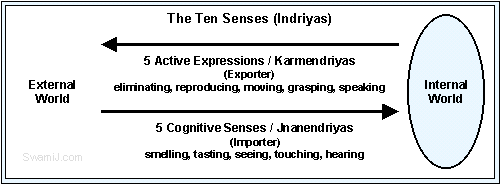
From vikshepa arises the unmanifest, subconscious, and from that springs forth the grosser assertion of the manifest - the world of the five elements. The interplay of the elements produces the names and forms, including the senses of knowledge ( ज्ञानेन्द्रियाः/jnaanendriyaH) and the senses of action (कर्मेन्द्रियाः /karmendriyaH), which together constitute the helpless 'traveller of this sea of life', the  संसारिन् /samsaarin. By mistaking/misinterpreting our experience gained through action we build a world around us, separate from The Truth.

With this, we have the 'fall of man'. From being the Eternal, Immortal, All-full Pure Consciousness (नित्य-शुद्ध-मुक्त परमात्मन् /nitya-suddha-mukta paramaatman), due to the play of Maya and like Somadatta's father, we too have come to feel our limitation and live in our unbuilt huts with our unmarried wives and unborn sons.


Vedanta is not a pessimistic philosophy to leave its conclusion with a mere theory of fall. This very theory has been devised to explain the non-existent dream-fall so that the faithful may be shown a way to wake up and realise their own true and eternal nature once more; returning to the OM!

...the conclusion of chapter 26 next week...


Matter of Illusion

Hari Om

Each 'Choose-day' we will investigate the process by which we can reassess our activity and interaction with the world of plurality and become more congruent within our personality.

KINDLE LIFE. We continue exploring points raised by HH Pujya Gurudev Swami Chinmayananda-ji in the publication of this name. Remember, you can purchase, (very economically!), the book from  Chinmaya Mission Publications or if you prefer, the Amazon Link. Thus you can read Gurudev's words directly and bring your own voice to the discussion.

(We have been breaking up Chapter 26 of KL, firstly for length, but also for 'digestion'...mananam! It is hoped that you think deeply upon what you read, making notes and finding levels of inspiration. This is saadhana. To review the chapter so far, click the Choose-day label on right panel.)

Gurudev continues within this chapter with a further sub-heading now. RISE AND FALL OF MAN.

If, as said earlier, Consciousness/Awareness is our Real Nature and that evolution is completely fulfilled when we rediscover this state, them we must certainly seek the path by which we can regains this lost status of Perfect Bliss. When one gets lost in a jungle, the surest (if not the easiest) path to return to the familiar grounds is to retrace one's steps.  In order to go back to the pristine glory of our Real Nature, it will be easy for us if we investigate and discover the probable mistakes by which we have tumbled into this dark well of sorrow and finitude.

We, from that state of transcendent glory, from that nature of knowledge-bliss, have fallen to be men… limited, ignorant, sad.  How this seeming 'fall' has taken place is a necessary knowledge so that we may know our path to return to our h'om'e-divine.

Image result for tat tvam asiVedanta does not accept any real 'fall' in man from the Reality.  The Upanishads are never tired of repeating the assertion, "Thou Art that" ( तत्त्वं असि/tattvam asi). Yet, you and I are feeling our separate existence, our weakness and limitations. Minute by minute we only know the phenomenal world as we experience it. Vedanta asserts that this seeming world of sense objects is not real.  This is only a finite appearance.  It can be ended.

The world is seemingly real to us just as the snake is real to the deluded where only there is rope. The ghost is real to the frightened only for as long as it is not recognised as a post. Mirage can never be; even when we 'see' the mirage, desert alone is the reality in it.

Thus the eternal sat-chit-aananda alone is.

The world and the egocentric ideas of our separate existence are only superimposition upon the Truth. They are all false.  The plurality is a sad delusion. The One alone is Real and True.

This is how we are today, ignorant of the Real; we are in अविद्या/avidyaa (without knowledge). How does this delusion arise? This ought to be the natural question now in our minds.  An attempt to explain this stumbling doubt in the minds of the seekers has been made in vedanta, by the introduction of the term माया/maayaa.  It is defined as an inexplicable power of the Supreme, which is in That, as inseparable as heat from fire. Just as we cannot have fire as a thing of itself after removing heat from it, nor can heat have any existence if the fire element is removed from it then so, too, Maya is a power inherenet in the Supreme. Fire is heat, heat is fire.

It is possible that, when we have only a superficial understanding of this term, we entertain a growing suspicion that it is a tricky word introduced by the vedantins in their माया-वाद/maayaa-vaada, theory of illusion, to veil the main issues of a pointed question and to confuse the questioner with a mysterious nothing. Such misunderstanding can only arise out of our own ignorance of the language; for in Sanskrit, the word Maya in its etymological meaning stands for 'That which is not' (या मा सा माया/yaa maa saa, maayaa).  Our doubts and suspicions need not have any play at all.

The famous story of the boy Somadatta's father in vedanta is often quoted to explain the Maya in us, deluding us with our own active cooperation and sympathy…

...this example will be examined next Choose-day…

SAADHANA.

Ponder the nature of illusion. We often hear the term 'smoke and mirrors' where the doings of the political and corporate worlds are concerned. Stretch that concept now to the whole of creation. Consider the possibilities for the freeing of the spirit when all illusion is exploded!