ADVENTURES IN ADVAITA VEDANTA...

Adventures in Advaita Vedanta, the philosophy and science of spirit. We are one you and I; are you curious why?..


Showing posts with label Godesses. Show all posts

Praise The Mother


Hari OM
Sounds-day is for listening/viewing devotional items from and for all ages and traditions.


Sweet bhajan to the feminine principle.


Bhajan of Mata-ji

Hari Om

Sounds-day brings another song in praise of the Goddess


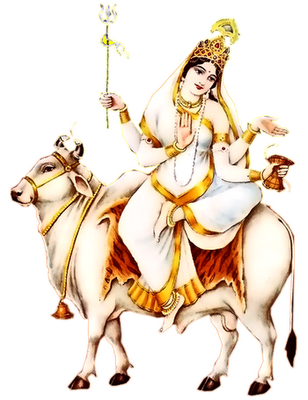
Siddhidatri

Hari Om

CLICK HERE for the post about the ninth avatar of Durga-maa. (Decided to put this in Story-day because, well, it is part of the Great Story of Existence!)


Mahagauri

Hari Om

CLICK HERE for the post about the eighth avatar of Durga-maa.


Kaalratri

Hari Om

CLICK HERE for the post about the seventh avatar of Durga-maa.


Katyayani

Hari Om

CLICK HERE for the post about the sixth avatar of Durga-maa.


Skandamata

Hari Om

CLICK HERE for the post about the fifth avatar of Durga-maa.


Praise of Maa

Hari Om

Sounds-day music of praise today is for the Goddess


Kushmanda

Hari Om

CLICK HERE for the post about the fourth avatar of Durga-maa.


Chandraghanta

Hari Om

CLICK HERE for the post about the third avatar of Durga-maa.


Brahmacharini

Hari Om

CLICK HERE for the post about the second avatar of Durga-maa.


UPDATE


Hari Om

Firstly, very best wishes to those readers who celebrate Navratri or partake Ramleela at this time.

Secondly, apologies for leaving so long a gap without an update. The broken left wrist has been a major inconvenience, not least in hampering the typing. Posting here was simply going to be one challenge too many and might end up with broken spirit also! While the cast has been removed after five weeks, things are sadly a bit slow, so am now heavily splint-strapped. Lighter and comfier but every bit as restrictive. Maintaining basic posts at the personal blog has been managed, however (due to more images than words really).

Thirdly... Wishing to start getting more active here again, you will now see links appearing... During this month, missing the true purpose which comes with producing Aatmavrajanam, it was decided to make a bit of a hybrid of posts there... thus, to read some lighter-hearted items on both Navratri and Ramleela, do please feel free to follow at the "Wild YAM" bloggy for now. On AVblog, you will now find daily links according to posts there and am also going to attempt the weekend posts as they too can be simply cut and paste or linked items. This will be the longest post you will see here for several weeks yet - it has already taken four times as long as it might with two hands!!!

The posts are not going to be strict to date at all and they will not be quite as officially Vedanta as they would be here, as "Wild YAM" readers are totally unfamiliar with these traditions, however, it will at least be fun and may even prove informative. (One major difference on that blog is you will notice the use of the personal pronoun for the writer - what? You've never noticed in all this time that your amma has never referred to herself here in the personal???)

For intro and Shailputri-maa, CLICK HERE.


Be Well Be Happy Be Prosperous!

Hari OM

Sounds-day is for listening/viewing a variety of devotional items from and for all ages and traditions.

This Thursday will be Deepavalli (Diwali), the festival of lights in Hindu homes. Lady Lakshmi is the deity of focus at this time and offerings and praise given in the hope that she will turn her liquid eyes upon the beseecher and bring forth a year of prosperity at all levels.


Om Namah Shivaaya

Hari OM

Story-day is for cultural exploration, puraanas and parables and finding out about leading lights in spiritual philosophy.

Monday is Maha-Shivraatri, the great night of Lord Shiva and His consort Parvati. Recall that last year, for each of February's Story-days, articles were written describing aspects of the Mighty One, He who sees to it that what is no longer required is destroyed, in order that what is new can arise. See the side bar for Sri Shiva label to review these.

India has many festivals, it cannot have escaped notice. Many, though, are local to certain geographical areas, or to specific cultural groups. There are several to which many attend on a larger scale and this is one such. All over India, some form of worship of Lord Shiva will take place.

It can be easy to look upon this deity and forget that the festival is about marriage and not birth, as majority other festivals are generally about. Whilst a significant focus is upon the Lord, Parvati is a strong figure Herself. Other names include Maheshvari (the power of the Lord Shiva), Mahodari (the 'large belly'...holding the universe as mother), Tapasvini (woman of austerities), Vaishnavi (invincible)… there 108 names, as is the tradition of all deities and gurus. Shakti (energy, power, strength) is the essence of this Goddess - that which feeds the creative and destructive forces as embodied by the trinity. Shakti appeared in many forms as the consort to all three aspects of the cycle of creation as represented by Brahma, Vishnu and Shiva.  Without the Goddess principle, the God principle is nothing!

In Her own right, the Goddess took ten 'aspects', or forms. All these ten aspects are jointly known as Dasamahaavidyas and each one of them is a form that She undertook to destroy evil and bless Her worshippers.
   : Kali is the first representation of Goddess Parvati and She was known as the destroyer. She is also known as the Goddess of time.
   : Tara is known as the source from which the universe evolves as She is known to represent the power of the golden embryo. Boundless space or void is the other thing that She is known to represent.
   : Sodasi is the third representation of Goddess Parvati and is known to represent perfection and fullness.
   : The forces of the material world are represented by Vidya Bhuvanevari
   : Desires and temptations that often lead to destruction and death are represented by the fifth form of Goddess Parvati known as Bhairavi.
   : Vidya Chinnamasta is the sixth form of Goddess Parvati and is known to represent the created world in a continuous cycle of creation and destruction.
   : Destroying the world by fire is the seventh form of Goddess Parvati and is known as Dhumavati. After the world is destroyed by fire only the smoke and ashes will remain
   : Vidya Bagala is the eight form of the Goddess and is known to represent cruelty, hatred and jealousy. These are the negative aspects of any individual.
   : The power of domination is represented by the ninth form of Goddess Parvati and is known as Matangi.
   : Vidya Kamala, who is also known as Lakshmi, is said to be the Goddess of fortune.

Thus, in celebration of Masculine, the Feminine as acknowledged fully; two sides of the same coin. Indeed, there is a deity figure (murti) which represents this essential connection. 
The name is अर्धनारीश्वर/Ardhanārīśvara.

Image result for अर्धनारीश्वर, ArdhanārīśvaraImage result for अर्धनारीश्वर, ArdhanārīśvaraImage result for अर्धनारीश्वर, Ardhanārīśvara

Showering Blessings

Hari OM

Sounds-day is for listening/viewing a variety of devotional items from and for all ages and traditions.

Adi Shankara became a monk at a very young age. The story goes that one day, he went begging for his food as was the custom, and arrived at the hut of a very poor Brahmin woman. The woman had no food at home except an Amla fruit (gooseberry), and she gave this to Adi Shankara. He was so overwhelmed by her generosity and so moved by her poverty that he extemporaneously composed and sang the Kanakadhara Stotram in front of the woman's hut.  This prayer instantly invoked the Goddess Mahalakshmi, who rained down a shower of gold for the woman. Each piece of gold was shaped like a gooseberry.


Image result for om

All-conquering Ones

Hari Om

'Freedays' are the 'gather our thoughts' days; Q&As; a general review of the week so far…

Image result for vijayadashami 2015Yesterday was actually Vijayadashamai, the 10th day of celebration of Navratri. The preceding nine nights had been about celebrating the Goddess in her various forms from birth to crone-hood. This 10th day, however, is technically separate but is a celebration of the Goddess in her full from of Durga as she slays the demon Mahishasur.

However, the day is shared with another victory of good over evil in the form of Sri Rama and his defeat of the rogue king Raavana. The day is then referred to as Dussehra.

Image result for vijayadashami 2015

Of course, the 'evil' represents all the negative tendencies we have within us and the message is that by adhering to the principles demonstrated by Durga or Rama, we can overcome our inner 'demons'.

This is the wish is carried in greetings of this day and wishes for a strongly spiritual year to follow.


Honour Her

Hari OM

Sounds-day is for listening/viewing a variety of devotional items from and for all ages and traditions.

Image result for navratri

Continuing to sing with devotion to the Mother in Her many forms. She is the strength (shakti) to keep the universe and its contents cohesive. This delightful bhajan clip does have English subtitles.

Hail to Mother of The Nine Nights

Hari OM

Sounds-day is for listening/viewing a variety of devotional items from and for all ages and traditions.


In anticipation of Navraatri... "Oh mother, won't you come and meet, you are my happiness...."

Celebrate Maa

Hari OM

Story-day is for cultural exploration, puraanas and parables and finding out about leading lights in spiritual philosophy.

Starting this Tuesday is Navraatri; the nine nights in celebration of the Goddess/feminine aspect and on the tenth day is Vijaydashami - the day of victory. Last year the basics of Navraatri were given here. What was not mentioned was the colour-coordination. This is, after all, the female we are discussing!!! Each day of the festival, ladies will wear new saris according to the ordained colour for that day's puja. They are -

Shailaputri - red
Brahmacharini - royal blue
Chandraghanta - yellow
Kushmanda - green
Skandamaata - grey
Kaatyayani - orange
Kaalratri - white
Mahagauri - pink
Siddhadatri - sky blue 

There are some variations in the order of the colours which may pertain to region or annual cycle… and occasionally, groups of ladies will make their own arrangements on colour, not necessarily tied to the traditional. On Vijayadashami, the tenth day, any (and all!) colours are worn.

The key thing is to show solidarity and sisterhood and acknowledging that all women go through the nine stages as represented by the faces of the Goddess. The first three manifestations are faces of Sri Lakshmi, mother of wealth and growth; the next three are of Sri Durga, the active, reproducing female who must also be prepared to defend as well as care for her family;  the final three are Sri Saraswati, the patron of peace, skills and wisdom.

Mother Durga is also celebrated on Vijayadashami for her victory over a demon who had been distracting her devotees (ego); implied in that celebration is also the power of service provided by Sri Lakshmi and the input of knowledge provided by Saraswati-ji.  Many educational institutions around India hold a special puja on this day to have the text books of the students blessed.


 Image result for navratri

Tri-gunaaH - Melting Pot

Hari Om

Each 'Choose-day' we will investigate the process by which we can reassess our activity and interaction with the world of plurality and become more congruent within our personality.

KINDLE LIFE. We continue exploring points raised by HH Pujya Gurudev Swami Chinmayananda-ji in the publication of this name. Remember, you can purchase, (very economically!), the book from  Chinmaya Mission Publications or if you prefer, the Amazon Link. Thus you can read Gurudev's words directly and bring your own voice to the discussion.

(We have been breaking up Chapter 26 of KL, firstly for length, but also for 'digestion'...mananam! It is hoped that you think deeply upon what you read, making notes and finding levels of inspiration. This is saadhana. To review the chapter so far, click the Choose-day label on right panel.)

"Yaa maa saa maayaa - that which is not, is Maya" was our discussion last week. Now the example of Somadatta's father.

One newly initiated hermit, during a pilgrimage, felt tired and weary as the day was burning hot.  He, seeing a shady spot near the Ganges' bank, took shelter there to rest.  There was a narrow piece of rock upon which he stretched himself, making comfy.  As he was dozing off, at that point just between waking and sleeping, his attention was attracted to two village girls who had come to collect water.  They filled their pots and went quietly away, but the visitors generated a line of thinking in the hermit.

"Why not? Certainly there is no harm.  Supposing I marry one of them, then I shall keep a small house...three rooms at least...and I shall be a very severe and grave husband…working my own fields.  I shall live a happy life of contentment and joy." The fellow goes off to the village and seeks out the girl whom he had favoured from the group. Later, he is well settled and he thinks, "The agrarian life suits me well. The harvest has been good and a little prosperity is ours.  Devi-wife is attentive and a mighty fine cook!"

Then the first born, yes a fat, beautiful son.  "Of course I must name him Somadatta..and we shall all three sleep happily in the bed together...but is there space for my son? Devi, please give some more space for our son, or he may fall out of the bed!"

"Husband, how can I? Move? To where?  You move a bit your side!"

"Alright…"

Splash...gnuh..ghooooooo……… Poor 'Somadatta's father moved a little towards his side and the stone was narrow.  He lost balance and rolled into the waters of the Ganges! Awakened now, the hermit swam out.

Now, think, what made the hermit fall? After his awakening, where should he go to regain his young wife and child? The poor ब्रह्मचारिन्/brahmachaarin (monk/solitary one) created the world of Somadatta in himself and, identifying completely with it, came to live the dream-life as though 'real', thus suffered the fall.

So, too, Pure Eternal Self we all are, The Self, in a dream, has forgotten itself and is now dreaming its own samsaara, filled with Somadattas and Devis and so much more.  WAKE UP! Roll off your stone beds, dip into the cool waters of Ganges (Shruti/scripture) and get awakened fully.  End the undivine dream at one stroke.  The power of Somadatta's father, with which he lived his domestic life and ultimately fell down into the mighty river, is Maya - that which is not, existing in his own mind.

त्रिगुणाः/trigunaaH - three qualities.
Maya is manifested in the world as three distinct गुणाः/gunaaH - eternal qualities. The सत्त्व/sattva (unactivity), the रजस् /rajas (activity) and the तमस् /tamas (inactivity).  All the three qualities are ever in a state of flux, mixing more of one then another. Their proportions vary from individual to individual and the same individual will differ from time to time.

When the Supreme Reality gets reflected in the part of Maya which is predominantly sattvic (सत्त्व गुण प्रधान माया/sattva guna pradhaana maayaa), we get a very distinct and clear reflection of that Supreme; this is the "God" principle.  The reflection is dimmer in the sattva which has mixed with rajas and/or tamas (मलिन सत्त्व माया/malina sattva maayaa)… this becomes the ego-centric जीव/jiiva, individual mortal.  The "God" principle manifests itself around us, in the world outside, as three main accomplishments.  We observe that at every moment, things and beings are created (born) and destroyed (dead) and certainly between these two points of an unknown beginning and an equally uncertain end, we also watch things and beings maintained (living their existence). In order to facilitate the common man to grasp these three powers manifest about him, we have them represented as the Creator (ब्रह्मा/Brahmaa), Sustainer (विष्णु /Vishnu) and Destroyer (शिव/Shiva).

Image result for brahma vishnu shiva trinityTo create a pot, the potter must have pre-knowledge of what (and how) he is going to make; thus the creator must 'know' his creation, prior to the act itself. We have, thus, Brahmaa-ji married to सरस्वती /Sarasvatii, the goddess of learning and knowledge (the feminine side of creation). In order to sustain (maintain), we need the capacity for it, with power and skill - a pauper cannot head and maintain a family.  Thus we have लक्ष्मी/Lakshmii, goddess of wealth and plenty as consort of Vishnu-ji. Further, the act of destruction, the removal of that no longer required, requires that there be something there at first to be destroyed. In this manner then, the partner of Shiva-ji is the goddess उमा/Umaa who is none other than प्रकृति/prakRti - Mother Nature, the manifest world - which represents that even in destruction there is renewal. Even when the Trinity is thus shown to be three distinct, divine 'personalities', it is also shown clearly that they are distinct and separate divine powers.  The Oneness of them is the soulful song of the scriptures, but the subtle song is heard only by the most attentive and most cultured.  In satguru Sri दत्तत्रेय/Dattatreya, the teachers' teacher, we have a synthesis of all the three lords and in goddess दुर्गा/Durgaa, we have the representation of a total synthesis of the three consorts.
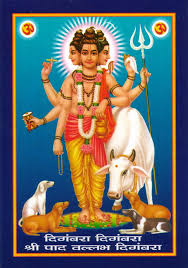
 Image result for dattatreya                                                  

SAADHANA

Consider the play of Maya in existence. Ponder the elegance of the naming of the powers, those very processes which modern science is still trying so hard to explain.