ADVENTURES IN ADVAITA VEDANTA...

Adventures in Advaita Vedanta, the philosophy and science of spirit. We are one you and I; are you curious why?..


Showing posts with label Karma. Show all posts

K v. P... What's It To Be? Pt 2


Hari OM

Story-day is for cultural exploration, puraanas and parables and finding out about leading lights in spiritual philosophy.

Last week we read the first half of a discussion by Gurudev on the matter of Karma versus Prarabdha. Today, the conclusion.

The mind is made up of a soft matter, as it were. As each thought passes through it, an ‘impression’ is left, on the mind-stuff like a scratch and when similar thoughts are repeated, it deepens into a canal. Every subsequent thought wave has got a tendency to flow through that ready-made thought-canal. Thus, if the impression or the canal made is of good thought-waves, then a good character is maintained and strengthened by the subsequent thought-waves flowing irresistibly in that direction.

Let us take an example and examine the working of the mind. If you have got a tendency to get angry and want to nut out that tendency you should first of all feel sorrowful or repentant about it. Then you will have already suppressed the anger to some extent. Of course, pent-up anger will burst forth at a later date if you merely suppress it. But, if you be intelligent, you should divert that anger-energy into some other profitable direction. You should not succumb to the anger-weakness, meekly saying, “It is my Prarabdha.”

Carve out a new canal in your mind with repeated good thought-waves. Repeat to yourself, ‘I love all - I am very, very tolerant.’ Go on repeating the self-suggestive thoughts, ‘I am kind, I will never get angry, I am tolerant,’ etc., and in a very short time, you will observe that you have no anger at all in your mental make-up. First of all, you should cognise things. Be aware of your weakness. Be fully aware of them. Man is his mind. He is the very composition of his mind. When one performs some actions, repeatedly, one’s mind gets fixed with certain impressions. It is in a world of reactions related to the outer world-of-objects that we live. The quality of one’s experiences depends upon the quality of the mind which one brings up to undergo the experience. The mind, being what it is, is ordered and set by the various impressions, it has gathered in its different transactions in Life. Thus, when we control and chasten the motives and thoughts in the mind, we purify it. Each moment of our life, we are not only living the fruits of past actions but also creating those for tomorrow. Each moment we are preparing ourselves for the lives yet to come. Prarabdha is caused by the actions done in the past. It is only the very self-effort of the past. So, if our Prarabdha be a sorrowful one now, let us do such acts today so that we can now determine or order a happier life for us in the future.

The Law of Destiny does not explain to us how, even while we live the preordained and Prarabdha-controlled pattern of circumstances, we can have in the immediate moments, a freedom to create afresh. This idea is not explained in the Law of Destiny. So it shatters our morale, and a soul-killing defeatist mentality comes to choke us. It takes away the fire, the enthusiasm, the grit in Man and makes him a dull, inactive individual, a mere dumb animal.

A happier morrow is built up only when we live today a Life Divine. Religion has been asking us to entertain and live such values of life so that while living them, we shall be creating an ordered life of fuller joys for the morrow. Not only in this life but also in the next life we shall be able to enjoy the fruits of our Divine actions. Use the main righteous path; avoid the by-lanes, the narrow, thorny, unrighteous path. We must start and constantly keep on to the right path, to reach the Supreme, our Goal. If our course is in the right direction, then we shall certainly reach in time, our destination, the Supreme.

Yet another way of looking at it and coming to the same conclusion is by reviewing life in the light of Time-flow, wherein the future, through the present, is ever becoming the past. Anything that is now in the future must in time arrive to become the presentand erelong should pass on to be the past.

We have already said that human intellect cannot rest without seeking the cause of things. This causation-hunting-urge in us is not generally investigated seriously and thoroughly. If we do so, we shall discover certain facts in it which shall reveal to us the inner meaning and the deeper significances of the Law of Karma.

From the seed the tree comes: the seed is the cause, and the tree is the effect. From cotton, the cloth is made: cotton is the cause, and cloth is the effect. Now, in all conceivable examples the cause is, like the father of a child, anterior, and the effect, like the child born, posterior, with reference to time: father was in existence before the son was born. Cause is thus that which was, and the effect is that which is. The past causes the present; the present will, therefore, cause the future!
In short, it is said that the future is not a mysteryan unknown miracle that man must wait for its stunning revelations. The past modified in the present alone is the future. The things to come are not ordered by a mere continuity of the past it can never be. This freedom to modify the past, and thereby create a future, for the better or worse, is Purushaartha: self-effort.

To illustrate: if down a river, running at 2 miles an hour, a log is floating, then it will also move at the same speed at which the river flows. But supposing, the log is fitted with a motor and manned by an intelligent driver; the log will have an independent movement of itselfno doubt, conditioned by the flow of the river. When the speedometer shows 10 miles an hour, the log will move 12 miles in an hour down the river, and only 8 miles an hour, if it is moving upstream. The flow of the river will always be there; but due to the machine and the intelligence of the driver, the log has developed a limited freedom of movement now. Similarly, the plant and the animal kingdoms move, directed and guided by their natural instincts and mere impulses. But on reaching the human level, man acquires his reasoning capacity and is a captain in his discriminative faculty. Using these two, he can steer the ship of his life safely to his destinationthe Goal, the Ideal.

Viewed carefully, the present in itself has no existence; it is a mingling of the past and the future…the passage of the future to the past is the present. The living present is at once the tomb of the past and the womb of the future. This tomb-womb present has roots going deep into the past and branches spreading around everywhere into the future. To consider, therefore, that the present is but a product of the past is undignified. To think that the future is but a product of the present is unintelligent. There is no slavery; nor is there full freedom. There is limited freedom, which, if intelligently used, can redeem us from all entanglements.

Thus, the Law of Karma, when correctly understood, is the greatest force of vitality in Indian philosophy. It makes us the architects of our own future. We are not helpless pawns in the hands of a mighty tyrant - God - who, it is believed, has created us weak, and fearful to lead our lives of limitations and pains. If we are weak or sorrowful, it is all because of our own willful actions. In our ignorance, we in the past had pursued certain negative values of life, and their fruits have come up now to give us the pattern of circumstances we are living today.

Never mind. Take heart. By living rightly today, the Divine values of love, kindness, tolerance, mercy, etc., we shall order a nobler pattern for our future. By careful self-policing, detect the wrong tendencies in us. Eliminate them through constant and willful effort. Develop Positivity and thus come to be the God of your own future life. Be a GOD!


TODAY WE MARK THE MAHASAMADHI OF 
HH PARAMAPUJYA GURUDEV SWAMI CHINMAYANDA-JI
HIS PRESENCE IS EVER WITH US!
ॐ  श्री  गुरुनात  महराजकि जै !!!

K v. P... What's It To Be? Pt 1


Hari OM

Story-day is for cultural exploration, puraanas and parables and finding out about leading lights in spiritual philosophy.

The first half of a lengthy piece is given today. Gurudev's words are always filled with colour and insights - sometimes so blindingly clear, we wonder how we missed the point ourselves!

The Law of Karma has been often misunderstood as the Law of Destiny. There is indeed a lot of difference between the Law of Karma and the Law of Destiny. Had our Law of Karma been equal to the Law of Destiny, the Hindu civilisation would have been long ago ended like the Roman or the Egyptian civilisation. The Law of Destiny has a corroding effect upon the human heart, and in a short time, it renders its followers to be mere ineffectual lotus-eaters. If a nation depends entirely upon the Law of Destiny to guide it, it shall fall and become a country of narrow-minded, inactive animals.

On the other hand, a people believing in the Law of Karma and who live up to it, become a generation of spiritual giants and dynamic citizens. The Law of Karma is based upon the final conclusion that this life is not an end in itself but is just one of the little incidents in the Eternal Existence of each of us. Among us, each one is a type and has a life different from the other. The destiny of one is obviously different from that of the other. Had this been the very first and the last of our births; we should have had a more uniform experience in life.

Let us suppose that we have just ‘fallen’ from Truth or Reality into this momentous and calamitous misunderstanding, then we should not have such a dissimilar scheme, of each Ego living its own life of unique joys and woes. When we enquire, with the causes of great differences among human beings we are driven to the conclusion that having risen from different ’causes’, each of us should manifest as a different ‘effect.’ Effects depend upon their causes. This life in which we are living is only one of our incarnations. We have had many incarnations in the past, and probably, many more shall come to our lot. From birth to death and from death to birth, the whirl goes on, but we do not appreciate it or understand it because we are viewing life from a very circumscribed point of view.

We think that life means the period spent by us between our birth and our death, and what we see and experience around during this interval is life. Supposing there hangs a picture painted on a canvas. To see the entire picture painted on it, we have to step back to some distance, and only then can we see the whole view, the rhythm of the colours, the beauty of the curves, etc. Similarly, when Life is viewed, in its nearer perspective, we find that it is illogical, unrhythmic, etc. In detachment, we will have to move away from our present Life to view the whole Life and understand it as such.

Some of us blame the Creator for our unfortunate lives, and despair by saying ‘it is all our FATE.’ You should understand that there is a Rhythm in the Universe, in that the planets ‘move’ regularly, the stars ‘ride their appointed paths, etc. Everywhere there is the Law of Rhythm, and everything conforms to that Law. Only when we come to the subject of Life, we say “there is no Rhythm and there is no logic or system in it.”

It is not so. We are the various ‘effects’ rising from different ’causes.’ The ’causes’ being different, the ‘effects’ are different. Thus, each of our actions of the past has its own reactions, and each of us must have a treasure-house of the entire-past-actions. This is called the Sanchita Karma. We all should understand that at the end of living, the ‘fruits’ allotted for the life are called Prarabdha; on departing, each should take the next form according to the pattern ordained by the ripened ones in our total Sanchita Karma.

Let me explain it more clearly. Suppose I have a piece of land divided into plots. In one, I plant coconut seedlings, in the second seeds of lady’s-finger and in the third, mango seeds. In order to germinate, grow and yield fruit, each seed would take its own time. This is very well known to us. Similarly, each of our actions has got its own time limit for its fruition. Every action has got its own reaction; certain actions give their reactions immediately, while others will provide their reactions only after an interval. To enjoy and suffer the reactions of the past actions, each of us needs certain joys and sorrows, and in order to bring forth these required experiences, each must have a definite ‘field’ of his own experiences. The word Loka does not merely indicate its generally accepted meaning: 'the world'. Loka means the special world in which I live my own inner experiences, the external world-of-objects remaining almost the same for all. Loka etymologically means a field of experience.

Again, people misunderstand the real meaning of Prarabdha when they take the word to mean all the failure, impotence and weakness in them. If we are to be guided by this delusion, the Prarabdha, in every act of ours, there is no room for self-improvement through self-effort (purushaartha). There are some who console themselves by saying that, ‘I have no faith or love in God, and it is my ‘Prarabdha.’ This is a defeatist mentality. So far as we entertain and live in a defeatist mentality, we cannot expect any progress. Without personal morale, we cannot work for our progress.

From where does this Purushartha come in if Prarabdha orders every action? That we have been given by the Divine Being a limited freedom is the truth. For example, we cannot bend a piece of rail as it is but supposing this rail-piece is beaten out and made into a chain, the rail-matter becomes very easily pliable. Similarly, when a cow is tied to a rope in the centre of pasture land, she is not free to graze the entire field but she can move freely within that circle drawn by that rope. Again, Man, though he has taken his body to live a fixed Prarabdha can reach the Supreme Goal of life by living the freedom allowed to him from moment to moment.

No doubt, we have come here into this world to enjoy and suffer for certain of our past Karmas, through the circumstances ordered by our Prarabdha, and there is provision for us to discriminate and act rightly. For example, is there not a certain amount of freedom in choosing whether we should go to a cinema or a Satsang? Every moment in our life there is a challenge posed by these lines: ‘Shall I do this or shall I do that.’ There are two ways to deal with each challenge. Two distinct paths are open to us the Path of the Good (shreyas) and the Path of the Pleasant (preyas). We find ourselves from moment to moment, standing at the junction of these two paths. Often we are at a loss to decide which route to pursue. There is a tussle between Satan and God in us at such a moment of trial. By adopting the Path of the Pleasant, man cannot get, in the long run, his full satisfaction. This is the experience of all. One who has adopted the path of the Good gains peace of mind. Slowly, the former, under the impact of repeated disappointments, will come to think that he should go through the Path of the Good.

...tbc...

Acting Out

Hari OM
'Text-days' are for delving into the words and theory of Advaita Vedanta.

For our final "Textday" post of 2018, which has of late been about revision, you are pointed to the post, 'Actions Speak Loud'. Vedanta is a highly intellectual pursuit, but its purpose is to serve in daily, practical life.


Think, Act, Watch

Hari Om
Each 'Choose-day' we will investigate the process by which we can reassess our activity and interaction with the world of plurality and become more congruent within our personality.

Guru-ji, Swami Tejomayananda, now points out that as action is the result of an initial thought, it is up to us to choose the thoughts which will bring improved results.

We all face various problems in life. At the individual level, there may be problems related to health, emotions, relationships, marriage, children and career. At the national level, there are problems of poverty, unemployment, social unrest, illiteracy and corruption. These often bring us sorrow and pain. Yet, if we analyse them honestly we will find that their root cause is almost entirely a lack of proper thinking and acting.

Wrong thoughts lead to a defective vision of the world and a chaotic relationship with it. As a result, we have false expectations and disappointments at every step. If we can only improve our thinking, we can mend our homes and make the world a better place to live in. But many choose to suffer rather than to think. They get caught up in the mesh of wrong thinking, often coloured by prejudices and narrow-mindedness.

The solution: Think Big, Act Wisely, Show results!

Youth need right thinking, leading to a clear vision of life. We should remove all the barriers of pettiness and think big! Big things are achieved in the world, first by daring to conceive them in our mind.  Man dared to think that he could fly like a bird and the first flying machine was invented. He dared to think that he could reach the moon, and lo! Man landed there! Nothing is impossible for the one who thinks big. Our thoughts alone bind us and make us small, and thought alone can free us. Break this bondage of narrow, limiting thought and think big!

This means not only to think as an individual but as a nation as well. Think what will be beneficial to the nation, what will bring about the national good. When Swami Chinmayananda learnt the scriptures from his teacher, he thought about how he could pass on the knowledge to all people. This is called “Thinking Big.” Swami Vivekananda used to spend restless nights in America thinking of the welfare of India and the world.

After “Thinking Big” through proper vision, one should then strive hard to act wisely. As Pujya Gurudev said, ‘plan out your work, and work out your plan.” To act wisely is to act with proper understanding and good attitude. This is presented in the famous Serenity Prayer by Reinhold Niebuhr: “God grant me the serenity to accept the things I cannot change, courage to change the things I can, and the wisdom to know the difference.”

For example, Sri Rama knew which situation to accept as it was and which to take action against. Without complaint or mental agitation, he accepted his exile in the forest for fourteen years as the call of Dharma; but when Sitaji, his wife was kidnapped by the wicked king, Ravana, Rama put forth the effort to collect an army and attack Ravana in order to get her back.

Keeping the head calm and balanced, one should act efficiently to show results. Let the results be seen in the transformation of our personality. We should strive to become better human beings. Our purity, efficiency and wisdom should steadily grow. The result of our work should also be seen in our environment. The team of people with whom we work should become integrated and happy. The work should lead to harmony, beauty, and prosperity in the society.

Let us use all available opportunities to harness our inner potential, to learn to overcome all barriers in our thinking. Use opportunities to learn the secret of right action. Finally, get inspired and achieve greatness in the world within and without.


Karma In A Nutshell

Hari OM
Story-day is for cultural exploration, puraanas and parables and finding out about leading lights in spiritual philosophy.

If there is no God, are we not wasting our time trying to be good? Again, if there is a God He must be far too good natured to want to punish us if we act wrongly. So either way it hardly matters how we act. We might as well have our cake and eat it too! This is the argument projected in seeking complete freedom in morality. The busy man of the world has perhaps forgotten that it is not because there is a God above who is too mean to allow us to get away with all our bad deeds, but perhaps he is too good not to give us what we demanded, and that we get “rewarded” or “punished”, or get conducive or non-conducive results by the very fact of our choosing to act in a particular way. It is within a certain freedom that we carve out our own future.

SWAMI CHINMAYANANDA here explains very clearly the Law of Karma which is so much misunderstood by some.

“Each moment of our life, we are not only living the fruits of the past actions, but also creating those of tomorrow. Each of our actions has got its own time-limit for its fruition. Every action has got its own reaction; certain actions give their reaction immediately while others will provide their reactions only after interval. The Law of Karma is based upon the final conclusion that this life is not an end in itself but is just one of the little incidents in the Eternal Existence of each of us. Let us suppose that we have just “fallen” from truth or Reality into this momentous and calamitous misunderstanding, then we should not have such a dissimilar scheme, of each Ego living its own life of special joys and woes. When we enquire why there are such differences, we are driven to the conclusion that, having risen from different “causes”, each of us should manifest as a different “effect”. Effects depend upon their causes. This life in which we are living is only one of our incarnations, the result of our past actions, but we do not appreciate it or understand it because we are viewing life from a very circumscribed point of view.

Now, from where does purushaartha (self-determination) come in if praarabdha (destiny) orders every action? That we have been given by the Divine Being a limited freedom is the truth. For example we cannot bend a piece of rail as it is, but supposing this rail-piece is beaten out and made into a chair, the rail matter becomes very easily pliable. Similarly, man, though he has taken his body to live a fixed praarabdha, can reach the Supreme Goal of life by living the freedom allowed to him from moment to moment. There is provision for us to discriminate and act rightly. For example, is there not a certain amount of freedom in choosing whether we should go to a cinema or a satsang? There are two ways to deal with each challenge. Two distinct paths are open to us. The path of the Good and the path of the Pleasant. Often we are at a loss to decide which path to pursue. There is a tussle between Satan and God within us at such a moment of trial.

Man is his mind. When one does some actions, repeatedly, one’s mind gets fixed with certain impressions. It is in a world of reactions related to the outer world-of-objects that we live. The quality of one’s experiences depends upon the quality of the mind which one brings up to undergo the experience.

The future is not a mystery, an unknown miracle that man must wait for its stunning revelations. The past modified in the present alone is the future. The freedom to modify the past with action in the present, and thereby create a future for the better or for the worse, is purushaartha: self-effort. Thus, the Law of Karma when correctly understood is the greatest force of vitality in our philosophy. It makes us the architects of our own future. We are not helpless pawns in the hands of a mighty tyrant, God, who, it is believed, has created us so weak or fearful to live of our lives of limitations and pains. If we are weak or sorrowful it is because of our own willful actions. In our, ignorance, we in the past had pursued certain negative values of life, and like a Frankenstein, their fruits have come up now to give us the pattern of circumstances we are living today.

Never mind. Take heart. By careful, self-policing, detect the wrong tendencies. Eliminate them through constant and willful effort. Develop positivity and thus come to be the God of your own future life. “Be a God I”.


The Prompt

Hari OM
'Text-days' are for delving into the words and theory of Advaita Vedanta.

On Wings and Wheels is the publication we are delving into currently. It takes the form of a series of Q&As from devotees to HH Pujya Gurudev Swami Chinmayananda. There are many sections and subsections to this book - not all will be given, but it is hoped that the general thought-flow will not be broken for those omissions. To obtain the full picture and essence of the discussions, do consider attempting to purchase the text from the link above; it is currently only available from India.

MOTIVATION (and karma phala data - the dispensing of the fruits of actions)

Q - Don't motives count in the ethical worth of an action, swami-ji?
A - Yes! For example, a surgeon uses a knife in the operation theater to save a patient's life and, even should the patient die, it cannot be called a sin; whereas the act of killing somebody with that same knife for personal gain is decidedly sinful. The merit depends upon the motive of the act.

Q - If an action is to be judged good or bad by its motive, which of the several complex motives involved in any one action are to be taken as the main standard of judgement?
A - There can only be one motive; its branches will be the other motives, but they remain branches… there can be only one motive.

Q - but when I give to charity I can have several motives in giving…
A - having motive is not then charity!

Q - no?
A - giving money or signing a cheque is not charity.

Q - Let's say the act of giving money may have several motives…
A - Yes, according to the motive, it will may be charity or something else.

Q - I may feel kindness toward another and give money, but at the same time I know that people are watching me and at the back of my mind I feel I will get some applause. On the other hand, I may be getting some income-tax relief, or maybe I want to balance out some guilt from an earlier error… so there are several motives involved in giving away the money.
A - Then it will be the cumulative or the average of all motives that will decide the result of it. So many factors go into the determination of the final result of an action. Thus, when you do an action and surrender to the Higher, the judgement of the moral worth is also surrendered and the results will come back to you as you meet life.

Q - Should the totality of motives be accounted for?
A - the totality must play into it, but then for your practical purposes you should only think in terms of 'how far am I?' By giving this is one trying to gain joy and a sense of fulfilment and satisfaction, or is it going to disturb? Suppose the main motive was only the applause which might be gained, then ultimately the action will only leave you with a sense of disappointment. It is then not a morally good one. It is not charity. You with that amount are showing off and this way are trying to purchase something to further your vanity.

Q - That means the result of action is directly related to the totality of motive…
A - Yes, naturally. That is why every action, even in secular law, is calculated by means of the motive behind it

Q - an action may be prompted by dual or complex motives, some may be lofty others of base quality; like money given to relieve suffering but also to receive recognition. If the action is to be judged by this totality of motives, then no action is absolutely good or absolutely bad, it will be more a matter or predominance of one or the other, is it not?
A - Yes that is true. Really speaking, an action itself is neither good nor bad, whether absolute or relative. Action itself is of the relative world, not the Absolute… it is a relative manifestation of Reality, a delusion…

The conversation will continue, looking at means… note that Gurudev stated there can be only a one motive which initiates an action, and although the discussion seems to have now turned to the plurality behind motive, it is to be noted that at any given point of an action being undertaken, at that point a single motive alone is the catalyst, no matter how that motive is built. The discussion is looking at what builds up to the motive and demonstrates that we are adept at sidestepping our true reasons for action and that none are completely pure in their intention… it is all a matter of degrees.


Do Without Desire

Hari OM
Application - that is what 'Workings-days' are about!
The Narada Bhakti Sutra is our guide for a while… the nature of Love (with the capital 'ell') and a full exploration of it. As always, you are encouraged to seek out the full text from Chinmaya Publications (links in side-bar); but for those who prefer e-readers, this version is recommended. Whilst awareness and interest can be raised by these posts on AV-blog, they cannot substitute for a thorough reading and contemplation...and practice!
 
Chapter Six, Section Two - Obstacles to Practice.

Na t iTsÏaE laekVyvharae hey> ik<tu )lTyag> tTsaxn< c kayRmev.62.
Na tat-siddhau lokavya-vahaaro heyaH kimtu phala-tyaagaH cha kaaryam-eva ||62||
For as long as (Bhakti) is not yet attained, worldly activity must not be abandoned; but at the same time that (Bhakti) must be diligently pursued by the renunciation of the gain (phala = 'fruit') from such activities.

This sutra refers to the advice of the Bhagavad Gita that, for the majority of us, the highest spiritual goal is to be worked for and in order to do that we can utilise our daily work and tasks to the purpose. To do this, we must not anticipate more from the actions than they deserve. Fine, yes, we must earn a wage, but the 'fruit' being referred to here is the more subtle stuff which goes with our actions… expectations of certain outcomes, of praises, of kudos and so on. All these are of the ego and thus the ego must be extracted from our activity and, further, the activity dedicated to the Lord.

There are duties associated with life which must be attended and here the Guru is saying, do not ignore these as you seek the Higher, but rather, transform them into 'sacrifices at the altar', as it were. To leave one's work or family or responsibilities, declaring the abandonment as being for 'spiritual reasons', is rarely a valid thing! All too often it is escapism and not wishing to face up to the responsibilities of life.

Nothing at all need be given up in order to live spiritually! Indeed, it must not. The Omniscient One knows exactly what 'tempering' is required for each individual and living life is the 'pan' in which that tempering takes place. Within each life, opportunities and situations are presented in which we can 'burn' our vaasanas, or be challenged to see if we commit the same mistakes again or have learned enough to move into a higher plane. To protest and complain about our lives is to miss the point of it completely. We have exactly the life we have earned.

No matter if our karmic balance has resulted in our birth into happy circumstances or dismal depths, if we have brought with us sufficient spiritual skill, we will know that we must make the most of what we have and seek to better the situation. The true devotee makes no complaint, neither becomes complacent - the bhakta, regardless of being born to wealth or poverty, will seek to surrender all thoughts and deeds to the Higher and to rise out of the physical life altogether, reuniting with Self Supreme. Even those with excess material wealth cannot be truly happy if they do not have a purpose and meaning beyond the material. Those born to poverty who have the bhakta's heart, will know that the opportunity to rise comes from tweaking the mental attitude to one of service and gratitude without angst or complaint. No matter where we find ourselves, a constant awareness of the Lord and a desire to not be separate from Him is what will drive our days and bring a lightness of being into everything we do. In this condition, we minimise worries and maximise contentment.

The implication of this sutra, though, is that even those who are at the stage of renunciation of the world and who have truly purified themselves, for as long as they live in physical form, ought not necessarily to withdraw from the world. They can still offer much to their families, their community or their nation. Continuing to work in the world keeps the ego - that wily monster - from rising again. Remember, there can even be ego of "I am spiritual"!  For as long as the "I" remains, we must remain in action in order to tame it. At this higher level of bhakti though, we may be able to truly apply "phala-tyaga", a separation from desire for rewards from our deeds. Such a one is no longer affected by glory and praise or criticism and condemnation.

Life becomes saadhana; daily practice of offering all to the Higher. Never for a moment think that the goal, having been reached, means that spiritual practices can be dropped. For as long as one is in the world, that self-same world, that mischevious Maya, can reach out and grab you back. Spiritual discipline is akin to that of mountain climbing. One slip can be fatal.

By maintaining discipline and practice, by acting without ego in the world, one becomes an example for others. Even if they are not aware of one's practices and beliefs, the lightness of Being will shine forth and it will be wondered "what do they have that we do not?"


The Master's Voice

Hari OM

Story-day is for cultural exploration, puraanas and parables and finding out about leading lights in spiritual philosophy.

A Gurudev video again today - centenary celebrations are nearly upon us, so this is to honour the Guru, but also, the lesson is given in parable form and is joyous.


It Is Wisdom To Honour Wisdom!

Hari OM

'Text-days' are for delving into the words and theory of Advaita Vedanta.

TATTVABODHAH.
[You are reminded that reviewing the previous week's posts will become essential as the meanings of the Sanskrit terms may not be repeated. There may come additional or alternative meanings, but all should be noted. As study progresses, the technical terms must necessarily become 'second nature' to the student. When the Sanskrit is used, the translation will fall easily into place - or likewise, if the English is used, the Sanskrit term must easily come forwards.]

Please revisit THIS post and chant the mangala-charana. Please use the TattvabodhaH label to access all posts relevant to this text.

The question was asked, 'what happens to the results of actions (aagaami) of a Realised Master if there are no longer added to his karma account?'
(NB the vid-clip has chanting from last week also.)


किञ्च ये ज्ञानिनं स्तुवन्ति भजन्ति अर्चयन्ति तान्प्रति
ज्ञानिकृतं आगामि पुण्यं गच्छति।
ये ज्ञानिनं निन्दन्ति द्विषन्ति दुःखप्रदानं कुर्वन्ति
तान्प्रति ज्ञानिकृतं सर्वमागामि क्रियमाणं यद्वाच्यं
कर पापात्मकं तद् गच्छति। सुहृदःपुण्यकृत्यं
दुर्हृदः पापकृत्यं गृह्णान्ति
ki~nca ye GYaaninaM stuvanti bhajanti arcayanti taanprati
GYaanikR^itaM aagaami puNyaM gacchhati.
ye GYaaninaM nindanti dviSanti duHkhapradaanaM kurvanti
taanprati GYaanikR^itaM sarvamaagaami kriyamaaNaM yadvaacyaM
kara paaapaatmakaM tad gacchhati. suhR^idaHpuNyakR^ityaM
durhR^idaH paapakR^ityaM gR^ihNaanti

"Further, to those who praise, serve and worship the wise man, go the results of the good actions done by that wise man. To those who criticise, hate or cause pain to the wise man go the results of all unpraiseworthy and sinful actions done by the wise."

When the mahatma finally departs the body, the accrued merits and demerits of his (or her) actions fall to their devotees and their decriers accordingly. Wait, what is this?! The good we can accept and, perhaps understand - but bad? How can bad deeds be done by a sacred person?

Truly, the wise one, as has been stated, is no longer attached to any actions and makes not judgement upon them themselves. The 'good or bad' is relative only to the world as perceived in our current state of duality. In the fullness of Vedanta, no actions took place at all (just as all that you performed in your dream last night fell away the minute you awoke). However, those left behind in 'the dream' must still deal with what they currently believe to be real and therefore this is said (by shruti) in order to appease the enquiring minds wondering about the aagaami.

For we poor wretches who have not come near to the magnificent Realisation of Self, knowing that if we are in the orbit of a mahatma, how we are with that person will have a direct effect upon our own karma; for now we are presented with the potential to better our lot simply by being in his gaze and showing devotion… or we can worsen our lot by behaving negatively towards that personage.

Remember that Vedanta is universal. A Mahatma, as defined by this philosophy, can be present in all parts of the world and in all guises. Anyone who has understood the folly of mankind, yet who retains compassion for their fellow beings; anyone who has clear understanding of their scriptures, beyond the dogma and by appropriate application of 'lakshyaartha' (ie, not simply following word value but looking for the implied meaning); anyone who knows that God is to be attained from within…

It is an interesting dynamic, when one looks into the face of Truth. Even if one is far from achieving the Reality of That Truth for oneself, to fall under the gaze of one who has is as profound an experience as any seeker may have. Indeed, as any atheist may have… for our very own Gurudev was a serious doubter of 'guru myth', as he called it. Being a journalist of some note in his late 30's, he set off to attempt a debunking. It was his praarabdha, however, to come into the circle of Swami Sivananda of Divine Life Society. History changed. To revere and serve such a personage is not at all difficult. Gratitude abounds, and no small amount of Love, from the disciple who benefits from all the care and guidance and corrections given.

Not all can recognise or are willing to see the wisdom, however. Some will look at the mahatma only from their own, currently ignorant, standpoint and judge according only to what their own negativities and prejudices are. Others will go with expectations of some kind of benefit or boon and, if they don't get for any reason, will go away and talk badly of the mahatma. Still others, with perverted minds who hate anyone and everyone for one reason or another, will perpetrate evils upon the wise person.

If one is not able to see greatness in the wise man, or able to acknowledge and surrender to him, then don't be near such a one; be elsewhere. Neither call names and aspersions where you fail to understand. For by staying close whilst uttering the name of the mahatma wrongly, a portion of the negative aagaami becomes yours.

In accepting a true teacher into life, however, all the positive aagami will be shared among the disciples.

YAM at Sandeepany Sadhanalaya
Gurudev's murti behind.


The End in Sight

Hari OM

'Text-days' are for delving into the words and theory of Advaita Vedanta.

TATTVABODHAH.
[You are reminded that reviewing the previous week's posts will become essential as the meanings of the Sanskrit terms may not be repeated. There may come additional or alternative meanings, but all should be noted. As study progresses, the technical terms must necessarily become 'second nature' to the student. When the Sanskrit is used, the translation will fall easily into place - or likewise, if the English is used, the Sanskrit term must easily come forwards.]

Please revisit THIS post and chant the mangala-charana. Please use the TattvabodhaH label to access all posts relevant to this text.

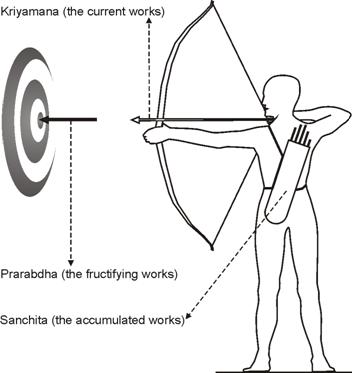
We have seen that karma is not just 'you hit me and you'll get hit back' thing; thought that is certainly the essence of it. There is more complexity insofar as there being a past, present and future to it. Future is determined by our aagaami karma. All actions have a 'fee' in the karma bank and we may not know what that fee will be in this life. It may take many lives to pay off the debt. Past karmas, the ones accrued via aagaami, are called sanchita. At any time, the sanchita may send out the 'interest balance'. This results in the jiiva having to enter the world. This brings it into the present of that jiiva - the praarabdha karma now takes over, determining the where, how, when and so forth of the birth.

Something to bear in mind, though not specifically mentioned in this text, is that all actions arise from thought. No action can take place without mind ordering it. Therefore, thoughts add to our aagaami as much as anything our body does.

Having taken birth, each jiiva must live out the life praarabdha has sketched… however, if we are blessed to have taken human birth, we have the facility to alter that sketch and improve our lot. For a truly blessed few of the already blessed, there may the opportunity to rise to the highest philosophical understanding which results in returning to True Self, even within this life itself. In such an event…

सञ्चितम् कर्म ब्रह्मैवाहमिति निस्चयात्मकज्ञनेन नश्यति।
sa~ncitam karma brahmaivaahamiti niscayaatmakaGYanena nashyati.

"Sanchita karma is destroyed by the firm knowledge 'I am Brahman alone'".

आगामि कर्म अपि ज्ञानेने नश्यति किञ्च आगामिकर्मणां निलजीदलगतजलवत् ज्ञानिनां सम्बन्धो नास्ति।
aagaami karma api GYaanene nashyati ki~nca aagaamikarmaNaaM nilajiidalagatajalavat GYaaninaaM sambandho naasti.

"The aagaami karma is also destroyed by Knowledge and the wise man is not affected by it, as a lotus leaf is not affected by the water on it."

On Realisation, our debts are nullified. The slate is cleaned. The gross body of the ignorant and of the wise at death disintegrate and merge with the elements. The subtle body of the ignorant, propelled by the causal body (ie force of previous actions) leaves the body to take up another at some point in the future according to the results of the karma which have fructified. The subtle body of the wise man merges with the five subtle elements and there is no more a propelling force. The causal body is destroyed by the Knowledge of Self. There is no more birth for him. It is like the space in the pot which is broken; it merges fully with the totality of space - never having been anything by space, albeit 'conditioned' by the pot.

Likewise, whilst the body of the wise man must play out the remainder of the praarabdha which brought him to this point, any actions now  (aagaami)  no longer accrue to sanchita. They just float, like the droplet of water on the leaf of the lotus. Have you seen that? No?... Perhaps nasturtium then…

The point being, there can be no more effect upon the one who has crossed the boundary between individual and total; jiivanmukta.

What then of the results of the remaining actions performed by the physical form of the jiivanmukta?

NB; the chants above will be on the clip provided next week.


Such is Destiny

Hari OM

'Text-days' are for delving into the words and theory of Advaita Vedanta.

TATTVABODHAH.
[You are reminded that reviewing the previous week's posts will become essential as the meanings of the Sanskrit terms may not be repeated. There may come additional or alternative meanings, but all should be noted. As study progresses, the technical terms must necessarily become 'second nature' to the student. When the Sanskrit is used, the translation will fall easily into place - or likewise, if the English is used, the Sanskrit term must easily come forwards.]

Please revisit THIS post and chant the mangala-charana. Please use the TattvabodhaH label to access all posts relevant to this text.

When watching a swami at times other than when giving discourse or satsang, it can be noted that there is little, if any, superfluous movement. The most alive part of such a sage is the eyes. They are all-seeing. To be blessed with even the most sideways glance from a Master is to know true blessing. Such an experience is never forgotten. The stillness of the physical container of the Master is a lesson in tranquillity. Every movement is economical and even the placing of a book or a pen is with repose.

If one attends satsang with such a Master, the atmosphere cannot be denied. This is not mere 'charisma'; it is something far greater. When a Master speaks, not one word is out of place… and every word is for the listener and only the listener. The fact that there might be a hundred other listeners sharing the room matters not; the Satguru is speaking only to the "I", which is Himself, and for a brief moment the individual is brought out of his or her condition and into that union.

Whether the jnaani serves by sharing the teaching this way, or remains at the work of their lifetime… or retreats to the forests or mountains… every action is merely burning up of the wick of destiny. Life, having been given, must run its course. This is destiny.

प्रारब्धं कर्म किमिति चेत्।
इदं शरीरमुत्पाद्य इह लोके एव सुखदुःखादिप्रदं
यत्कर्म तत्प्रारब्धं भोगेन नष्टं भवति
प्रारब्धकर्मणां भोगदेव क्षय इति।
praarabdhaM karma kimiti cet.
idaM shariiramutpaadya iha loke eva sukhaduHkhaadipradaM
yatkarma tatpraarabdhaM bhogena naSTaM bhavati
praarabdhakarmaNaaM bhogadeva xaya iti.

"Having given birth to this body, the actions which give result in this very world in the form of happiness or miser and which can be destroyed only by enjoying or suffering them, is called praarabdha karma."

Interestingly, the word praarabdha can be broken down to bring out "that which began well"… which sums it up rather nicely! We are born as children so innocent in at the beginning, but instantly the egg-timer starts running and it can only run according to the sanchita sands. In praarabdha, we face karma phala… the fruits of our actions.

How often have you said 'what have I done to deserve this?'; or heard another say 'oh he didn't deserve that!' Even if we are not of the tradition of Sanatana Dharma, we have some concept of having to pay a debt of some sort for our actions. Mostly we resent this! Properly understood, the karmic cycle can be a powerful influence upon us, for we start to act more consciously and conscientiously. However, a life of good acts does not necessarily preserve us from having to pay serious debts and if there is murder and mayhem several lives back, we will have to redress the balance sometime - and it may be in the current life. Further, within this life itself, we can experience the fullness of karma. It is what our reward and justice system is about. Good deeds can certainly yield reward this life itself and sour deeds may result in, for example, fines.

It is the praarabdha karma which determines the time and place of our birth, the environment, the lifespan. Do not consider praarabdha as 'set in stone' fate, something in which we are helpless. To be fatalistic, "oh there is nothing to be done, it is written in the stars", is of itself a negative karma. In fact, everything provides a learning, if we are alert, and by understanding that everything in life is a result of past action, in this life itself we can take responsibility, adjust our actions for the future, and fund a will to rise from the traps set by Maya. 

We must have the attitude that, whilst we may not have a choice in what is served to us, we do have a choice in how we 'eat' it. Adjustment of attitude from 'woe is me' to 'how can I use this' is what is required.

An arrow that has been shot from the bow reaches its target to exhaust its momentum. It cannot be withdrawn halfway. Similarly, those actions which have started fructifying can only be exhausted by giving their results. One must bear these results and the depth of their effect will be much determined by our attitude.

The jnaani, about whom this part of the text is talking, must also serve out 'time' in praarabdha, simply by virtue of having been born. However, as far as he is concerned there is no doing or enjoying or suffering. Eventually, his body, like the rest of us, must pass. The jiiva that found its freedom in mukta state (samaadhi) will now finally rest forever.


Future and Past

Hari OM

'Text-days' are for delving into the words and theory of Advaita Vedanta.

TATTVABODHAH.
[You are reminded that reviewing the previous week's posts will become essential as the meanings of the Sanskrit terms may not be repeated. There may come additional or alternative meanings, but all should be noted. As study progresses, the technical terms must necessarily become 'second nature' to the student. When the Sanskrit is used, the translation will fall easily into place - or likewise, if the English is used, the Sanskrit term must easily come forwards.]

Please revisit THIS post and chant the mangala-charana. Please use the TattvabodhaH label to access all posts relevant to this text.

Last week came the introduction to karma. It was stated there are three forms of it. All four chants for this section are on the clip. Today we will study two forms.

ज्ञानोत्पत्त्यनन्तरम् ज्ञानिदेहकृतं पुण्यपापरूपं
कर्म यदस्ति तदागामीत्यभिधीयते।
GYaanotpattyanantaram GYaanidehakR^itaM puNyapaaparuupaM
karma yadasti tadaagaamiityabhidhiiyate.

"The results of actions, good or bad, performed by the body of the realised soul after the dawn of Knowledge is known as agaami."

सञ्चितं किम्
अनन्तकोटिजन्मनां बीजभूतं सत् यत्कर्मजातं
पूर्वार्जितं तिष्ठति तत् सञ्चितं ज्ञेयम्।
sa~nchitaM kim
anantakoTijanmanaaM biijabhuutaM sat yatkarmajaataM
puurvaaarjitaM tiSThati tat sa~nchitaM GYeyam.

"What is sanchita?"
"The results of actions performed in all previous births which are in seed form and giving rise to endless crores of births are called sanchita (accumulated) karma."

In terms of how we currently think of karma, for those of us on the wrong side of Realisation every action undertaken must bring its consequences upon us. "As you sow, thus you reap." However, the Guru of this text is discussing from the point of view of one who has already passed the barrier and moved into Unity of Self. The aagami for such a one is thus altered slightly.

Whereas all our current actions will have a bearing on our future due our thinking we are the doer and enjoyer of those actions, the jnaani, being no longer bound by such notions, does not add to the 'debt' side of the karmic account - that is, the sanchita. All karmas performed by a jnaani are merely the burning out of left-over vaasanas and praarabdha. There are those who enter samaadhi and remain there until the physical container withers away. Others reenter the condition of daily transaction, mostly they will continue as they were; if a writer, the writing still gets done, if a carpenter, the woodwork still takes place, and so on. Those around, who are alert, will notice only that now the work is being done without any attachment. This is important because results of actions in terms of karma depend upon the intent behind them… if we remain in dualistic state. For a jnaani, who is unified, any 'intent', if there can be said to be any, will be only for the clearing of debt. Whilst we, in our ignorance may attach a label of good or bad action, the jnaani is indifferent. Actions must be burnt out, that is all. The jiva that has been 'fired' from bow of bondage, must still fly, like the released arrow, to the completion of its trajectory.

For the rest of us, the importance of ensuring pure and genuine intent for the betterment of society and Self behind every action is of prime importance.

In doing this we can limit depositing to our sanchita account; the repository for all past karmas. The basis of this word is 'chi', which means to collect. Placing 'sa' as prefix to a word says that it is good and the 'ta' makes it a past action. Thus sanchita is 'that which is well collected'.  From the very initiation of the jiiva it has gone through innumerable cycles and various incarnations. What drives the births is the need to utilise some of accrued balance - whilst the balance is 'positive', it is actually a debt from the point of view of aatmaa - to obtain Realisation is to clear out this account and to make no further deposit. The problem we have in taking each birth, whilst we may well use up our sanchita account, we are almost certainly adding to it via aagaami. Aagaami can only be utilised whilst in manifest state. Sanchita exists 'in the cloud'; aagaami is our 'salary account', whilst sanchita is our ISA, or term deposit!

Each of us has a 'healthy capital' account of karma and we are very adept at adding to it. If we learn the right knack of performing actions, such that we can exhaust our sanchita without creating new deposits, we can be truly 'rich'. If one must collect karmas, let them be for the good actions to ensure a shift up the ladder of spiritual path in future lives.