Hari
Om
Each 'Choose-day' we will investigate the process by
which we can reassess our activity and interaction with the world of plurality
and become more congruent within our personality.
KINDLE LIFE. We continue exploring
points raised by HH Pujya Gurudev Swami Chinmayananda-ji in the publication of
this name. Remember, you can purchase, (very economically!), the book
from Chinmaya Mission Publications or if you prefer,
the Amazon Link. Thus you can read
Gurudev's words directly and bring your own voice to the discussion.
(We
have been breaking up Chapter 26 of KL, firstly for length, but also for
'digestion'...mananam! It is hoped that you think deeply upon what you read,
making notes and finding levels of inspiration. This is saadhana. To review the
chapter so far, click the Choose-day label on right panel.)
"Yaa
maa saa maayaa - that which is not, is Maya" was our discussion last week.
Now the example of Somadatta's father.
.jpg)
One
newly initiated hermit, during a pilgrimage, felt tired and weary as the day
was burning hot. He, seeing a shady spot
near the Ganges' bank, took shelter there to rest. There was a narrow piece of rock upon which
he stretched himself, making comfy. As
he was dozing off, at that point just between waking and sleeping, his
attention was attracted to two village girls who had come to collect
water. They filled their pots and went
quietly away, but the visitors generated a line of thinking in the hermit.
"Why
not? Certainly there is no harm.
Supposing I marry one of them, then I shall keep a small house...three
rooms at least...and I shall be a very severe and grave husband…working my own
fields. I shall live a happy life of
contentment and joy." The fellow goes off to the village and seeks out the girl
whom he had favoured from the group. Later, he is well settled and he thinks,
"The agrarian life suits me well. The harvest has been good and a little
prosperity is ours. Devi-wife is
attentive and a mighty fine cook!"
Then
the first born, yes a fat, beautiful son.
"Of course I must name him Somadatta..and we shall all three sleep happily in the bed together...but is there space for my son? Devi,
please give some more space for our son, or he may fall out of the bed!"
"Husband,
how can I? Move? To where? You move a
bit your side!"
"Alright…"
Splash...gnuh..ghooooooo………
Poor 'Somadatta's father moved a little towards his side and the stone was
narrow. He lost balance and rolled into
the waters of the Ganges! Awakened now, the hermit swam out.
Now,
think, what made the hermit fall? After his awakening, where should he go to
regain his young wife and child? The poor ब्रह्मचारिन्/brahmachaarin (monk/solitary one)
created the world of Somadatta in himself and, identifying completely with it,
came to live the dream-life as though 'real', thus suffered the fall.
So,
too, Pure Eternal Self we all are, The Self, in a dream, has forgotten itself
and is now dreaming its own samsaara, filled with Somadattas and Devis and so
much more. WAKE UP! Roll off your stone
beds, dip into the cool waters of Ganges (Shruti/scripture) and get awakened
fully. End the undivine dream at one
stroke. The power of Somadatta's father,
with which he lived his domestic life and ultimately fell down into the mighty
river, is Maya - that which is not, existing in his own mind.
त्रिगुणाः/trigunaaH - three qualities.
Maya
is manifested in the world as three distinct गुणाः/gunaaH - eternal qualities. The सत्त्व/sattva (unactivity), the रजस् /rajas (activity) and the तमस् /tamas (inactivity). All the three qualities are ever in a state
of flux, mixing more of one then another. Their proportions vary from
individual to individual and the same individual will differ from time to time.
.jpg)
When
the Supreme Reality gets reflected in the part of Maya which is predominantly
sattvic (सत्त्व गुण प्रधान माया/sattva guna pradhaana maayaa), we get a very distinct and clear
reflection of that Supreme; this is the "God" principle. The reflection is dimmer in the sattva which
has mixed with rajas and/or tamas (मलिन सत्त्व माया/malina sattva maayaa)… this becomes the
ego-centric जीव/jiiva, individual mortal.
The "God" principle manifests itself around us, in the world
outside, as three main accomplishments.
We observe that at every moment, things and beings are created (born)
and destroyed (dead) and certainly between these two points of an unknown
beginning and an equally uncertain end, we also watch things and beings
maintained (living their existence). In order to facilitate the common man to
grasp these three powers manifest about him, we have them represented as the Creator
(ब्रह्मा/Brahmaa), Sustainer (विष्णु /Vishnu) and Destroyer (शिव/Shiva).

To
create a pot, the potter must have pre-knowledge of what (and how) he is going
to make; thus the creator must 'know' his creation, prior to the act itself. We
have, thus, Brahmaa-ji married to सरस्वती /Sarasvatii, the goddess of learning and
knowledge (the feminine side of creation). In order to sustain (maintain), we
need the capacity for it, with power and skill - a pauper cannot head and
maintain a family. Thus we have लक्ष्मी/Lakshmii, goddess of wealth and plenty as consort of Vishnu-ji. Further, the
act of destruction, the removal of that no longer required, requires that there
be something there at first to be destroyed. In this manner then, the partner
of Shiva-ji is the goddess उमा/Umaa who is none other than प्रकृति/prakRti - Mother
Nature, the manifest world - which represents that even in destruction there is
renewal. Even when the Trinity is thus shown to be three distinct, divine
'
personalities', it is also shown clearly that they are distinct and separate
divine
powers. The Oneness of them is
the soulful song of the scriptures, but the subtle song is heard only by the
most attentive and most cultured. In
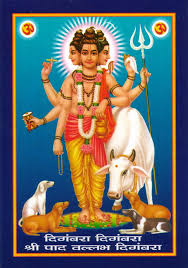
satguru Sri दत्तत्रेय/Dattatreya, the teachers' teacher, we have a synthesis of all the
three lords and in goddess दुर्गा/Durgaa, we have the representation of a total
synthesis of the three consorts.

SAADHANA
Consider
the play of Maya in existence. Ponder the elegance of the naming of the powers,
those very processes which modern science is still trying so hard to explain.


.jpg)
