ADVENTURES IN ADVAITA VEDANTA...

Adventures in Advaita Vedanta, the philosophy and science of spirit. We are one you and I; are you curious why?..


Showing posts with label Rajas. Show all posts

The Goal

Hari OM
'Text-days' are for delving into the words and theory of Advaita Vedanta.

On Wings and Wheels is the publication we are delving into currently. It takes the form of a series of Q&As from devotees to HH Pujya Gurudev Swami Chinmayananda. There are many sections and subsections to this book - not all will be given, but it is hoped that the general thought-flow will not be broken for those omissions. To obtain the full picture and essence of the discussions, do consider attempting to purchase the text from the link above; it is currently only available from India.

MORAL SENSITIVITY
Q - what has to be present in an individual to make them morally sensitive?
A - saatvika.

Q - please explain…
A - the three gunas (qualities of personality) are sattva, rajas and tamas. The psychological being of everyone comes under the influence of these three 'climatic conditions' of the mind and intellect. Sattva is perfect purity and luminosity and under its influence the mind/intellect are steady, reflecting the Universal Consciousness, the Self. In sattvika, the mind is creative, intelligent and capable of taking long flights into the realms of wisdom. On all such occasions of vast knowing and deep understanding and right choice, the inner equipment is under the influence of sattva.

Q - and rajas?
A - where rajoguna dominates, the mind is wrecked with a hundred passions, desires for things not yet acquired, attachment to those which have been, and there is a constant need to earn, spend, save, procure, procreate, protect… and never be satisfied. Action is the prompt of rajas and always there is the idea that "I am the doer" - it is an egocentric guna.

Q - what then of tamas?
A - it is born out of ignorance. The intellectual capacity under tamas is hampered and the capacity to discriminate between right and wrong gets blurred; there is indolence, heedlessness as to there being anything higher in life to work for. It is an existence but not a full life which prevails under the influence of tamas-dominant personality.

Q - are all three present in us?
A - oh yes, to varying degrees. The more often and more completely we go beyond rajas and tamas and make our bosom full of sattva, the more grows our capacity to observe, analyse, understand and to become aware of the world outside and judge it correctly. 

Q - would it be sattva that would have to be present to make an individual morally sensitive?
A - yes. If one is rajasic or tamasic, one will not feel the full, or any, impact of one's actions. The looter, plunderer or murderer are unable to fully cognise the effects of their actions - only by building on saatva can any remorse be present. The greater the sattvika in one, the more sensitive to results of actions there will be, the ability to sense disharmony in society and the world.

Q - training and experience can bring about morality?
A - yes. At any given moment you take that which is morally good for you; it depends upon the grossness or the sensitivity of your mind. That is why the dharma (life course) of, say, a garbage collector [NB this would be classified as 'shudra' in Sanskrit terms] will be different from that of a university professor [NB this would be classified as braahmin]; at each level the scriptures have tried to prescribe that which is right and which is not. To a shudra, drinking alchohol and non-vegeterianism is fine; but for the braahmin, these would be forbidden, as they dull the mind and block the body. Each level has its own morality, but it is possible to breach the barriers and raise oneself. It is important to note that one ought not to prescribe for the other, but each has the potential to rise or fall into another's category of personality type and way of life. Be responsible for your own level of morality and assess whether it needs to be bettered. That is all that is required.

STATION AND DUTY
Q - would it then, be advisable to follow a standpoint of lesser values as advised in the Bhagavad Gita, doing one's duty according to the station in life?
A - yes. The varnas and ashramas (castes and stages of life) are psychological evaluations. For whatever you are fit, depending on your temperament and your constitution, likewise will be your duties. By following one's station in life one can serve society more efficiently and without inner conflicts. One may have rajoguna but also tamas well intermingled - therefore he is 'vaishya' and it is likely that agriculture or trade will suit the temperament best. If such a temperament was forced into, say, doing academic work, both that personality - and the work - would suffer! Equally, if one is of an age for vanaprastha (retirement and retreat), to be placed in a situation where one must work would take a great toll.

Q - suppose there is choice involved; should you choose according to your station or the larger viewpoint?
A - Station… the war may be coming, but the braahmin who takes up arms will only confuse matters. Let him stay where he is stationed in life and proceed according to the duties there allotted according to qualification. Doing his dharma, that person will be supporting the war efforts and not hindering them by incompetence as a soldier!

Q - even if the choice is between that and the highest goal?
A - to serve your dharma is to serve the highest goal. The dharma of a judge is to assess dispassionately - even if his own son is in the dock. The dharma of a street sweeper is to ensure that all may walk with cleanest feet possible. An engineer, no matter how compassionate, cannot enter an area of a pandemic and 'fix' things, it must be left to the doctors and nurses, who can. If each seeks to cross into another's area of expertise, there will be no proper effect. If we bring it down that each is only earning a living, the higher and more social goal of each is lost and morality is affected.

Q - is one dharma better than another?
A - NO! at any given level each one is right. By being loyal to our own level of feelings, ideas, development of consciousness, we can evolve into higher states of unfoldment.

Q - which level is higher?
A - the highest level is wherein you are nearer to the Aatman - the Self. To recognise yourself with the One, in harmony with All - living then becomes effortless and creative. When one goes beyond the action-reaction stage then life becomes again creative and joyful.

Q - so ethics is evolutionary? One has to work towards creating sattva in order to reach the ultimate goal of finding one's Self? The goal of all, regardless of dharma, is to work towards that one final goal?
A - YES!

Start Where You Are

Hari OM
Application - that is what 'Workings-days' are about!
The Narada Bhakti Sutra is our guide for a while… the nature of Love (with the capital 'ell') and a full exploration of it. As always, you are encouraged to seek out the full text from Chinmaya Publications (links in side-bar); but for those who prefer e-readers, this version is recommended. Whilst awareness and interest can be raised by these posts on AV-blog, they cannot substitute for a thorough reading and contemplation...and practice!
 
Chapter Five, Section Two - Secondary Love Divine. In section one we learned of the personality type which works for and attains the Supreme Bhakti. As noted, such personalities are rare: not because folk are incapable, but because they have yet to understand the benefit, or even know that there is such a goal and are, instead, lost in the 'daily grind'. These are the majority who will fall into the subcategories now pointed out by Sri Narada.

gaE[I iÇxa gu[_aedad! AataRid_aedad! Vaa.56.
Gaunii tridhaa guna-bhedaad aartaadi-bhedaad vaa ||56||
The secondary devotion is of three kinds, according to the difference in the mental disposition or according to the type of discontentment.

No matter how keenly we wish to reach the highest, in the beginning we must practice the 'lower' forms of bhakti. Can you, as one who has never pole-vaulted before, think to immediately run, grasp that pole, fly over the bar and successfully release that pole and land in graceful completion? Indeed not. However, according to previous experience and inherent talent, there may be varying degrees of success from at least not breaking any bones, all the way down to landing in hospital!

The form of spiritual practice which Vedanta demands of its adherents, it bears repeating, is like any study and any form of exercise. One must begin where one is at and seek to improve.

Thus, reference is made here to the triguna - sattva, rajas, tamas. We know this because of the mention of 'mental disposition'. The gunas are all three within us, but one or other will dominate at different times in different situations, as well as there being one dominant guna into which we might generally be classified. What is more, the gunas will influence the nature of the vaasanas which manifest in our current incarnation and colour our actions.

As long as vaasanas are present, we are forced to act; one must hear, must read, speak and feel. The highest devotion spoken of prior can only take place where all vaasanas have been exhausted in the individual. We can only approach the Higher through those vaasanas and the actions prompted by them, therefore the Guru here tells us that, according to the makeup within us of the gunas and how we deal with them, we can only work in 'gauna-bhakti', secondary devotion. In short, our motivation towards devotion may be lesser or greater and hold a different focus according to our personality.

One who is predominantly tamasic in nature is less likely to either have the desire or the focus for devotion; however, if the spark is there, such a person can indeed pull his or herself up towards the higher by moving into a more dominant rajasic temperament. The rajasic individual, who is ever on the move and restless and who may well seek the Higher keenly, may struggle by simple fact that rajas is also easily distracted. By continued self-discipline and determination, there is no reason why the rajasic one cannot lift into more predominant sattvika and improve their spiritual gain. It is from sattva that one can rise, finally, to the highest level (moksha) - but this is not a given. Many a sattvika has been heard to complain that they are doing everything 'the right way', but still there are conditionings to be overcome and vaasanas to burn. The sattvika must work only in total and selfless Love in order to succeed in rooting out the vaasanas.

When one can move into the state of unconditioned and unconditional Love (with the capital 'ell'), there alone will one join with the Higher.

This is because the essential heart of Love is, itself, renunciation. To reach to this state, as said in this sutra, it is imperative that we work our way through all the gunas and their various combined manifestations within us. Overcoming all these inherent 'personality grenades' is our work, our saadhana.

Now, there was mention of the secondary devotion itself having three categories. These are according to guna; tamas = arthaarthi, rajas = jijnasu and sattva = aarta. These will be explored in more detail in the following sutra, but basically, arthaarthi is discontented and knows s/he wants better, but on the whole this is perceived only within the material (to have a better home, better job etc); jijnasu is more spiritually aware and understands there may be something worth paying attention to, but becomes discontented when it all seems 'too hard'; aarta is discontented with the material life and knows there is something more intellectually and spiritually stimulating awaiting.

All have a sense of incompleteness and the drive to improve, and each must use this as a springboard towards the better. The actions to make these improvements, though, are governed by those pesky gunas and vaasanas!


Tweaking The Thinker, part 2

Hari Om

Each 'Choose-day' we will investigate the process by which we can reassess our activity and interaction with the world of plurality and become more congruent within our personality.

We are reading the small booklet called "Not Too Loose, Not Too tight - Just right!" This is written by Swamini Vimalananda, and gives a very general overview of Vedanta for the beginner.

INTRODUCTION part 2.
The main characteristic of sattva guna is Knowledge.  Other characteristics are compassion, faith, Love, self-control, understanding, purity, equanimity and memory. The main characteristic of rajo-guna is activity.  Others are ambition, dynamism, restlessness, haste, anger, jealousy, greed and passion.  The main characteristic of tamo-guna is inertia. Others are disorganised thinking and behaviour, carelessness, laziness, forgetfulness, violence and criminal thoughts.

The cause pervades the effect.  Hence, these three qualities of prakRiti pervade everything in the creation. However, when one quality is predominant, the other two lie dormant. The inert world of objects is predominantly tamasic. Plants manifest more rajo-guna than stones do and animals even more than plants. Man can manifest sattva guna to a greater extent than animals and presiding deities even more than man.  Even amongst plants, trees, animals, birds, some are sattvic, others rajasic and yet others tamasic.  The tulsi, lotus, peepal, cow and swan are seen to be more sattvic and are therefore held as sacred in India. The pitcher plant, sunflower, mango tree, monkey and crow are more rajasic, whereas weeds, cactii, buffalo and vulture are more tamasic. Look around at the world and try to see these gunas in the beings around you. Not as judgement! Merely as an observation.

Human beings too have these three gunas. Different qualities gain dominance at different times, but one of them generally dominates each personality.  Hence we may categorise people as being sattvic, rajasic ro tamasic.  Remember, everything we do -the way we sit, eat, walk, talk, work or behave - reflects the quality or mood of the mind.  For example, in a sattvic mood we eat unhurriedly and neatly; in a rajasic mood, speedily, with little chewing and perhaps moodily also; in tamasic mood, the food is taken sloppily, lethargically and with not attention at all.

What do we want to be?  What is the ideal combination of the gunas we ought to strive to have?

When the strings of the sitar are too loose, they produce a base and unmusical sound.  If they are too tight, they make a squeaky or shrill sound.  When they are tuned rightly, they produce melodious music. Similarly, if the strings of our mind are too loose (tamasic) we are dull, lazy and often negative in our thoughts.  If they are too tight (rajasic), then despite being ambitious and hard working, we are often tense, dissatisfied, worried and unhappy.  However, when the strings of our minds are tuned rightly (sattvic), then we are poised, successful and happy; there is beautiful music in our lives. Therefore, the formula for success and happiness is "Not Too Loose, Not Too tight - Just right!"


When we look in a mirror and see dirt on our face, we wash it off.  we enhance our looks by highlighting our good features and reducing or managing the defects. The following posts from this booklet will act as if that mirror. There will be 23 aspects expounded, meant to help us look at ourselves and guide us to beautify our inner selves and lives. Each of the three gunas is expanded upon in relation to specifics of living.  This is useful as a daily sadhana 'monitor', but also, for those who are pondering the practicality of undertaking spiritual/philosophical pursuit, highlights the methodology of Vedanta succinctly, whilst at the same time not being 'the final word'. 


Tweaking The Thinker

Hari Om

Each 'Choose-day' we will investigate the process by which we can reassess our activity and interaction with the world of plurality and become more congruent within our personality.

Image result for swamini vimalananda
Swni. Vimalananda (CM)
We completed the small text on Gita in Daily Life. Next we will take up a slightly longer small booklet called "Not Too Loose, Not Too tight - Just right!" This is written by Swamini Vimalananda, who is head of Schools for Chinmaya Mission. The booklet is written with children in mind - but of course for majority readers who are new to Vedanta and/or who are trying to make up their mind whether or not to read this philosophy more deeply, then there is a need for such beginner's texts… and there is the saying of Lord Jesus that 'ye must become as children to enter the kingdom of the Lord'; ...empty yourselves and be ready to accept anew! [Avblog - you will note "the creation" is used, rather than simply "creation" - this is because Vedanta views the manifestation of everything as an object, ie an effect, so even the creation itself is an effect…]

INTRODUCTION part 1.
Every effect must have a cause. It naturally follows that the world we experience must also have a cause. There are various causes for the various objects, phenomena, circumstances and experiences of the world.  For example, a seed gives rise to a tree, condensation results in rain, unfulfilled desires cause frustration and anger and so on.  There may be one or many causes for a phenomenon. However, what is the ultimate cause - the Cause of all causes - the cause of the entire world and not just a small part or event within it?  Both Science and Religion seek this Ultimate Cause.

Logically thinking, an object, energy or phenomenon of the world cannot be the Ultimate Cause. Why?
  • A part cannot create the whole. The finite cannot create the infinite.
  • Any object being a part of the world cannot itself be the world.
  • The cause has to precede the effect. The object would have to exist before the world came into being and yet all objects are logically a part (result) of creation.
These and many other logical fallacies would occur if we assume that an object, form of energy or phenomenon is the Ultimate cause of the world.  Therefore, the Ultimate Cause cannot be an object or aspect of the world.

Then what is it?

Let us first see what is the world. Then we can arrive at its cause by negating all that the world represents.  The creation, universe and world are names for forms and their attributes, which exist within the realm of time and space.  Therefore the Ultimate Cause of the creation must be a nameless, formless, quality-less, timeless and spaceless entity.  It is called 'God' in religion and 'Truth' in philosophy.

This Truth, [which in Vedanta is referred to as Purusha or Brahman - and other such names], has the unmanifest infinite potential ( प्रकृति /prakRiti) to create the vast universe.  This potential first manifests as the five subtle elements called तन्मतराः /tanmatras. They are आकाश /aakaasha -space (or ether), वायु /vaayu - air, अग्नि /agni -fire, जल /jala -water and प्रिथ्वि /prithvi - earth.  The elements are called subtle because they cannot be perceived by our sense organs. These subtle elements from the entire subtle world of our thoughts, emotions, talents and abilities.  They then transform to make the five gross elements. These form the world as we perceive it with our five sense organs (eye, ears, nose, skin, tongue) as forms, sounds, smells, touch and taste.

If everything has emerged from the same Truth, the same unmanifest potential, the same subtle and gross elements, then why do we perceive differences?  Why is one brilliant and another dull?

PrakRiti inherently has three qualities. These manifest in various ways causing a wide range of differences. For example, tea contains milk, sugar and the tea leaves.  The various permutations and combinations of these three ingredients create a variety of tastes.  Similarly, everyone and everything in the creation is made up of three qualities (gunas); sattva, rajas and tamas. The permutations and combinations of these three create the vast variety of the world.

...tbc...


Impediments

Hari Om

Each 'Choose-day' we will investigate the process by which we can reassess our activity and interaction with the world of plurality and become more congruent within our personality.

KINDLE LIFE. We continue exploring points raised by HH Pujya Gurudev Swami Chinmayananda-ji in the publication of this name. Remember, you can purchase, (very economically!), the book from  Chinmaya Mission Publications or if you prefer, the Amazon Link. Thus you can read Gurudev's words directly and bring your own voice to the discussion.

(We have been breaking up Chapter 26 of KL, firstly for length, but also for 'digestion'...mananam! It is hoped that you think deeply upon what you read, making notes and finding levels of inspiration. This is saadhana. To review the chapter so far, click the Choose-day label on right panel.)

By naming all the aspects of nature, resulting in what appears to be a plurality of 'Gods', it is to be understood that there is but one and same God Principle. In fact, individually, each of the named Gods is helpless; they are fully independent. Without creation, there would be no requirement of maintenance or destruction. Without maintenance, creation has built in destruction which does itself have purpose beyond the task done - there can be no re-creation. Only by true 'teamwork' between the three can things exist as they do. What keeps this balance? The One God Principle. Plurality, the idea that each living system of the world and its process can operate independently, is an illusion. There is one governing power.

That nature ( सत्त्व-माया/sattva-maayaa, pure illusion) exists for us at this moment as we wrangle with this philosophy, let us accept. In these times we do have an improved sense of the interconnectedness of everything and it is this which is being called the God Principle. If the reflection of that is found in nature; then next thing to accept is that the reflection of the God Principle also reflects in the realm of activity (rajas) and inactivity (tamas). The ego-self, the individualised sense of separateness, is therefore but a poor reflection of The True Self.

The example which is used often for this is that, just as we can see the sun reflected upon water in a puddles and buckets, none of those 'suns' is the One True Sun.  Equally, each of those reflections can only be as clear and as representative of The Sun as the purity of the water doing the reflecting. The purest clearest and calmest water (sattva) provides the best image. Water which is ruffled and agitated (rajas) by any means causes the reflection to be broken up whilst this is so, but also has the capacity to calm down and become steady again.  Water which has become contaminated with mud or dung (tamas) gives a dull reflection and purifying that water will take some effort.  The tamas quality acts in us in two distinct ways. It produces the mental agitations of  विक्षेप/vikshepa (agitation) and  आवरण/aavarana (veiling).

The veiling power of tamas plays out in three distinct negativities; a) don't know, b) can't understand, 
c) not experienced.  These three negative concepts in us are removed by the three main items of Vedantic practice; a) श्रवणम्/shravanam - listening, b) मननम्/mananam - reflection upon what was heard, c) निदिध्यासन /nididhyaasana - meditation, in attempts to gain the experience.

The first of these three main 'tragedies', is that when left to ourselves, few of us have the capacity to independently observe, analyze and conclude that there is a God Principle behind the ever-changing flux in the phenomenal world.  "I don't know" is the grossest state of aavarana. It is removed by shravanam; either directly from the great masters, or their disciples; or indirectly through reading of the appropriate texts. In taking up shravanam we are removing the first negativity and a subtler one now appears; "I can't understand". This is surmounted by intellectual analysis and reasoning, when the seeker comes to feel that in and through the endless names and forms is running the One Golden Chord of Unity, a sense of oneness, the आत्मन् /aatman (Universal Spirit).

A problem at this stage is that very often, students of philosophy begin to devalue their own intellectual awareness of this changeless Truth, since it is "not experienced" by them. This aavarana manifestation is removed by the process of the prescribed practice of meditation.

Meditation is a process of inner self-discipline by which, through constant practice, the seeker learns the art of keeping their mind at one and the same chosen line of thinking to the strict and severe exclusion of all other dissimilar currents of thought.  Ultimately the saadhaka succeeds in bringing the mind to complete stillness in which, unlike sleep, he has his entire awareness brightly lit up and kindling in his bosom.  At the moment of experiencing the transcendental Bliss and Knowledge, (सविकल्प समाधि /savikalpa samaadhi), the saadhaka comes to chop off the last traces of the aavarana.

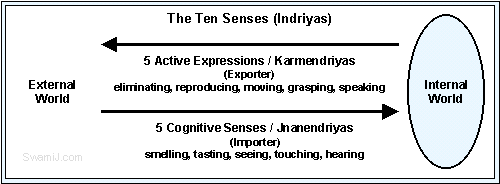
From vikshepa arises the unmanifest, subconscious, and from that springs forth the grosser assertion of the manifest - the world of the five elements. The interplay of the elements produces the names and forms, including the senses of knowledge ( ज्ञानेन्द्रियाः/jnaanendriyaH) and the senses of action (कर्मेन्द्रियाः /karmendriyaH), which together constitute the helpless 'traveller of this sea of life', the  संसारिन् /samsaarin. By mistaking/misinterpreting our experience gained through action we build a world around us, separate from The Truth.

With this, we have the 'fall of man'. From being the Eternal, Immortal, All-full Pure Consciousness (नित्य-शुद्ध-मुक्त परमात्मन् /nitya-suddha-mukta paramaatman), due to the play of Maya and like Somadatta's father, we too have come to feel our limitation and live in our unbuilt huts with our unmarried wives and unborn sons.


Vedanta is not a pessimistic philosophy to leave its conclusion with a mere theory of fall. This very theory has been devised to explain the non-existent dream-fall so that the faithful may be shown a way to wake up and realise their own true and eternal nature once more; returning to the OM!

...the conclusion of chapter 26 next week...


Tri-gunaaH - Melting Pot

Hari Om

Each 'Choose-day' we will investigate the process by which we can reassess our activity and interaction with the world of plurality and become more congruent within our personality.

KINDLE LIFE. We continue exploring points raised by HH Pujya Gurudev Swami Chinmayananda-ji in the publication of this name. Remember, you can purchase, (very economically!), the book from  Chinmaya Mission Publications or if you prefer, the Amazon Link. Thus you can read Gurudev's words directly and bring your own voice to the discussion.

(We have been breaking up Chapter 26 of KL, firstly for length, but also for 'digestion'...mananam! It is hoped that you think deeply upon what you read, making notes and finding levels of inspiration. This is saadhana. To review the chapter so far, click the Choose-day label on right panel.)

"Yaa maa saa maayaa - that which is not, is Maya" was our discussion last week. Now the example of Somadatta's father.

One newly initiated hermit, during a pilgrimage, felt tired and weary as the day was burning hot.  He, seeing a shady spot near the Ganges' bank, took shelter there to rest.  There was a narrow piece of rock upon which he stretched himself, making comfy.  As he was dozing off, at that point just between waking and sleeping, his attention was attracted to two village girls who had come to collect water.  They filled their pots and went quietly away, but the visitors generated a line of thinking in the hermit.

"Why not? Certainly there is no harm.  Supposing I marry one of them, then I shall keep a small house...three rooms at least...and I shall be a very severe and grave husband…working my own fields.  I shall live a happy life of contentment and joy." The fellow goes off to the village and seeks out the girl whom he had favoured from the group. Later, he is well settled and he thinks, "The agrarian life suits me well. The harvest has been good and a little prosperity is ours.  Devi-wife is attentive and a mighty fine cook!"

Then the first born, yes a fat, beautiful son.  "Of course I must name him Somadatta..and we shall all three sleep happily in the bed together...but is there space for my son? Devi, please give some more space for our son, or he may fall out of the bed!"

"Husband, how can I? Move? To where?  You move a bit your side!"

"Alright…"

Splash...gnuh..ghooooooo……… Poor 'Somadatta's father moved a little towards his side and the stone was narrow.  He lost balance and rolled into the waters of the Ganges! Awakened now, the hermit swam out.

Now, think, what made the hermit fall? After his awakening, where should he go to regain his young wife and child? The poor ब्रह्मचारिन्/brahmachaarin (monk/solitary one) created the world of Somadatta in himself and, identifying completely with it, came to live the dream-life as though 'real', thus suffered the fall.

So, too, Pure Eternal Self we all are, The Self, in a dream, has forgotten itself and is now dreaming its own samsaara, filled with Somadattas and Devis and so much more.  WAKE UP! Roll off your stone beds, dip into the cool waters of Ganges (Shruti/scripture) and get awakened fully.  End the undivine dream at one stroke.  The power of Somadatta's father, with which he lived his domestic life and ultimately fell down into the mighty river, is Maya - that which is not, existing in his own mind.

त्रिगुणाः/trigunaaH - three qualities.
Maya is manifested in the world as three distinct गुणाः/gunaaH - eternal qualities. The सत्त्व/sattva (unactivity), the रजस् /rajas (activity) and the तमस् /tamas (inactivity).  All the three qualities are ever in a state of flux, mixing more of one then another. Their proportions vary from individual to individual and the same individual will differ from time to time.

When the Supreme Reality gets reflected in the part of Maya which is predominantly sattvic (सत्त्व गुण प्रधान माया/sattva guna pradhaana maayaa), we get a very distinct and clear reflection of that Supreme; this is the "God" principle.  The reflection is dimmer in the sattva which has mixed with rajas and/or tamas (मलिन सत्त्व माया/malina sattva maayaa)… this becomes the ego-centric जीव/jiiva, individual mortal.  The "God" principle manifests itself around us, in the world outside, as three main accomplishments.  We observe that at every moment, things and beings are created (born) and destroyed (dead) and certainly between these two points of an unknown beginning and an equally uncertain end, we also watch things and beings maintained (living their existence). In order to facilitate the common man to grasp these three powers manifest about him, we have them represented as the Creator (ब्रह्मा/Brahmaa), Sustainer (विष्णु /Vishnu) and Destroyer (शिव/Shiva).

Image result for brahma vishnu shiva trinityTo create a pot, the potter must have pre-knowledge of what (and how) he is going to make; thus the creator must 'know' his creation, prior to the act itself. We have, thus, Brahmaa-ji married to सरस्वती /Sarasvatii, the goddess of learning and knowledge (the feminine side of creation). In order to sustain (maintain), we need the capacity for it, with power and skill - a pauper cannot head and maintain a family.  Thus we have लक्ष्मी/Lakshmii, goddess of wealth and plenty as consort of Vishnu-ji. Further, the act of destruction, the removal of that no longer required, requires that there be something there at first to be destroyed. In this manner then, the partner of Shiva-ji is the goddess उमा/Umaa who is none other than प्रकृति/prakRti - Mother Nature, the manifest world - which represents that even in destruction there is renewal. Even when the Trinity is thus shown to be three distinct, divine 'personalities', it is also shown clearly that they are distinct and separate divine powers.  The Oneness of them is the soulful song of the scriptures, but the subtle song is heard only by the most attentive and most cultured.  In satguru Sri दत्तत्रेय/Dattatreya, the teachers' teacher, we have a synthesis of all the three lords and in goddess दुर्गा/Durgaa, we have the representation of a total synthesis of the three consorts.

 Image result for dattatreya                                                  

SAADHANA

Consider the play of Maya in existence. Ponder the elegance of the naming of the powers, those very processes which modern science is still trying so hard to explain.