ADVENTURES IN ADVAITA VEDANTA...

Adventures in Advaita Vedanta, the philosophy and science of spirit. We are one you and I; are you curious why?..


Showing posts with label Mananam. Show all posts

What Are You Waiting For?

Hari OM
'Text-days' are for delving into the words and theory of Advaita Vedanta.

We are now studying Aatmabodha. As always, with each week, you are encouraged to review the previous teachings and spend some time in contemplation of the meanings as the affect your life. Please do consider purchasing the text. Remember, also, to recite the mangala charana before each study and review the lessons before each new one.

The shloka last week was said to be 'shravanam', an instruction given out by the Guru, that the shishya is expected to listen attentively too. By taking in the essence of the teaching in that given instruction, the student must attend to further study and consideration of the subject. This is 'mananam' - contemplation.

degaNyTvaÚ me jNmjrakaZyRlyady>,
zBdaidiv[yE> s'gae inirNÔytya n c.32.
Dehaanyatvaanna me janma-jaraakaarshyala-yaadayaH,
shabdaadivinayaiH sango nirindrayatayaa na cha ||32||
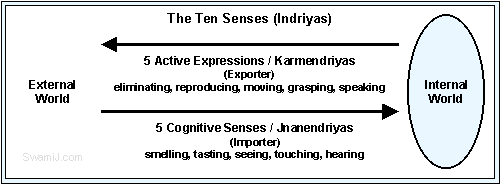
I am other than the body and so I am free from the changes such as birth, aging, senility, death and so on. I have nothing to do with the sense objects such as sound and taste, for I am without these sense organs.

The shishya has been learning that everything which can be perceived, including his or her own thoughts, are external to the True Self, our natural state of being. Through the teaching thus far it has been established that there is an eternal 'substratum' upon which all else is placed. In the preceding shloka, the Guru asked of the student to pay attention to what had been taught and get serious in saadhana and begin to apply the theory in practice. Therefore, in this shloka, we 'hear' the shishya beginning the process. REMEMBER - YOU ARE THE 'SHISHYA! Don't just read and close; make it real.

Yes indeed, and here we are given the biggest clue as to how to begin the negation of the pluralistic existence. We can only undertake this level of contemplation if we have worked our way steadily through all the novice training, asked our questions, cleared our doubts and so forth. It is not that all doubts will be gone, but certainly any which remain will be very much more specific to Vedantic enquiry. All extraneous, mundane, worldly 'interferences' will have been largely removed by the time we are ready for this advanced level of thinking upon the Pure Self. Our questions will have moved from general 'faqs' to dedicated and pertinent inquiry.

As you sit in your next period of contemplation, you are to consider the points given above, from your own perspective. Being in Sanskrit, the lot is given at once, as well us giving the impression this can all be done at once. Not the case. Whilst the text must necessarily flow onwards and keep piling up the activity (as you will see), the actual practice is a much slower process and requires that each part falls into place before moving on to the next. The mind can certainly entertain the lot in one go, but the intellect and - most importantly - the spirit require much deeper analysis and inculcation.

Therefore, for practical saadhana, start with the physical level "I am not this body". Keep on keeping on in daily contemplation until there is a point where, even if it is only for a few seconds initially, there is a suspension of body-awareness.  Don't get over-excited, keep at the practice, but now, when those moments come more readily and for longer periods of time, it is possible to move into the slightly more esoteric contemplation, that as the body is not 'me', neither can the changes which are wrought upon the physical being be 'me'. Keep on keeping on with this contemplation until such time as it makes sense and is fully accepted by your whole individual self. Then the next step, separation of that individual self with the experiences which come from the physical.  This is the suggestion - nay, the instruction - which has been given to us and which we must carry out if we are seriuos seekers of Self Realisation.

SAADHANA
Are you ready? Begin! 


Viveka Applied

Hari OM

'Text-days' are for delving into the words and theory of Advaita Vedanta.

TATTVABODHAH.
[You are reminded that reviewing the previous week's posts will become essential as the meanings of the Sanskrit terms may not be repeated. There may come additional or alternative meanings, but all should be noted. As study progresses, the technical terms must necessarily become 'second nature' to the student. When the Sanskrit is used, the translation will fall easily into place - or likewise, if the English is used, the Sanskrit term must easily come forwards.]

Please revisit THIS post and chant the mangala-charana. Please use the TattvabodaH label to access all posts relevant to this text. 

The enquiry into Truth is now our subject. Note that the chanting for this will be given next week, as the longer section follows this initial question.

The shishya, having enquired and heard Guru's responses on sadhana chatushtaya, now finds that the question arises as to
तत्त्वविवेकःकः
आत्मा सत्यं तदन्यत् सर्वं मिथ्येति।
tattvavivekaHkaH ?
aatmaa satyaM tadanyat sarvaM mithyeti.

"what is this enquiry into Truth?"
"It is of the firm conviction that the Self is Real and all, other than That, is unreal."

Viveka is here used as 'enquiry', as in 'determination'. What is it, exactly, that we are supposed to be understanding here? To what are we expected to apply our discriminative talents? We are told that it is the act of discovering what is True and what is False. Even at this beginning stage, the guru does not hold back from facing the student with highest concept… nothing at all which we perceive is to be considered as 'real'. Only by coming to full appreciation of Self can we say that Truth is found.  Advaita Vedanta is the only दर्शन /darshana (philosophy) which propounds this esoteric understanding. All others vary in how much they accept as being 'real' external to the person. In AV, even nature, the cosmos itself, are unreal.  It is the philosophy of Pure Consciousness. It is the one abiding and permanent factor. Absolutely everything else is impermanent, even this cosmos of the greatest age that we can conceive. We know - science knows - there was a beginning and it predicts an end. That which is impermanent is unreal, according to Advaita. This is the discrimination and understanding to which we must apply our intellect.

There are those who misunderstand and say that, in the end, Reality = nothing. Non-existence (non-consciousness) is illogical. From nothing, only nothing can arise. By virtue of the fact that something - albeit an illusion - has arisen, there is proven a pre-existence, a something from which the illusion can project.

Here, at our novice stage, we are 'experiencing' the world. However, we can negate everything about this existence. Nothing in it is in the least bit permanent. There are two aspects to life. "I" (the experiencer) and "The World" (the experienced). The relationship between the experiencer and the experienced is the experiencing. The name, form, quality and so forth, of every object in the world is a changeable quantity - including the body in which this "I" resides.  "I", the observer of it all, do not change. The "I" is never absent even as the world gets negated… it is this "I" - the ultimate witness of all things - which is the Reality.

However, due to misdirection and attachment to the world, "I", as in The Big Self, lost its way and have become identified with body, mind and intellect. The Big Self has become small and mean and lonely in its travails within the illusion, The Big Dream. We say "I" all the time, meaning this small individual with an ego-identity, believing ourselves to be separate and independent of the Whole. This was the 'original sin', as far as AV is concerned, this is the great fall of Man; that he forgot his divine nature.

The ancient seers understood this and brought down the teachings in order that those who are of sufficient awareness, who have the burning curiosity, will ask precisely the sorts of questions being put forth by the shishya in TattvabodaH. The Guru here is pointing to the exact nature of all enquiry which will follow. To determine the Real from the unreal, it is necessary to go through a process of negation, testing everything which, till now, we have held as being real and removing the illusion created by Maya.  This is referred to as  अध्यरोपापवाद /adhyaaropa-apavaada - revealing the superimposition (of Maya) by negation. We keep going through all the processes of negation until there comes a point where no further negation can take place. That is the point of Truth.

 Image result for adhyaropa apavada

Now, of course, all hard-thinking students are wondering, 'what exactly then is the Self, never mind the enquiry into it? We can see easily all this which is not That....but what is That?' A perfectly valid question.


This we shall take up next week. Ponder the points made here. Give proper mananam. When Adi Shankara wrote this text, it was directed at students who had already spent some years in spiritual study within santana dharma and who already were proficient in Sanskrit. The Truth is there for all who are ready to stretch themselves intellectually. That is the promise made in this early text. Be aware, that it is impossible to make this enquiry and not be affected by it, provided the heart and mind are open. It is a mystery of Truth that, when we start to experience it, we find that actually we already knew it ...


Impediments

Hari Om

Each 'Choose-day' we will investigate the process by which we can reassess our activity and interaction with the world of plurality and become more congruent within our personality.

KINDLE LIFE. We continue exploring points raised by HH Pujya Gurudev Swami Chinmayananda-ji in the publication of this name. Remember, you can purchase, (very economically!), the book from  Chinmaya Mission Publications or if you prefer, the Amazon Link. Thus you can read Gurudev's words directly and bring your own voice to the discussion.

(We have been breaking up Chapter 26 of KL, firstly for length, but also for 'digestion'...mananam! It is hoped that you think deeply upon what you read, making notes and finding levels of inspiration. This is saadhana. To review the chapter so far, click the Choose-day label on right panel.)

By naming all the aspects of nature, resulting in what appears to be a plurality of 'Gods', it is to be understood that there is but one and same God Principle. In fact, individually, each of the named Gods is helpless; they are fully independent. Without creation, there would be no requirement of maintenance or destruction. Without maintenance, creation has built in destruction which does itself have purpose beyond the task done - there can be no re-creation. Only by true 'teamwork' between the three can things exist as they do. What keeps this balance? The One God Principle. Plurality, the idea that each living system of the world and its process can operate independently, is an illusion. There is one governing power.

That nature ( सत्त्व-माया/sattva-maayaa, pure illusion) exists for us at this moment as we wrangle with this philosophy, let us accept. In these times we do have an improved sense of the interconnectedness of everything and it is this which is being called the God Principle. If the reflection of that is found in nature; then next thing to accept is that the reflection of the God Principle also reflects in the realm of activity (rajas) and inactivity (tamas). The ego-self, the individualised sense of separateness, is therefore but a poor reflection of The True Self.

The example which is used often for this is that, just as we can see the sun reflected upon water in a puddles and buckets, none of those 'suns' is the One True Sun.  Equally, each of those reflections can only be as clear and as representative of The Sun as the purity of the water doing the reflecting. The purest clearest and calmest water (sattva) provides the best image. Water which is ruffled and agitated (rajas) by any means causes the reflection to be broken up whilst this is so, but also has the capacity to calm down and become steady again.  Water which has become contaminated with mud or dung (tamas) gives a dull reflection and purifying that water will take some effort.  The tamas quality acts in us in two distinct ways. It produces the mental agitations of  विक्षेप/vikshepa (agitation) and  आवरण/aavarana (veiling).

The veiling power of tamas plays out in three distinct negativities; a) don't know, b) can't understand, 
c) not experienced.  These three negative concepts in us are removed by the three main items of Vedantic practice; a) श्रवणम्/shravanam - listening, b) मननम्/mananam - reflection upon what was heard, c) निदिध्यासन /nididhyaasana - meditation, in attempts to gain the experience.

The first of these three main 'tragedies', is that when left to ourselves, few of us have the capacity to independently observe, analyze and conclude that there is a God Principle behind the ever-changing flux in the phenomenal world.  "I don't know" is the grossest state of aavarana. It is removed by shravanam; either directly from the great masters, or their disciples; or indirectly through reading of the appropriate texts. In taking up shravanam we are removing the first negativity and a subtler one now appears; "I can't understand". This is surmounted by intellectual analysis and reasoning, when the seeker comes to feel that in and through the endless names and forms is running the One Golden Chord of Unity, a sense of oneness, the आत्मन् /aatman (Universal Spirit).

A problem at this stage is that very often, students of philosophy begin to devalue their own intellectual awareness of this changeless Truth, since it is "not experienced" by them. This aavarana manifestation is removed by the process of the prescribed practice of meditation.

Meditation is a process of inner self-discipline by which, through constant practice, the seeker learns the art of keeping their mind at one and the same chosen line of thinking to the strict and severe exclusion of all other dissimilar currents of thought.  Ultimately the saadhaka succeeds in bringing the mind to complete stillness in which, unlike sleep, he has his entire awareness brightly lit up and kindling in his bosom.  At the moment of experiencing the transcendental Bliss and Knowledge, (सविकल्प समाधि /savikalpa samaadhi), the saadhaka comes to chop off the last traces of the aavarana.

From vikshepa arises the unmanifest, subconscious, and from that springs forth the grosser assertion of the manifest - the world of the five elements. The interplay of the elements produces the names and forms, including the senses of knowledge ( ज्ञानेन्द्रियाः/jnaanendriyaH) and the senses of action (कर्मेन्द्रियाः /karmendriyaH), which together constitute the helpless 'traveller of this sea of life', the  संसारिन् /samsaarin. By mistaking/misinterpreting our experience gained through action we build a world around us, separate from The Truth.

With this, we have the 'fall of man'. From being the Eternal, Immortal, All-full Pure Consciousness (नित्य-शुद्ध-मुक्त परमात्मन् /nitya-suddha-mukta paramaatman), due to the play of Maya and like Somadatta's father, we too have come to feel our limitation and live in our unbuilt huts with our unmarried wives and unborn sons.


Vedanta is not a pessimistic philosophy to leave its conclusion with a mere theory of fall. This very theory has been devised to explain the non-existent dream-fall so that the faithful may be shown a way to wake up and realise their own true and eternal nature once more; returning to the OM!

...the conclusion of chapter 26 next week...


Carpe Diem!

Hari Om

'Freedays' are the 'gather our thoughts' days; Q&As; a general review of the week so far…

Gurudev has been addressing a group of young people and one fellow in particular who asked a very pertinent question.  Their conversation has become almost personal, despite there being quite a large crowd. The discussion is in regards to who, or what, constitutes "God". Now for the second part of YOU, ME & GOD…(2nd?!, Yes - go back here to read the first!)

Ram is alert and asks "Swami-ji, why did you say 'Self'?"

"The Supreme, the Life Principle, is also the Self in you, in me and in everybody.  It is the innermost core of your personality.  The popular misconception is that man is a body with soul. The Truth is that man is a soul which has become embodied! He is eternal.  The role of the body is likened to a worn-out garment that is discarded by the wearer at his will. 

Now, the other members of the audience, who have been listening with awe and reverence, take the opportunity to clear their dowbts.

"Swami-ji, if God cannot be seen or thought of, is an abstraction...is there any significance in worshipping murti (idol/icon)?"

"Of course there is a lot of significance. When your son is in america and you cannot see him whenever you want, do you or do you not get solace by looking at his photograph? You do know that the photo is not your son, but only a piece of paper with play of colour and light creating his likeness, but it reminds you of your beloved boy and his great love for you.  So also the murti-s in temples are to remind the devotees of the ideal, the Supreme.  Since the human mind cannot conceive of a formless Supreme, god is conceived in a form as represented by a statue, a painting, or a symbol.  To the earnest devotee, this image appears as a 'living embodiment of his Lord'. It is, however, necessary to remember that the statue, painting or symbol are not God, but represent God."

"Why is it, Swami-ji, that, as Christianity or Islam, a particular day of the week is not earmarked in Hinduism for temple worship?"

At this question, Gurudev straightened and roared, "Hinduism is not a part-time job?!" He then explained at length that the aspiration to associate with divinity cannot be restricted to any particular time. "Have you heard of any school-boy who would say the Earth is round on Sundays and flat on other days? Man cannot be made divine on Sundays and devilish on all other days." [AV note; of course there are advocations for daily observance in all faiths; but the question was specific to the physical structures of worship, and in this Hinduism is unique in that there is no specific 'day of observance'.]  "Constant practice, frequent association with the good and so on are needed.  Temple visits and worship should elevate the mind of the seeker and help him to keep his mind on that higher plane.  He must take steps also for the purification of the mind at all times of the day, at home, office or market place."

"What is a pure mind, Swami-ji?"

"A pure mind is one which is calm, free from agitation. Agitations are caused mainly by our likes, dislikes and desires. Desires spell disaster, fulfilled or frustrated.  Mahatma Ghandi was very fond of the 'sthitha prajna' portion of the second chapter of the Bhagavad Gita, in which the causes and consequences of desire are most graphically described.  It is the ladder to fall;

'When a man thinks of objects, attachment for them arises; from attachment desire is born; from desire (unfulfilled), anger; from anger, delusion; from delusion, loss of memory; from loss of memory, the destruction of discrimination; from this, he perishes.' 

The three great entrances to the state called as 'hell' are lust, anger and greed."

An audience member raised the practicality; "I have read a good deal, I also have convictions. Yet to put these values into practice is my problem."

Gurudev pointed out this was exactly the problem Arjuna was having when he was faced with fighting his battle in the Bhagavad Gita. "The Lord advised him to recognise the enemies born out of anger and passion. Knowing the enemy is a boon to defeat of same; equally, knowing your weaknesses and acknowledging them is a big step in overcoming them.  If you know there is a rat in the cupboard, do you not make all effort to remove it?! The shaastras (scriptures) have laid down a clear procedure. The three-fold practice consists of श्रवण/sravana (listening), मनन/manana (consideration) and निदिध्यासन/nididhyaasana (meditation as 'application').

"Hearing is not 'in one ear and out the other'! It is attentive listening to discourses on the shaastra (this includes reading them), contemplating and giving due consideration to the tenets and suggestions there, then moving into the fullness of meditative practice.  Many people come and tell me that they have gone through the Gita many times.  I tell them 'let the Gita go through you once at least!' Not just hearing or reading, but absorption and assimilation, then applying the values, alone will produce the Radiance of Life you seek.  Proper understanding and correct attitudes are important. For example, we often meet the allegation that Hinduism is an 'out of the world' religion meant only for the reclusive. The spirit of Hinduism is not understood by those who say this. Wealth is not a taboo for the seeker, but the constant craving for wealth is.  Property is not prohibited, but one is enjoined to use it in the service of society.

"The Vedantic concept of renunciation has nothing to do with have or have-not in a physical sense; it means the attitude of non-attachment. The classical example in our ancient lore is that of the Emperor Janaka, living in the luxury of a palace, but still considered such a great saint and sage he had countless aspirants seeking his guidance.  If you ask me 'how or when to start?' my answer is 'Just start - NOW!'

"Today is the best day - a better day will not come. …"


...Next Free-day we will take chapter 32 of Kindle Life in which Gurudev gives his instruction...


Essence of Mumukshatvam

Hari Om

'Freedays' are the 'gather our thoughts' days; Q&As; a general page reviewing the week so far…

A commenter via the Google + page had indicated a state of 'head-scratching' in response to the workings-day post this week. Certainly, if one is coming in just at that point, it might have looked a bit of a headful. Aatmaavrajanam is being written as if for a live study group and as such can be read like a book. Anyone coming in at any time is best advised to start at the very first post and work their way through at their own pace.....and nobody ever truly gets it at first reading. It's not that any of us are lacking, but that the thinking is of the level of Quantum Theory!  This is why your questions and doubts are encouraged, either via the comments (so all can learn) or privately through the email address on the 'P-O-O-P' page.

As ever, one is amazed at synchronicity. Whilst doing some personal reading and mananam, it was again being pondered that the great Rsis had such a grasp of the workings of the universe. It will only be glanced in this first run through the basics of Vedanta which has just begun - but when we get to the next level of texts, it will begin to become clear to all readers that these masters 'got' the concept of 'quantum' before ever the term was manufactured.

What was the synchronicity? This week another science program came on our televisions (in UK) which looks at the fundamentals of Quantum Mechanics/Physics. The 'father' of quantum theory was Max Planck. It is very clear that he perhaps came the closest to understanding the universe in the same manner as the Rsis. It is synchronous in that one was pondering the matter so recently, but that also this is another indication that 'the message' will find all sorts of ways of revealing itself.

Naturally, the general establishment within science and society rejected (and continue to reject) the possibility that nothing is real until we 'think' it so. However, this is the very understanding put forward in Upanishadic teaching. To come to that understanding, or even to have developed the concept, in terms of physics, took minds of incredible stature and clarity.  To reach that same understanding within the realm of philosophy also demands strong intellect and exceptional clarity.  These things can be nurtured, developed through application of the basics. A theoretical physicist becomes so by first learning the tried and proven formulae; a Rsi only becomes so by learning the fundamentals of existence and consistently applying the rules of study. In both cases, only at the very highest levels can truly creative thinking and formulation of theory arise.

In both cases, a burning curiosity and a desire to gain knowledge, using it first to improve and satisfy oneself and then to help others up, is a key factor. Resolve is firm.

Gaining advanced knowledge of anything is not an easy ride. Understanding that no matter how much we learn, there is always more yet to come is an important aspect of such advancement. An insatiable hunger for knowledge, the drive to seek it out, the ability to absorb its lessons and utilise the benefits gained...all these form part of the quest of the physicist and the philosopher, the scientific enquirer and the spiritual student.

Worry not at stumbles along the way. Keep the eye fixed on the goal. Others have reached. We can too.


Purity, Clarity

Hari Om

'Freedays' are the 'gather our thoughts' days; Q&As; a general page reviewing the week so far…

Mananam. It has been mentioned a few times. In shravanam (active listening) we ought to not only be hearing the sounds, the words given out (or read as the case may be), but actively taking them into our intellectual store ready for milling and mulling… mananam.

The importance of properly and carefully thinking through each and every new thing which comes to us, or indeed anything familiar which comes to us but in new guise and unfamiliar setting, cannot be over-stressed. When we attend talks and lectures on any subject, it ought to be with the expectation of hearing something fresh, gaining a piece of knowledge we have otherwise lacked and, perhaps, having our perspective altered slightly in ways which help us grow.  With luck, after such meetings, we may be able to discuss the subject, the points raised, with others who attended and in comparing notes there is further potential for intellectual benefit.

This is the essence of the study group methodology Gurudev set up. No doubt, one can study alone and in the end mananam must be only within the individual. Sharing the learning though, finding out where others feel 'stuck', adds a wonderful and practical dimension. Oftentimes we have a question but are not sure how to ask, or whether we even ought to ask.  In a study group it is generally found that if one person asks a question, then almost certainly others within the group will admit to having been wondering the same thing.

Likewise, there are those in the group who can bring 'live examples' to demonstrate points from the text under study and add to the pool of growing knowledge and experience.

Here at Aatmaavrajanam, you are being afforded the benefit as if at a study group. You have the option of utilising the comments facility to bring out doubts and questions and offer your own thinking on a matter.  One or two of you are using this, but it could be so much more!  For the shy, or for more personal guidance you have the option of emailing. Where responses are warranted, they will be either to the comment directly, to your email directly, or - where a more general learning can be taken up - right here on Free-day.


Mananam was taking place here whilst preparing the Sadhana Panchakam post for the week. One was struck by the concept of being 'boxed in'. We all do it.  As per the teaching, at the highest philosophical level, the Greater Soul has divided itself among all living things, and due to that corporeal incarnation, becomes attached.  First it attaches to the body which carries it. In lower species, that is all it knows and it fights and struggles in only the maintenance of the body and the procreation of more bodies.  Further up the evolutionary line, greater levels of awareness lead to other attachments. Ultimately, in Mankind, the attachments and bindings and complexities are enormous.

We build such boxes for ourselves with all our attachments and expectations.  We set ourselves up for disappointments and hurts when our attachments don't meet our expectations. A lot of time is spent patching and repairing our ego boxes; they become murky, thickened and inflexible, and despite all our efforts, the world gets through. We allow ourselves to be governed by the external...and our ego.

All scriptures preach humility. Taking on the mantle of humility to the fullest is far from easy.  We can wear it like a cloak, yet be festering with ego beneath it. Dramatic?  Perhaps, but think more; give this mananam. Every single human being (other than the realised sages, who are few indeed!) must face their own self at different times. As will be discovered as the lessons here progress, there are every day challenges to this ego of ours and nine times out of ten we are unaware of it. Our boxes are so comfortable.  We have laid out our 'ego territory' and the minute we feel that it is infringed it pricks at us.

Yes. The ego is a minefield and we alone can disarm it. Not to loose character but to repair and rebuild with improved materials and experiences.  There will still be a box.  It is inevitable as long as we reside within the BMI matrix. However, the box which is becoming ours now through application of good values and the shastric principles will be pure, clear and flexible. It can allow us to take part fully in life with still some protection.

In this state, there is no place, nor is there any need, to hide.Turn your thoughts always to the Higher. Extend your boundaries. Become Pure.  Become Clear. Become supple. Become subtle. 

Become...

Burning The Ego

Hari OM

'Text-days' are for delving into the words and theory of Advaita Vedanta

SAADHANA PANCHAKAM.

FIVE VERSES ON SPIRITUAL PRACTICE. Written by Sri Adi Shankaraachaarya. Please click on the relevant label and ensure to review the posts till date.

Sloka Three. Paada Six.
Renounce Pride. This requires little explanation… but much mananam! As we continue to identify with BMI we have a sense of possession; this is MY body, this is how "I" do it.  We can so very easily become self-important, selfish and consider ourselves before, and better than, all others.  It doesn't have to be blatantly egotistical, it is just the hard-wiring which grabs hold of our personality and we, the observer Self, forget who we really are.  The arrogance that the BMI 'me' is the reality is what is being talked of here.  Drop that false attitude.   Drop the pride of appearances, what is the status held among all the other bodies.  It is your tool, your instrument through which much good and positive work can be achieved.  Those works also must not be prideful.  Remember the instructions of shloka one. Keep examining and note; where there is any sense of individual identity - me against the world - where there is a feeling of injury or anger or any other such emotion, it is the ego-self which has forgotten who it is. Let it go.


Paada Seven.
Give up the idea 'I am the body'.  This is how the gurus teach.  We are being reminded again, but with direct reference now to the greatest mistake the jiiva (ego-self) makes. The Rsis understood that the BMI had developed to such refinement that the Self could begin to bring the roaming soul back home! They had an understanding of evolution.  Yes there was creation, but from that creation, all else has evolved and most evolved of all is Mankind. Or so it would think itself to be! It is due to being stuck with the body image that the arrogance arises.

Now we have reached a stage where 'survival' must take a turn into the metaphysical. Despite all around us continuing to evolve in the physical sense, Mankind really has stood still.  The very fact that the Rsis of countless centuries past have given us such personal insight to our condition… that it applies as freshly today as it did millennia ago… makes this abundantly clear; there is only metaphysical evolution left to us.  Left, as we are, in our physical state, we must learn to use the body for humanitarian purpose.  We must develop our mental capacity to a transcendence of the mundane and petty nature of Maya.  We must prioritise what is important and what is frivolous, what binds us and what frees us.  More and more must begin to question their own motives rather than looking outwards to others.  In doing so, the society moves in that direction.  After all, the personality of a society is only the sum of the component natures which operate within it.  The predominant personality traits are what sum up any community group. We know this.  We see it in action when groups of like-mind and need put their 'hand up' to be counted.  How wonderful would it be if the largest group was the one which agreed, 'we are not the physical, we are one in Brahman and together we make the difference'?


It is lying there, beneath the surface.  The wick has yet to be fully lit.

Paada Eight.
Give up arguments with the wise.  This appears the same as paada three of this shloka.  However, here we are reminded that the Rsis, the Gurus, the Swamis and achaaryas are who they are because they have specialised in the subject. To question is one thing.  To approach with the intention of going into verbal battle is not only disrespectful, but rather futile.

All teachers have the aim of imparting their acquired knowledge and experience with a view to engendering the spirit of enquiry and analytical processes within their students.  It is a true vocation. It is only our gain to be in the presence of one who is wiser than ourselves on a given matter.

Be respectful of the learning before you. Yes of course you must ask your questions and voice your doubts - this is an important component of learning - but do so with open hearts and minds and seek not to tear down or block the responses received simply because they do not fit into the frame you have built for yourself until this moment. Spiritually speaking, the scaffold of your experiences is best when you allow it to be flexible, to be restructured and made stronger. The teachings of the wise help bring you into joy and happiness… if you permit.


Master Mind

Hari OM

Application - that is what 'Workings-days' are about!

By now your little workbooks ought to be expanding! Noting all the technical words, keeping track of saadhana, … charting the vices and virtues and how they play their part in your life. Maintaining the workbook (or spreadsheet or other such recording mechanism) is part of Self-care. The whole basis of spiritual practice and philosophical exploration is Self-care. The little self may stamp its foot and protest the need for such an exercise, but the Self which is the true observer, the actual you, will thank you for the care.

It is trusted that you have been applying appropriate mananam to each of the items given thus far; taken them and held them up to your own intellectual light, turned them, 'tasted' them and tested them. This is mananam.

One thing ought to have become clear.  The greatest hurdle to happiness is the personality… or to put it more correctly, the mind. From next week, we shall be taking up the fundamental principals of Vedanta (guided by the book 'Kindle Life') and in due course, the make up of the mind will be approached. (This is where it would be truly useful for you to have a copy of the book in your possession… check back to the Friday 14th Nov post for links for purchase of one.)

Today, though, a video to bridge the gap.  Swamini Vimalananda here presents a clear and entertaining discourse on what is mind and how it rules us.  Some of the facets already covered here at Aatmaavrajanam will be spoken of, so there should be a sense of familiarity.  It is hoped that you will at times go "oh yes I recognise that word, or oh yes we noted that…"  At other times of course, it will seem foreign and esoteric.  This is as it should be in a learning situation.  It is no good the student coming along and saying, 'oh I know all this'!  Even what you think you know, if you are listening carefully, can be advanced and strengthened.

This is of one hour and eighteen minutes duration. If  you cannot sit right this minute to listen, then do please use the 'watch later' function. Give yourself the care, and swami-ji the respect, of listening the full length.  It is a practice of shravanam.  Take notes if you wish. There will be new technical words along the way. Don't worry, we will cover them later. There are also some mutterings in Hindi; swami-ji always makes clear her point so do not be distracted by this.

Most of all, enjoy the lively presentation and take on board this notion…..... 

"Mind is mine alone to master".


Ever More Focus

Hari OM

'Text-days' are for delving into the words and theory of Advaita Vedanta

SAADHANA PANCHAKAM.

FIVE VERSES ON SPIRITUAL PRACTICE. Written by Sri Adi Shankaraachaarya. Please click on the relevant label and ensure to review the posts till date.

Now we come to shloka three.

वाक्यार्थश्च विचार्यतां श्रुतिशिरःपक्षः समाश्रीयतां
दुस्तर्कात् सुविरम्यतां श्रुतिमतस्तर्कोऽनुसंधीयताम्।
ब्रह्मासीति विभाव्यतां अहरहर्गर्वः परित्यज्यतां
देहेऽह्ंमतिरुझ्यतां बुधजनैर्वादः परित्यज्यताम्॥  ॥३॥

vAkyArthashca vicAryatAM shrutishiraHpaxaH samAshriiyatAM
dustarkAt suviramyatAM shrutimatastarko.anusandhiiyatAm.
brahmAsiiti vibhAvyatAM aharahargarvaH parityajyatAM
dehe.ahMmatirujhyatAM budhajanairvAdaH parityajyatAm..   ..3..
Reflect ever upon the meaning of the Upanishadic commandments and...
take refuge in the Truth of Brahman
Avoid Perverse arguments
Follow the discriminative rationale of Shruti
Be absorbed in the attitude "I am Brahman"
Renounce Pride
Give up the idea "I am the body"
Give up arguments with the wise

Sri Adi Shankaraachaarya-ji was supreme in his lucid and succinct presentation of instruction.  It shows in his higher teachings also, but here in the five jewels of saadhana we find the very epitome of concise presentation of the essentials to be worked upon in the life of spiritual pursuit. In shloka one it was the basics to be incorporated into daily life.  In shloka two the greater focus required to give life solid meaning.  Here we now enter the intense and committed purpose of spiritual living.

Paada One
Reflect ever upon the meaning of the Upanishadic commandments. Immediate we find the flow direct from the last paada of shloka two. In that statement we were asked to listen...shravanam. It is not the simple hearing of the words spoken, but full listening is to absorb as the sounds are heard and store them well for this stage now given which is to reflect...mananam. Indeed, the experienced shishya is so alert and attentive in shravanam that mananam happens almost instantaneously.  That same experienced shishya understands that there ought to be no distraction from shravanam - even mananam!  The rumination, cogitation, assessment and inquiry must be reserved until all the relevant information of the day has been received.

How often do we leave from a discussion with only partial (if any recall) of what was actually said? Mananam can only lead to problems and wrong conclusions if at first the shravanam has been at fault.  If, during study or lecture we have half our mind thinking on, say, the speaker themselves rather than what they are saying, or worse still, on the shopping which must be done afterwards, we can  miss so much of value.

There are those who say "oh but I just record the lecture and listen again later." However, if during that 'later' there are other distractions such as preparing a meal or the party next door, is this any better?  Recording and taking notes are a good support for memory prompt, but the best of students are so present in the lectures or in their reading that relistening or rereading become almost unnecessary and are used simply to clarify or confirm understanding. Thus it is within the last of shloka two and the first of shloka three that we find one of the most powerful pointers to the need for 'presence of mind'.

Only if the listening has been strong can the mananam reach the depths which will lift the student's being.

What are 'the commandments' referred to in this paada, though?  वाक्याः/vaakyaaH are the sentences and passages of such import in shruti that they are often quoted outwith the texts in which they are found.  There are  many; but from each Veda comes one  महावाकयाः/mahaavaakya or 'great statement'. Each represents an understanding of the Ultimate Truth in stages;
  1. प्रज्ञानं ब्रह्मा/prajnaanam brahmaa (definition of Truth = 'consciousness is Brahman')
  1. तत्त्वं असी/tat tvam asii (instruction/advice of the guru to the shishya = 'that thou art')
  1. अयं आत्मा ब्रह्मा /ayam aatma brahmaa (statement of direct experience = 'this atman is Brahman')
  1. अहं ब्रह्मास्मी/aham brahmaasmii (statement of the realised soul = 'I am Brahman')

These mahaavaakyas will be getting studied fuller and at great length at later stages of study, but all who approach Vedanta will hear them often and they are used at first to keep the mind focused on the goal.

It is worth pointing out that complete understanding of the BMI chart and how we relate to body, mind, intellect versus our higher natures is essential now. This is where we have to integrate the concept that the presence we refer to as 'God' is pure consciousness; that same awareness is what we are; that the individual soul expression of consciousness is nothing but Brahman and, finally, acceptance of total unity within that Universal Consciousness.

Almost too huge to contemplate?  NO! ...and that is exactly what these instructions request. Right now these statements can seem abstract.  We may even find there is a fear arising at the prospect of raising ourselves to such heights.

Yet, if we follow each step and the guidance of those who have gone before, we can reach places we never thought possible.

Paada Two.
Take refuge in the Truth of Brahman. If, now, we are feeling limited and intensely mortal, we must trust fully the instinct which has brought us even this far. Until we are able to recognise our fullness of Being, we can latch onto our personal God, in whichever guise we prefer.  We must do so, though, in the understanding that all such are representations of that One Consciousness, just as we, the individualised ego-selves, are. Keep working on the concept of the one divinity, the One True Self, being our own Self and the Self in every thing we perceive.


ॐ  तत् सत् /OM TAT SAT.


Freedom of Choice

Hari Om 

Each 'Choose-day' we will investigate the process by which we can reassess our activity and interaction with the world of plurality and become more congruent within our personality.

KINDLE LIFE. 
In the next few weeks we will explore some of the points raised by HH Pujya Gurudev Swami Chinmayananda-ji in the publication of this name. Each of the chapters is short and concise and designed to prompt discussion, to raise questions, to bring out doubts… to kick-start appropriately analytical thinking. It is a book which lays bare all the basics of the mistakes which are made in spiritual understanding, it understands that there will be many who are sceptical and who, in defence of their established behaviours, will seek to argue the points.

As stated last week, the chapters will not be recited here.  You are encouraged to access Chinmaya Mission Publications or if you prefer, the Amazon Link where a copy of the book may be obtained, or contact or any one of the local CM Centres (see sidebar).

For those who take up this opportunity, at first glance the book might appear extremely basic. Simple to the point of condescension. Remember, though, that these early chapters are intended to stimulate discussion, to shake folk awake. Almost always we spend our time in advanced states of confusion and information overload that we forget just how simple things really are!

In the first chapter, Freedom and Licence, Gurudev very clearly and precisely states that despite all technological advancements, despite all the comforts he has succeeded in bringing, despite having risen from primitive and barbarous living into so-called civilized and intelligent societies, Mankind still writhes in a mire of anxiety, dissatisfaction, and all other sorts of negative states. Can we deny this truth? Equally, as our historians and researchers of past civilisations are uncovering greater insights, we find that the 'state of man' has actually altered very little in the passage of time.  Conditions of living and utensils with which we work may have changed beyond words; but the living of life in actual fact has changed very little indeed.

The great spiritual scientists (Rsis) pondered long on this matter and found certain factors contributed to this poor state of being. Later, Western researchers into the condition of man drew somewhat similar conclusions. Man wants everything his own way. He will do anything he can to ensure he gets his way. When he succeeds in this he is elated.  When he does not he falls in a heap. Man permits his animal side, the lust and greed, the uncontrolled excesses, to dominate his desires. Absolute freedom is what he demands; the licence to live life with abandonment of self-control.

The Rsis and elders of society drew up plans of living; guidelines of how to live rightly in order to minimise the impact of such licentiousness. Man is not fond of such disciplined thought! It is perceived as censorship and 'against my right of freedom'.  What he fails to recognise is that true freedom is based in the mind; it is built upon responsibility for everything he does and for living life with a higher purpose than self-gratification. The example Gurudev uses is that of the traffic management systems we have, without which there would be absolute chaos. This analogy falls down a little given prevailing traffic conditions in the major centres of the world! However, the principle still applies. We certainly appreciate that accidents are most likely when one or other driver breaks away from the established protocol, or when focus is taken for a moment from the road.

It is in our inability to appreciate the difference between correct freedom and the licentiousness we call as freedom which underpins the problems of daily life. The tendency to turn our backs on the wisdom of our elders, whether that comes from the church, the synagogue, the mosque or the temple - or the great philosophers - is said by Gurudev to be the root cause of our ignorance. The ancient texts provide grist for our intellectual mill; tools for rigorous analysis of our condition and methods to adjustment in order to rectify the problem.

What is interesting is the freedom of choice - yes freedom! - to follow a higher path, or remain on the one we have set for ourselves.  Often we stay because we do not believe we have a choice. We throw our hands in the air and say it is the fault of this or that or them… a poem which has been given some airing of late, in different quarters, is a good one to end today's post as it points to a clear understanding that for there to be any direction in life, we must first be clear that we are in charge of ourselves.

INVICTUS; W E Henley

Out of the night that covers me,
Black as the Pit from pole to pole,
I thank whatever gods may be
For my unconquerable soul.

In the fell clutch of circumstance
I have not winced nor cried aloud.
Under the bludgeonings of chance
My head is bloody, but unbowed.

Beyond this place of wrath and tears
Looms but the Horror of the shade,
And yet the menace of the years
Finds, and shall find, me unafraid.

It matters not how strait the gate,
How charged with punishments the scroll.
I am the master of my fate:
I am the captain of my soul.

SAADHANA;
Readers! Yes you are there… consider what has been written here; if you have taken the leap and purchased Kindle Life, even better. Ponder on it (mananam) and write about the areas of your own life which you know to be undisciplined. Do this in your little journal books, which you were asked to make. Here begins introspection; an important and valuable part of spiritual training.


Don't forget that you can raise questions and doubts right here, through the comments box or via email.

Pitfalls

Hari OM

Monday is AUM-day; in search of meditation.


Thus far we have discussed;
  • Aasana - correcting position for prolonged introspection
  • Necessity of clearing the mind
  • Supplanting extraneous thought with guided thought in the form of AUM
  • Taken up some understanding of how to think on AUM
  • Introduced breathing as part of aasana and focus
  • Introduced the idea of objectifying thought

Please keep reading back over these things, raise any questions, seek correction. It is one of the peculiarities of modern education that students seek only to have it confirmed that they are 'doing it right' rather than asking 'what can I do better?' 

No matter how much a teacher says, it is never enough; for the student must first take what has been said, then must exercise appropriate analysis and put into practice. Almost certainly there will appear gaps in understanding, failures in application.  The keen and observant student will realise that either something in the teaching already received has been missed or misunderstood; or there is still something more to learn which has not yet arrived in the teaching.  Either way, the hand must go up!

In gurukula meditational instruction it was not uncommon to see the guru moving round the group and with a staff, or a foot, pointing to the backs which were bowing, shoulders which were stooping, heads which were falling… every guru would know who was working and who was sleeping! Sleep, or dozing at least, is the most common foe to the early meditators.  There are many group meditations the world over where someone drops into the 'snoring' phase of meditation! How many denials have been heard over the centuries? "No no no swami-ji, I reached samaadhi, I knew nothing!"


Which gives the shishya away immediately.  In  समाधि/samaadhi one has certainly moved beyond thought, but, we are told, all knowledge is known.

Can such a condition be there? There is a common experience of nothingness and everything-ness which is described by serious pursuers of this truth.  Some choose to stay in their caves and turrets and remain seated in bliss.  Some, though, elect to came back from those far reaches and bring the news to us and seek to give guidance. All of them say, though, that all they can do is point to the path.  Walking it is yours alone.

In the early stages, company and leadership are required. Sometimes the guru can appear harsh, may all the time be correcting.  There are students who will crumble from this. The guru has no ill-intention, but it is his responsibility to raise the spiritual fitness of the student in order that the oncoming rigours can be met with the best that student has.  Seargent-major of Company Y needs to drill them before entering any theatre of battle. Whilst the battle may involve many parts, the individual within it must always have the greater good in mind, the purpose for his/her being there, and be fit enough to overcome the onslaught.  Spiritually, our battlefield is our ego, our mind, our emotions, our attachments… these are the things which Arjuna lamented and Krishna corrected him from in the sacred text of Bhagavad Gita.

These are the things which Lord Yeshu had to overcome in the desert when 'the devil' offered temptations. Conventional Christian interpretation is straightforward warning against material lusts; this is perfectly appropriate as the greed of food, pride of life and avarice (seeing and wanting) are among the strongest barriers to spiritual advancement. Additionally though, once an understanding from vedantic standpoint is gained, this portion of scripture (Matt 4, 1-11/Luke 4, 1-13) brings even more. In taking Himself to the desert after baptism (sanyaasa - adopting spiritual habit) and fasting ( तपः/tapas - abstinence/austerity/discipline) and keeping always the thought of the teachings of the forefathers and His own Father in mind (ध्यानम् /dhyaanam - contemplation), our Lord funded the inner strength to beat down the 'devil' ego which would keep arising and go searching for distractions. Why would the Son of God need to do this?  For He had come in human form.  He was subject to all the strife of human life. Thus we can hold the example of Christ up in the light of vedantic philosophy whilst losing nothing of the Christian exegetic concept.

SAADHANA.
These are the kinds of contemplation which must be taken up before approaching advanced meditation. Success in meditation comes in having clarified our knowledge, asked our questions, voiced our doubts, cleared away all our inner debris. The daily exercise which has been given thus far is to be maintained. There is to be no rush to extend beyond it.  Use it to settle yourself in the mornings and evenings.  Use it, also, before approaching study and mananam (reflection/contemplation) regarding the effect of what is learned upon you.

All of this is incorporated in the early steps of meditation. The more that is learned, the easier it becomes to empty yourself. 

Then the journey really begins.